


Page 575 - Williams Hematology ( PDFDrive )
P. 575
550            Part VI:  The Erythrocyte                                                                                                                                         Chapter 37:  Anemia of Chronic Disease            551


                     50                                                  ETIOLOGY AND PATHOGENESIS
                                                                      In the chronic setting, AI predominantly results from the body’s inabil-
                     40                                               ity to increase erythrocyte production to compensate for relatively small
                                                                      decrements in erythrocyte survival (reviewed in Ref. 1). In the steady
                                                                      state, erythrocyte production is sufficiently high so that the resulting
                     30                                               anemia is mild to moderate. The anemia associated with acute critical
                    Hct (%)                                           illness has the same pathogenesis as other forms of AI but it devel-

                     20                                               ops more rapidly perhaps because of the more extensive erythrocyte
                                                                      destruction and intensive diagnostic phlebotomy common in this set-
                                                                      ting. The key questions about the pathogenesis of AI, still only partially
                     10                                               answered, are: (1) What accounts for the inability of the AI marrow to
                                                                      increase erythropoiesis? and (2) How is this deficit connected to the
                                                                      characteristic hypoferremia and sequestration of iron in macrophages
                      0       20      40      60     80      100      and hepatocytes? Anemia of CKD is similar to AI but the underly-
                                                       2
                             Creatinine clearance (mL/min/1.73 m )    ing renal pathology also impairs the ability of the kidneys to produce
                                                                      enough EPO leading to insufficient compensatory erythropoiesis.
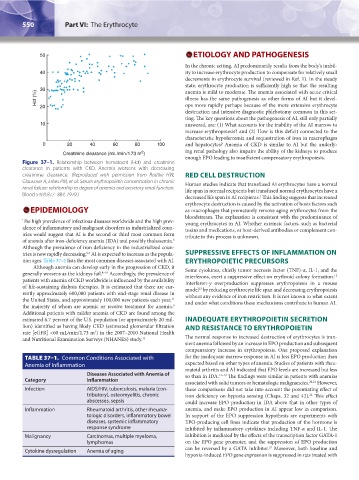
               Figure 37–1.  Relationship between hematocrit (Hct) and creatinine
               clearance  in patients with  CKD. Anemia  worsens with  decreasing
               creatinine clearance.  (Reproduced with permission from Radtke HW,   RED CELL DESTRUCTION
               Claussner A, Erbes PM, et al: Serum erythropoietin concentration in chronic   Human studies indicate that transfused AI erythrocytes have a normal
               renal failure: relationship to degree of anemia and excretory renal function.   life span in normal recipients but transfused normal erythrocytes have a
               Blood 54(4):877–884, 1979.)                            decreased life span in AI recipients.  This finding suggests that increased
                                                                                               1
                                                                      erythrocyte destruction is caused by the activation of hosts factors such
                  EPIDEMIOLOGY                                        as macrophages that prematurely remove aging erythrocytes from the
                                                                      bloodstream. The explanation is consistent with the predominance of
               The high prevalence of infectious diseases worldwide and the high prev-  young erythrocytes in AI. Whether extrinsic factors, such as bacterial
               alence of inflammatory and malignant disorders in industrialized coun-  toxins and medications, or host-derived antibodies or complement con-
               tries would suggest that AI is the second or third most common form   tribute to this process is unknown.
               of anemia after iron-deficiency anemia (IDA) and possibly thalassemia.   6
               Although the prevalence of iron deficiency in the industrialized coun-
               tries is now rapidly decreasing,  AI is expected to increase as the popula-  SUPPRESSIVE EFFECTS OF INFLAMMATION ON
                                     6,7
               tion ages. Table 37–1 lists the most common diseases associated with AI.  ERYTHROPOIETIC PRECURSORS
                   Although anemia can develop early in the progression of CKD, it   Some cytokines, chiefly tumor necrosis factor (TNF)-α, IL-1, and the
               generally worsens as the kidneys fail. 8–10  Accordingly, the prevalence of   interferons, exert a suppressive effect on erythroid colony formation.
                                                                                                                        12
               patients with anemia of CKD worldwide is influenced by the availability   Interferon-γ overproduction suppresses erythropoiesis in a mouse
               of life-sustaining dialysis therapies. It is estimated that there are cur-  model  by reducing erythrocyte life span and decreasing erythropoiesis
                                                                           13
               rently approximately 600,000 patients with end-stage renal disease in   without any evidence of iron restriction. It is not known to what extent
                                                                 11
               the United States, and approximately 100,000 new patients each year,    and under what conditions these mechanisms contribute to human AI.
               the majority of whom are anemic or receive treatment for anemia.   9
               Additional patients with milder anemia of CKD are found among the
               estimated 6.7 percent of the U.S. population (or approximately 20 mil-  INADEQUATE ERYTHROPOIETIN SECRETION
               lion) identified as having likely CKD (estimated glomerular filtration   AND RESISTANCE TO ERYTHROPOIETIN
                                        2
               rate [eGFR] <60 mL/min/1.73 m ) in the 2007–2010 National Health
               and Nutritional Examination Surveys (NHANES) study. 11  The normal response to increased destruction of erythrocytes is tran-
                                                                      sient anemia followed by an increase in EPO production and subsequent
                                                                      compensatory increase in erythropoiesis. One proposed explanation
                TABLE 37–1.  Common Conditions Associated with        for the inadequate marrow response in AI is less EPO production than
                Anemia of Inflammation                                expected based on other types of anemia. Studies of patients with rheu-
                                                                      matoid arthritis and AI indicated that EPO levels are increased but less
                                     Diseases Associated with Anemia of   so than in IDA. 14–19  The findings were similar in patients with anemias
                Category             Inflammation                     associated with solid tumors or hematologic malignancies. 20,21  However,
                Infection            AIDS/HIV, tuberculosis, malaria (con-  these comparisons did not take into account the potentiating effect of
                                     tributory), osteomyelitis, chronic   iron deficiency on hypoxia sensing (Chaps. 32 and 42).  This effect
                                                                                                                22
                                     abscesses, sepsis                could  increase EPO  production  in  IDA  above  that  in  other  types  of
                Inflammation         Rheumatoid arthritis, other rheuma-  anemia, and make EPO production in AI appear low in comparison.
                                     tologic disorders, inflammatory bowel   In support of the EPO suppression hypothesis are experiments with
                                     diseases, systemic inflammatory   EPO-producing cell lines indicate that production of the hormone is
                                     response syndrome                inhibited by inflammatory cytokines including TNF-α and IL-1. The
                Malignancy           Carcinomas, multiple myeloma,    inhibition is mediated by the effects of the transcription factor GATA-1
                                     lymphomas                        on the EPO gene promoter, and the suppression of EPO production
                                                                      can be reversed by a GATA inhibitor.  Moreover, both baseline and
                                                                                                  23
                Cytokine dysregulation  Anemia of aging
                                                                      hypoxia-induced EPO gene expression is suppressed in rats treated with


          Kaushansky_chapter 37_p0549-0558.indd   550                                                                   9/17/15   6:16 PM

