


Page 576 - Williams Hematology ( PDFDrive )
P. 576
550  Part VI:  The Erythrocyte                                      Chapter 37:  Anemia of Chronic Disease            551


                  bacterial lipopolysaccharide or IL-1β to mimic a septic state.  However,   macrophage recycling of senescent erythrocytes and from hepatocyte
                                                             24
                  suppression of EPO production is not the major mechanism of AI. If   iron stores; only approximately 1 to 2 mg come from dietary iron. Only
                  it were, administration of relatively small amounts of EPO should be   approximately 2 to 4 mg of iron is bound to transferrin but the entire
                  sufficient to reverse the AI.                         daily iron flow transits through this compartment; thus, the iron in this
                     In contrast, relative EPO deficiency is often a major contributor   pool turns over every few hours. During inflammation the release of
                  to anemia of CKD. Most destructive diseases affecting the kidneys also   iron from macrophages and probably also from liver stores is markedly
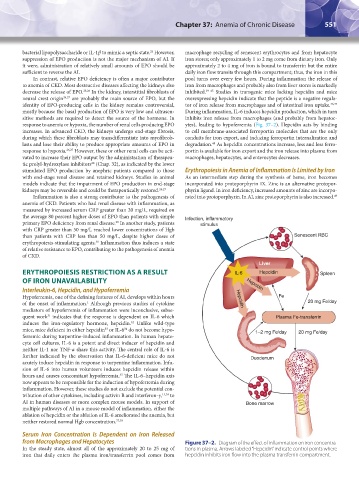
                  decrease the release of EPO. 25,26  In the kidney, interstitial fibroblasts of   inhibited. 39–45  Studies in transgenic mice lacking hepcidin and mice
                  neural crest origin 26,27  are probably the main source of EPO, but the   overexpressing hepcidin indicate that the peptide is a negative regula-
                  identity of EPO-producing cells in the kidney remains controversial,   tor of iron release from macrophages and of intestinal iron uptake. 46,47
                  mostly because the basal production of EPO is very low and ultrasen-  During inflammation, IL-6 induces hepcidin production, which in turn
                  sitive  methods  are  required  to  detect  the  source  of  the  hormone.  In   inhibits iron release from macrophages (and probably from hepatoc-
                  response to anemia or hypoxia, the number of renal cells producing EPO   ytes), leading to hypoferremia (Fig. 37–2). Hepcidin acts by binding
                  increases. In advanced CKD, the kidneys undergo end-stage fibrosis,   to cell  membrane-associated ferroportin molecules that are the  only
                  during which these fibroblasts may transdifferentiate into myofibrob-  conduits for iron export, and inducing ferroportin internalization and
                                                                                 48
                  lasts and lose their ability to produce appropriate amounts of EPO in   degradation.  As hepcidin concentrations increase, less and less ferro-
                  response to hypoxia. 26,27  However, these or other renal cells can be acti-  portin is available for iron export and the iron release into plasma from
                  vated to increase their EPO output by the administration of therapeu-  macrophages, hepatocytes, and enterocytes decreases.
                                         28
                  tic prolyl-hydroxylase inhibitors  (Chap. 32), as indicated by the lower
                  stimulated EPO production by anephric patients compared to those   Erythropoiesis in Anemia of Inflammation Is Limited by Iron
                  with end-stage renal disease and retained kidneys. Studies in animal   As an  intermediate step during the  synthesis of  heme, iron  becomes
                  models indicate that the impairment of EPO production in end-stage   incorporated into protoporphyrin IX. Zinc is an alternative protopor-
                  kidneys may be reversible and could be therapeutically restored. 26,27  phyrin ligand. In iron deficiency, increased amounts of zinc are incorpo-
                     Inflammation is also a strong contributor to the pathogenesis of   rated into protoporphyrin. In AI, zinc protoporphyrin is also increased.
                                                                                                                          49
                  anemia of CKD. Patients who had renal disease with inflammation, as
                  measured by increased serum CRP greater than 20 mg/L, required on
                  the average 80 percent higher doses of EPO than patients with simple   Infection, inflammatory
                  primary EPO deficiency from renal disease.  In another study, patients   stimulus
                                                 29
                  with CRP greater than 50 mg/L reached lower concentrations of Hgb
                  than patients with CRP less than 50 mg/L, despite higher doses of                          Senescent RBC
                  erythropoiesis-stimulating agents.  Inflammation thus induces a state
                                          30
                  of relative resistance to EPO, contributing to the pathogenesis of anemia
                  of CKD.
                                                                                                 Liver
                  ERYTHROPOIESIS RESTRICTION AS A RESULT                                 IL-6    Hepcidin             Spleen
                  OF IRON UNAVAILABILITY                                                     Hepcidin
                  Interleukin-6, Hepcidin, and Hypoferremia
                  Hypoferremia, one of the defining features of AI, develops within hours   Hepcidin    Fe
                                        1
                  of the onset of inflammation.  Although previous studies of cytokine                            20 mg Fe/day
                  mediators of hypoferremia of inflammation were inconclusive, subse-
                          31
                  quent work  indicates that the response is dependent on IL-6 which                   Plasma Fe-transferrin
                  induces the iron-regulatory hormone, hepcidin.  Unlike wild-type
                                                      32
                  mice, mice deficient in either hepcidin  or IL-6  do not become hypo-         1–2 mg Fe/day  20 mg Fe/day
                                                    34
                                             33
                  ferremic during turpentine-induced inflammation. In human hepato-
                  cyte cell cultures, IL-6 is a potent and direct inducer of hepcidin and
                  neither IL-1 nor TNF-α share this activity. The central role of IL-6 is
                  further indicated by the observation that IL-6-deficient mice do not        Duodenum
                  acutely induce hepcidin in response to turpentine inflammation. Infu-
                  sion  of  IL-6  into  human  volunteers  induces  hepcidin  release  within
                                                  35
                  hours and causes concomitant hypoferremia.  The IL-6–hepcidin axis
                  now appears to be responsible for the induction of hypoferremia during
                  inflammation. However, these studies do not exclude the potential con-
                  tribution of other cytokines, including activin B and interferon-γ, 13,36  to
                  AI in human diseases or more complex mouse models. In support of           Bone marrow
                  multiple pathways of AI in a mouse model of inflammation, either the
                  ablation of hepcidin or the ablation of IL-6 ameliorated the anemia, but
                  neither restored normal Hgb concentration. 37,38
                  Serum Iron Concentration Is Dependent on Iron Released
                  from Macrophages and Hepatocytes                      Figure 37–2.  Diagram of the effect of inflammation on iron concentra-
                  In the steady state, almost all of the approximately 20 to 25 mg of   tions in plasma. Arrows labeled “Hepcidin” indicate control points where
                  iron that daily enters the plasma iron/transferrin pool comes from   hepcidin inhibits iron flow into the plasma transferrin compartment.


          Kaushansky_chapter 37_p0549-0558.indd   551                                                                   9/17/15   6:16 PM

