


Page 578 - Williams Hematology ( PDFDrive )
P. 578
552  Part VI:  The Erythrocyte                                      Chapter 37:  Anemia of Chronic Disease            553


                   TABLE 37–2.  Laboratory Studies of Iron Metabolism in Iron-Deficiency Anemia and Anemia of Inflammation
                                             IDA (n = 48)              AI (n = 58)                COMBI (n = 17)
                   Hemoglobin, g/L           93 ± 16 (96)              102 ± 12 (103)             88 ± 20 (90)
                   MCV, fL                   75 ± 9 (75)               90 ± 7 (91)                78 ± 9 (79)
                   Iron, μmol/L (10–40)      8 ± 11 (4)                10 ± 6 (9)                 6 ± 3 (6)
                   Transferrin, g/L (2.1–3.4 m,   3.3 ± 0.4 (3.3)      1.9 ± 0.5 (1.8)            2.6 ± 0.6 (2.4)
                   2.0–3.1 f)
                   Transferrin saturation, %  12 ± 17 (5.7)            23 ± 13 (21)               12 ± 7 (8)
                   Ferritin, μg/L (15–306 m, 5–103 f) 21 ± 55 (11)     342 ± 385 (195)            87 ± 167 (23)
                   TfR, mg/L (0.85–3.05)     6.2 ± 3.5 (5.0)           1.8 ± 0.6 (1.8)            5.1 ± 2.0 (4.7)
                   TfR/log ferritin          6.8 ± 6.5 (5.4)           0.8 ± 0.3 (0.8)            3.8 ± 1.9 (3.2)
                  f, Females; m, males; TfR, transferrin receptor.
                  Diagnosis was defined by marrow iron stain and appropriate coexisting disease. Patients with a combination of no stainable marrow iron and
                  either coexisting disease or elevated CRP were classified as “COMBI.” Normal ranges for this laboratory for males (m) and females (f) are indi-
                  cated. Measurements are presented as mean ± SD (median).
                  Modified with permission from Punnonen K, Irjala K, Rajamaki A: Serum transferrin receptor and its ratio to serum ferritin in the diagnosis of iron
                  deficiency. Blood 89(3):1052–1057, 1997.


                  number of sideroblasts is characteristic of AI. Although marrow stain   DIFFERENTIAL DIAGNOSIS
                  could be considered the gold standard for differential diagnosis of AI
                  and iron deficiency, the discomfort to the patient associated this proce-  Most patients with chronic infections, inflammatory diseases, or neo-
                  dure, reports of variability in interpretation  and the wide availability   plastic disorders are anemic. The diagnosis of AI should only be made if
                                                 70
                  of the serum ferritin assay have decreased the use of marrow stain in   the anemia is mild to moderate, the serum iron and iron-binding capac-
                  this setting.                                         ity are low, and the serum ferritin is elevated. Anemia of CKD is rare in
                                                                        mild renal disease but common and often severe in end-stage renal dis-
                                                                        ease. Underlying diseases, comorbidities, and their treatments can cause
                                                                        many types of anemia, so other potential causes should be considered.
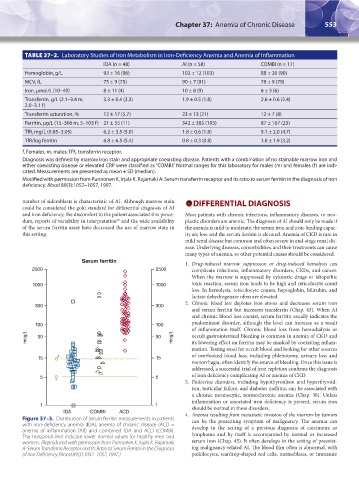
                                      Serum ferritin
                                                                        1.  Drug-induced marrow suppression or drug-induced hemolysis can
                     2500                                      2500        complicate infections, inflammatory disorders, CKDs, and cancer.
                                                                           When the marrow is suppressed by cytotoxic drugs or idiopathic
                     1000                                      1000        toxic reaction, serum iron tends to be high and reticulocyte count
                                                                           low. In hemolysis, reticulocyte counts, haptoglobin, bilirubin, and
                                                                           lactate dehydrogenase often are elevated.
                                                                        2.  Chronic blood loss depletes iron stores and decreases serum iron
                      300                                      300
                                                                           and serum ferritin but increases transferrin (Chap. 43). When AI
                                                                           and chronic blood loss coexist, serum ferritin usually indicates the
                      100                                      100         predominant disorder, although the level can increase as a result
                                                                           of inflammation itself. Chronic blood loss from hemodialysis or
                   mcg/L  50                                   50   mcg/L  occult gastrointestinal bleeding is common in anemia of CKD and
                                                                           its lowering effect on ferritin may be masked by coexisting inflam-
                                                                           mation. Testing stool for occult blood and looking for other sources
                                                                           of overlooked blood loss, including phlebotomy, urinary loss and
                       15                                      15
                                                                           menorrhagia, often identify the source of bleeding. Once this issue is
                                                                           addressed, a successful trial of iron repletion confirms the diagnosis
                        5                                      5           of iron deficiency complicating AI or anemia of CKD.
                                                                        3.  Endocrine disorders, including hypothyroidism and hyperthyroid-
                                                                           ism, testicular failure, and diabetes mellitus, can be associated with
                                                                           a chronic normocytic, normochromic anemia (Chap. 38). Unless
                                                                           inflammation or associated iron deficiency is present, serum iron
                        1                                     1            should be normal in these disorders.
                                IDA     COMBI     ACD                   4.  Anemia resulting from metastatic invasion of the marrow by tumors
                  Figure 37–3.  Distribution of serum ferritin measurements in patients   can be the presenting symptom of malignancy. The anemia can
                  with iron-deficiency anemia (IDA), anemia of chronic disease (ACD =     develop in the setting of a previous diagnosis of carcinoma or
                  anemia of inflammation [AI]) and combined IDA and ACD (COMBI).
                  The horizontal lines indicate lower normal values for healthy men and   lymphoma  and  by  itself  is  accompanied  by  normal  or  increased
                  women. (Reproduced with permission from Punnonen K, Irjala K, Rajamaki   serum iron (Chap. 45). It often develops in the setting of preexist-
                  A: Serum Transferrin Receptor and Its Ratio to Serum Ferritin in the Diagnosis   ing malignancy-related AI. The blood film often is abnormal, with
                  of Iron Deficiency. Blood 89(3):1052–1057, 1997.)        poikilocytes, teardrop-shaped red cells, normoblasts, or immature


          Kaushansky_chapter 37_p0549-0558.indd   553                                                                   9/17/15   6:17 PM

