


Page 579 - Williams Hematology ( PDFDrive )
P. 579
554            Part VI:  The Erythrocyte                                                                                                                                         Chapter 37:  Anemia of Chronic Disease            555


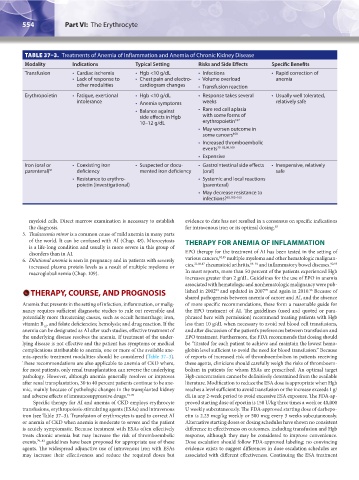
                TABLE 37–3.  Treatments of Anemia of Inflammation and Anemia of Chronic Kidney Disease
                Modality        Indications          Typical Setting      Risks and Side Effects   Specific Benefits
                Transfusion     •   Cardiac ischemia  •  Hgb <10 g/dL     •  Infections            •   Rapid correction of
                                •   Lack of response to   •   Chest pain and electro-  •  Volume overload  anemia
                                  other modalities     cardiogram changes  •  Transfusion reaction

                Erythropoietin  •   Fatigue, exertional   •  Hgb <10 g/dL  •   Response takes several   •   Usually well tolerated,
                                  intolerance        •  Anemia symptoms     weeks                   relatively safe
                                                     •   Balance against    •   Rare red cell aplasia
                                                       side effects in Hgb   with some forms of
                                                       10–12 g/dL           erythropoietin 107
                                                                          •   May worsen outcome in
                                                                            some cancers 108
                                                                          •   Increased thromboembolic
                                                                            events 79–82,96,109
                                                                          •  Expensive
                Iron (oral or   •   Coexisting iron   •   Suspected or docu-  •   Gastrointestinal side effects   •   Inexpensive, relatively
                parenteral) 51    deficiency           mented iron deficiency  (oral)               safe
                                •   Resistance to erythro-                •   Systemic and local reactions
                                  poietin (investigational)                 (parenteral)
                                                                          •   May decrease resistance to
                                                                            infections? 83,103–105


                  myeloid cells. Direct marrow examination is necessary to establish   evidence to date has not resulted in a consensus on specific indications
                  the diagnosis.                                      for intravenous iron or its optimal dosing. 83
               5.  Thalassemia minor is a common cause of mild anemia in many parts
                  of the world. It can be confused with AI (Chap. 48). Microcytosis   THERAPY FOR ANEMIA OF INFLAMMATION
                  is a life-long condition and usually is more severe in this group of
                  disorders than in AI.                               EPO therapy for the treatment of AI has been tested in the setting of
               6.  Dilutional anemia is seen in pregnancy and in patients with severely   various cancers, 84,85  multiple myeloma and other hematologic malignan-
                  increased plasma protein levels as a result of multiple myeloma or   cies, 21,86,87  rheumatoid arthritis, 88–91  and inflammatory bowel diseases. 92,93
                  macroglobulinemia (Chap. 109).                      In most reports, more than 50 percent of the patients experienced Hgb
                                                                      increases greater than 2 g/dL. Guidelines for the use of EPO in anemia
                                                                      associated with hematologic and nonhematologic malignancy were pub-
                                                                                                 95
                                                                                94
                                                                                                                96
                  THERAPY, COURSE, AND PROGNOSIS                      lished in 2002  and updated in 2007  and again in 2010.  Because of
                                                                      shared pathogenesis between anemia of cancer and AI, and the absence
               Anemia that presents in the setting of infection, inflammation, or malig-  of more specific recommendations, these form a reasonable guide for
               nancy requires sufficient diagnostic studies to rule out reversible and   the EPO treatment of AI. The guidelines (used and quoted or para-
               potentially more threatening causes, such as occult hemorrhage; iron,   phrased here with permission) recommend treating patients with Hgb
               vitamin B , and folate deficiencies; hemolysis; and drug reaction. If the   less than 10 g/dL when necessary to avoid red blood cell transfusions,
                      12
               anemia can be designated as AI after such studies, effective treatment of   and after discussion of the patient’s preferences between transfusion and
               the underlying disease resolves the anemia. If treatment of the under-  EPO treatment. Furthermore, the FDA recommends that dosing should
               lying disease is not effective and the patient has symptoms or medical   be “titrated for each patient to achieve and maintain the lowest hemo-
               complications attributable to anemia, one or more of the available ane-  globin level sufficient to avoid the need for blood transfusion.” Because
               mia-specific treatment modalities should be considered (Table 37–3).   of reports of increased risk of thromboembolism in patients receiving
               These recommendations are also applicable to anemia of CKD where,   these agents, clinicians should carefully weigh the risks of thromboem-
               for most patients, only renal transplantation can reverse the underlying   bolism in patients for whom ESAs are prescribed. An optimal target
               pathology. However, although anemia generally resolves or improves   Hgb concentration cannot be definitively determined from the available
               after renal transplantation, 30 to 40 percent patients continue to be ane-  literature. Modification to reduce the ESA dose is appropriate when Hgb
               mic, mainly because of pathologic changes in the transplanted kidney   reaches a level sufficient to avoid transfusion or the increase exceeds 1 g/
               and adverse effects of immunosuppressive drugs. 71-78  dL in any 2-week period to avoid excessive ESA exposure. The FDA-ap-
                   Specific therapy for AI and anemia of CKD employs erythrocyte   proved starting dose of epoetin is 150 U/kg three times a week or 40,000
               transfusions, erythropoiesis-stimulating agents (ESAs) and intravenous   U weekly subcutaneously. The FDA-approved starting dose of darbepo-
               iron (see Table  37–3). Transfusion of erythrocytes is used to correct AI   etin is 2.25 mcg/kg weekly or 500 mcg every 3 weeks subcutaneously.
               or anemia of CKD when anemia is moderate to severe and the patient   Alternative starting doses or dosing schedules have shown no consistent
               is acutely symptomatic. Because treatment with ESAs often effectively   difference in effectiveness on outcomes, including transfusion and Hgb
               treats chronic anemia but may increase the risk of thromboembolic   response, although they may be considered to improve convenience.
               events, 79–82  guidelines have been proposed for appropriate use of these   Dose escalation should follow FDA-approved labeling; no convincing
               agents. The widespread adjunctive use of intravenous iron with ESAs   evidence exists to suggest differences in dose escalation schedules are
               may  increase  their  effectiveness  and  reduce  the  required  doses  but   associated with different effectiveness. Continuing the ESA treatment


          Kaushansky_chapter 37_p0549-0558.indd   554                                                                   9/17/15   6:17 PM

