


Page 589 - Williams Hematology ( PDFDrive )
P. 589
564            Part VI:  The Erythrocyte                                                                                                                        Chapter 39:  The Congenital Dyserythropoietic Anemias              565


                             Primitive   Committed                                Lineage-
                           progenitor cells  precursor cells                    committed cells
                  Multipotent
                  hematopoietic
                   stem cell

                      Common myeloid   FA; DKC
                        progenitor
                                      *
                                              XLTDA;             DBA                         CDA
                             Myeloid erythroid  CEP; XLTT
                              progenitor                          *                           *
                                               *
                                                    BFU-E    CFU-E  Proerythroblast  Basophilic  Polychromatic  Orthochromatic  Reticulocyte  Erythrocyte
                 A                                                           erythroblast  erythroblast  erythroblast

                  Hemolytic anemia with
                  inadequate reticulocyte  BMF Syndromes
                  count


                            Trilineage            Isolated ineffective      CDA I                  • EM: “swiss cheese appearance” of
                        ineffective hematopoiesis  erythropoiesis           Incompletely divided cells; thin    the erythroblasts heterochromatin
                                                                            chromatin bridges between nuclei  • Molecular diagnosis: CDAN1;
                                                                            of pairs of erythroblasts    C15orf41
                                                   BM examination
                                                                                                    • EM: double plasma membrane of
                                                                            CDA II                    the erythroblasts
                                                                            Binucleate and rarely   • Biochemical diagnosis: band 3
                        FA, AA, DKC, PNH, MDS   Erythroid  Erythroid        multinucleate late polychromatic    hypoglycosylation
                                                hypoplasia  hyperplasia     erythroblasts           • WB: ER proteins on RBC plasma
                                                                                                      membrane
                                                                                                    • Molecular diagnosis: SEC23B
                                                                            CDA III
                                                 DBA                        Large multinucleated   • Molecular diagnosis: KIF23
                                                                            erythroblasts (gigantoblasts)

                                                                                                   • Ineffective erythropoiesis; HPFH
                                                                                                   • Molecular diagnosis: KLF1
                                                                            Dyserythropoietic morphology
                                                                            variants
                                                                                                   • Ineffective megakaryopoiesis and
                                                                                                     erythropoiesis
                                                                                                   • Molecular diagnosis: GATA1
                  B
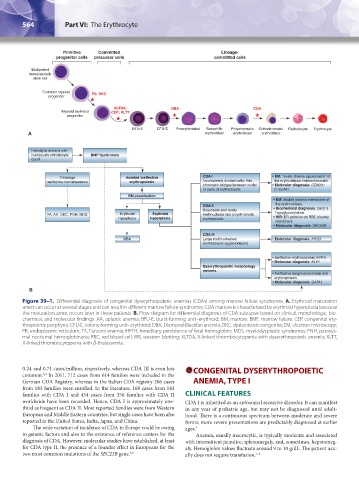
               Figure 39–1.  Differential diagnosis of congenital dyserythropoietic anemias (CDAs) among marrow failure syndromes. A. Erythroid maturation
               arrest can occur at several stages and can result in different marrow failure syndromes. CDA marrow is characterized by erythroid hyperplasia because
               the maturation arrest occurs later in these patients. B. Flow diagram for differential diagnosis of CDA subtypes based on clinical, morphologic, bio-
               chemical, and molecular findings. AA, aplastic anemia; BFU-E, burst-forming unit–erythroid; BM, marrow; BMF, marrow failure; CEP, congenital ery-
               thropoietic porphyria; CFU-E, colony-forming unit–erythroid; DBA, Diamond-Blackfan anemia; DKC, dyskeratosis congenita; EM, electron microscopy;
               ER, endoplasmic reticulum; FA, Fanconi anemia; HPFH, hereditary persistence of fetal hemoglobin; MDS, myelodysplastic syndromes; PNH, paroxys-
               mal nocturnal hemoglobinuria; RBC, red blood cell; WB, western blotting; XLTDA, X-linked thrombocytopenia with dyserythropoietic anemia; XLTT,
               X-linked thrombocytopenia with β-thalassemia.


               0.24 and 0.71 cases/million, respectively, whereas CDA III is even less     CONGENITAL DYSERYTHROPOIETIC
               common.  In 2011, 712 cases from 614 families were included in the
                      3,4
               German CDA Registry, whereas in the Italian CDA registry 206 cases   ANEMIA, TYPE I
               from 183 families were enrolled. In the literature, 169 cases from 143
               families with CDA I and 454 cases from 356 families with CDA II   CLINICAL FEATURES
               worldwide have been recorded. Hence, CDA I is approximately one-  CDA I is inherited as an autosomal recessive disorder. It can manifest
               third as frequent as CDA II. Most reported families were from Western   in any year of pediatric age, but may not be diagnosed until adult-
               European and Middle Eastern countries, but single cases have been also   hood. There is a continuous spectrum between moderate and severe
               reported in the United States, India, Japan, and China.  forms; more severe presentations are predictably diagnosed at earlier
                   The wide variation of incidence of CDA in Europe could be owing   ages. 7
               to genetic factors and also to the existence of reference centers for the   Anemia, usually macrocytic, is typically moderate and associated
               diagnosis of CDA. However, molecular studies have established, at least   with intermittent jaundice, splenomegaly, and, sometimes, hepatomeg-
               for CDA type II, the presence of a founder effect in Europeans for the   aly. Hemoglobin values fluctuate around 9 to 10 g/dL. The patient usu-
               two most common mutations of the SEC23B gene. 5,6      ally does not require transfusion. 7–9


          Kaushansky_chapter 39_p0563-0570.indd   564                                                                   9/17/15   6:21 PM

