


Page 593 - Williams Hematology ( PDFDrive )
P. 593
568            Part VI:  The Erythrocyte                                                                                                                        Chapter 39:  The Congenital Dyserythropoietic Anemias              569


                   Allogeneic  marrow  transplantation  from  an  human  leukocyte      OTHER CONGENITAL
               antigen (HLA)-identical sibling  has  been  successful in  transfusion-
               dependent children with very severe CDA II and in one adult with CDA   DYSERYTHROPOIETIC ANEMIAS
               II and β-thalassemia trait. 32,33,55,56
                                                                      A number of cases of CDA that do not have specific features of types I,
                                                                      II, or, to some extent, III disease have been reported. 69–74  Classification
                                                                                                            75
                    CONGENITAL DYSERYTHROPOIETIC                      has been proposed based largely on cell morphology.  In addition, sev-
                                                                      eral genes have been associated with CDA variants, including mutations
                  ANEMIA, TYPE III                                    in the GATA1 and KLF1 genes, which are critical for development of
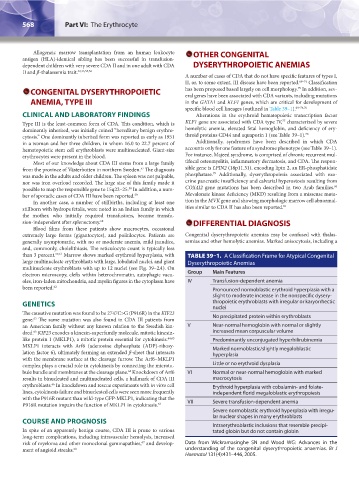
                                                                      specific blood cell lineages (outlined in Table 39–1). 69–74,76
               CLINICAL AND LABORATORY FINDINGS                           Alterations in the erythroid hematopoietic transcription factor
                                                                                                       77
               Type III is the least-common form of CDA. This condition, which is   KLF1 gene are associated with CDA type IV,  characterized by severe
               dominantly inherited, was initially coined “hereditary benign erythro-  hemolytic anemia, elevated fetal hemoglobin, and deficiency of ery-
               cytosis.” One dominantly inherited form was reported as early as 1951   throid proteins CD44 and aquaporin 1 (see Table  39–1). 78
               in a woman and her three children, in whom 16.0 to 22.7 percent of   Additionally, syndromes have been described in which CDA
               hematopoietic stem cell erythroblasts were multinucleated. Giant-size   accounts only for one feature of a syndrome phenotype (see Table  39–1).
               erythrocytes were present in the blood.                For instance, Majeed syndrome, is comprised of chronic recurrent mul-
                   Most of our knowledge about CDA III stems from a large family   tifocal osteomyelitis, inflammatory dermatosis, and CDA. The respon-
               from the province of Västerbotten in northern Sweden.  The diagnosis   sible gene is LPIN2 (18p11.31), encoding lipin 2, an ER-phosphatidate
                                                       57
                                                                               79
               was made in the adults and older children. The spleen was not palpable,   phosphatase.  Additionally, dyserythropoiesis associated with exo-
               nor was iron overload recorded. The large size of this family made it   crine pancreatic insufficiency and calvarial hyperostosis resulting from
                                                                                                                        80
               possible to map the responsible gene to 15q22–25.  In addition, a num-  COX4I2 gene mutations has been described in two Arab families.
                                                   58
               ber of sporadic cases of CDA III have been reported. 59  Mevalonate kinase deficiency (MKD) resulting from a missense muta-
                   In another case, a number of stillbirths, including at least one   tion in the MVK gene and showing morphologic marrow cell abnormal-
               stillborn with hydrops fetalis, were noted in an Indian family in which   ities similar to CDA II has also been reported. 81
               the mother, who initially required transfusions, became transfu-
               sion-independent after splenectomy. 60                    DIFFERENTIAL DIAGNOSIS
                   Blood films from these patients show macrocytes, occasional
               extremely large forms (gigantocytes), and poikilocytes. Patients are   Congenital dyserythropoietic anemias may be confused with thalas-
               generally asymptomatic, with no or moderate anemia, mild jaundice,   semias and other hemolytic anemias. Marked anisocytosis, including a
               and, commonly, cholelithiasis. The reticulocyte count is typically less
               than 3 percent. 57,61  Marrow shows marked erythroid hyperplasia, with   TABLE 39–1.  A Classification Frame for Atypical Congenital
               large multinucleate erythroblasts with large, lobulated nuclei, and giant   Dyserythropoietic Anemias
               multinucleate erythroblasts with up to 12 nuclei (see Fig. 39–2A). On
               electron microscopy, clefts within heterochromatin, autophagic vacu-  Group  Main Features
               oles, iron-laden mitochondria, and myelin figures in the cytoplasm have   IV  Transfusion-dependent anemia
               been reported. 62                                               Pronounced normoblastic erythroid hyperplasia with a
                                                                               slight to moderate increase in the nonspecific dysery-
               GENETICS                                                        thropoietic erythroblasts with irregular or karyorrhectic
                                                                               nuclei
               The causative mutation was found to be 2747C>G (P916R) in the KIF23   No precipitated protein within erythroblasts
                   63
               gene.  The same mutation was also found in CDA III patients from
               an American family without any known relation to the Swedish kin-  V  Near-normal hemoglobin with normal or slightly
               dred.  KIF23 encodes a kinesin-superfamily molecule, mitotic kinesin-  increased mean corpuscular volume
                   63
               like protein 1 (MKLP1), a mitotic protein essential for cytokinesis. 64,65    Predominantly unconjugated hyperbilirubinemia
               MKLP1 interacts with Arf6 (adenosine diphosphate (ADP)-ribosy-  Marked normoblastic/slightly megaloblastic
               lation factor 6), ultimately forming an extended β-sheet that interacts   hyperplasia
               with the membrane surface at the cleavage furrow. The Arf6–MKLP1
               complex plays a crucial role in cytokinesis by connecting the microtu-  Little or no erythroid dysplasia
               bule bundle and membranes at the cleavage plane.  Knockdown of Arf6   VI  Normal or near-normal hemoglobin with marked
                                                   64
               results in binucleated and multinucleated cells, a hallmark of CDA III   macrocytosis
               erythroblasts.  In knockdown and rescue experiments with in vitro cell   Erythroid hyperplasia with cobalamin- and folate-
                         66
               lines, cytokinesis failure and binucleated cells were seen more frequently   independent florid megaloblastic erythropoiesis
               with the P916R mutant than wild-type GFP-MKLP1, indicating that the
               P916R mutation impairs the function of MKLP1 in cytokinesis. 63  VII  Severe transfusion-dependent anemia
                                                                               Severe normoblastic erythroid hyperplasia with irregu-
                                                                               lar nuclear shapes in many erythroblasts
               COURSE AND PROGNOSIS                                            Intraerythroblastic inclusions that resemble precipi-
               In spite of an apparently benign course, CDA III is prone to various   tated globin but do not contain globin
               long-term complications, including intravascular hemolysis, increased
               risk of myeloma and other monoclonal gammapathies,  and develop-  Data from  Wickramasinghe SN and  Wood  WG: Advances in the
                                                       67
               ment of angioid streaks. 68                            understanding of the congenital dyserythropoietic anaemias.  Br J
                                                                      Haematol 131(4):431–446, 2005.


          Kaushansky_chapter 39_p0563-0570.indd   568                                                                   9/17/15   6:21 PM

