


Page 591 - Williams Hematology ( PDFDrive )
P. 591
566            Part VI:  The Erythrocyte                                                                                                                        Chapter 39:  The Congenital Dyserythropoietic Anemias              567


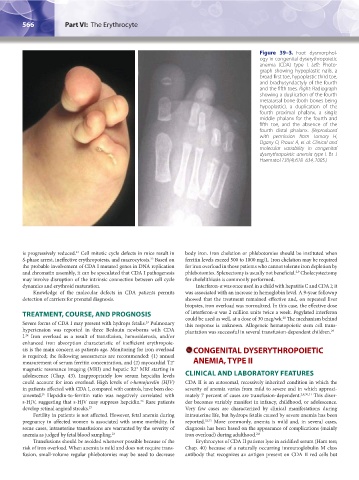
                                                                                               Figure 39–3.  Foot dysmorphol-
                                                                                               ogy in congenital dyserythropoietic
                                                                                               anemia (CDA) type I.  Left: Photo-
                                                                                               graph showing hypoplastic nails, a
                                                                                               broad first toe, hypoplastic third toe,
                                                                                               and brachysyndactyly of the fourth
                                                                                               and the fifth toes. Right: Radiograph
                                                                                               showing a duplication of the fourth
                                                                                               metatarsal bone (both bones being
                                                                                               hypoplastic), a duplication of the
                                                                                               fourth proximal phalanx, a single
                                                                                               middle phalanx for the fourth and
                                                                                               fifth toe, and the absence of the
                                                                                               fourth distal phalanx.  (Reproduced
                                                                                               with permission from Tamary H,
                                                                                               Dgany O, Proust A, et al: Clinical and
                                                                                               molecular variability in congenital
                                                                                               dyserythropoietic anemia type I.  Br J
                                                                                               Haematol 130(4):628–634, 2005.)


               is progressively reduced.  Cell mitotic cycle defects in mice result in   body iron. Iron chelation or phlebotomies should be instituted when
                                 21
               S-phase arrest, ineffective erythropoiesis, and macrocytosis.  Based on   ferritin levels exceed 500 to 1000 mg/L. Iron chelation may be required
                                                          22
               the probable involvement of CDA I mutated genes in DNA replication   for iron overload in those patients who cannot tolerate iron depletion by
               and chromatin assembly, it can be speculated that CDA I pathogenesis   phlebotomies. Splenectomy is usually not beneficial.  Cholecystectomy
                                                                                                           2,9
               may involve disruption of the intrinsic connection between cell cycle   for cholelithiasis is commonly performed.
               dynamics and erythroid maturation.                         Interferon-α was once used in a child with hepatitis C and CDA I; it
                   Knowledge of the molecular defects in CDA patients permits   was associated with an increase in hemoglobin level. A 9-year followup
               detection of carriers for prenatal diagnosis.          showed that the treatment remained effective and, on repeated liver
                                                                      biopsies, iron overload was normalized. In this case, the effective dose
               TREATMENT, COURSE, AND PROGNOSIS                       of interferon-α was 2 million units twice a week. Pegylated interferon
                                                                      could be used as well, at a dose of 30 mcg/wk.  The mechanism behind
                                                                                                       28
                                                         23
               Severe forms of CDA I may present with hydrops fetalis.  Pulmonary   this response is unknown. Allogeneic hematopoietic stem cell trans-
               hypertension was reported in three Bedouin newborns with CDA   plantation was successful in several transfusion-dependent children. 29
               I.  Iron overload as a result of  transfusion,  hemosiderosis,  and/or
                24
               enhanced iron absorption characteristic of inefficient erythropoie-
               sis is the main concern as patients age. Monitoring for iron overload     CONGENITAL DYSERYTHROPOIETIC
               is required; the following assessments are recommended: (1) annual
                                                                  *
               measurement of serum ferritin concentration, and (2) myocardial T2    ANEMIA, TYPE II
               magnetic resonance imaging (MRI) and hepatic R2  MRI starting in
                                                      *
               adolescence (Chap. 43). Inappropriately low serum hepcidin levels   CLINICAL AND LABORATORY FEATURES
               could account for iron overload. High levels of s-hemojuvelin (HJV)   CDA II is an autosomal, recessively inherited condition in which the
               in patients affected with CDA I, compared with controls, have been doc-  severity of anemia varies from mild to severe and in which approxi-
               umented.   Hepcidin-to-ferritin ratio was negatively correlated with   mately 7 percent of cases are transfusion-dependent. 2,8,30,31  This disor-
                      25
               s-HJV, suggesting that s-HJV may suppress hepcidin.  Rare patients   der becomes variably manifest in infancy, childhood, or adolescence.
                                                       26
               develop retinal angioid streaks. 27                    Very few cases are characterized by clinical manifestations during
                   Fertility in patients is not affected. However, fetal anemia during   intrauterine life, but hydrops fetalis caused by severe anemia has been
               pregnancy in affected women is associated with some morbidity. In   reported. 32,33  More commonly, anemia is mild and, in several cases,
               some cases, intrauterine transfusions are warranted by the severity of   diagnosis has been based on the appearance of complications (mainly
               anemia as judged by fetal blood sampling. 23           iron overload) during adulthood. 2,8
                   Transfusions should be avoided whenever possible because of the   Erythrocytes of CDA II patients lyse in acidified serum (Ham test;
               risk of iron overload. When anemia is mild and does not require trans-  Chap. 40) because of a naturally occurring immunoglobulin M class
               fusion, small-volume regular phlebotomies may be used to decrease   antibody that recognizes an antigen present on CDA II red cells but


          Kaushansky_chapter 39_p0563-0570.indd   566                                                                   9/17/15   6:21 PM

