


Page 590 - Williams Hematology ( PDFDrive )
P. 590
564  Part VI:  The Erythrocyte                      Chapter 39:  The Congenital Dyserythropoietic Anemias             565


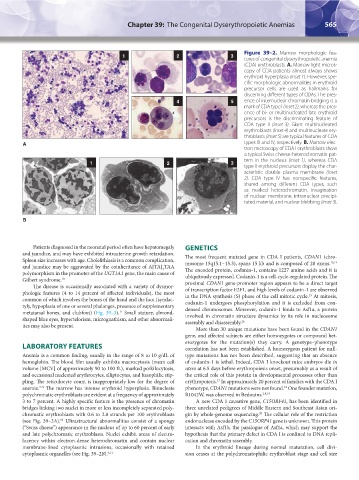
                                                                                            Figure 39–2.  Marrow morphologic fea-
                                                   1                  2                 3
                                                                                            tures of congenital dyserythropoietic anemia
                                                                                            (CDA) erythroblasts. A. Marrow light micros-
                                                                                            copy of CDA patients almost always shows
                                                                                            erythroid hyperplasia (inset 1). However, spe-
                                                                                            cific morphologic abnormalities in erythroid
                                                                                            precursor cells are used as hallmarks for
                                                                                            discerning different types of CDAs. The pres-
                                                                      4                 5   ence of internuclear chromatin bridging is a
                                                                                            mark of CDA type I (inset 2), whereas the pres-
                                                                                            ence of bi- or multinucleated late erythroid
                                                                                            precursors is the discriminating feature of
                                                                                            CDA type II  (inset 3). Giant multinucleated
                                                                                            erythroblasts (Inset 4) and multinucleate ery-
                                                                                            throblasts (Inset 5) are typical features of CDA
                  A                                                                         types III and IV, respectively. B. Marrow elec-
                                                                                            tron microscopy of CDA I erythroblasts show
                                                                                            a typical Swiss cheese-heterochromatin pat-
                                                                                            tern in the nucleus  (inset 1), whereas CDA
                                        1                         2                     3
                                                                                            type II erythroid precursors display the char-
                                                                                            acteristic double plasma membrane  (inset
                                                                                            2). CDA type IV has nonspecific features,
                                                                                            shared among different CDA types, such
                                                                                            as  marked  heterochromatin,  invagination
                                                                                            of nuclear membrane, intranuclear precipi-
                                                                                            tated material, and nuclear blebbing (inset 3).


                  B


                     Patients diagnosed in the neonatal period often have hepatomegaly   GENETICS
                  and jaundice, and may have exhibited intrauterine growth retardation.   The most frequent mutated gene in CDA I patients,  CDAN1 (chro-
                  Spleen size increases with age. Cholelithiasis is a common complication,   mosome 15q15.1–15.3), spans 15 kb and is composed of 28 exons. 13,14
                  and jaundice may be aggravated by the coinheritance of A[TA] TAA   The encoded protein, codanin-1, contains 1227 amino acids and it is
                                                                 7
                  polymorphism in the promoter of the UGT1A1 gene, the main cause of   ubiquitously expressed. Codanin-1 is a cell-cycle-regulated protein. The
                  Gilbert syndrome. 10                                  proximal CDAN1 gene-promoter region appears to be a direct target
                     The disease is occasionally associated with a variety of dysmor-  of transcription factor E2F1, and high levels of codanin-1 are observed
                  phologic features (4 to 14 percent of affected individuals), the most   in the DNA synthesis (S) phase of the cell mitotic cycle.  At mitosis,
                                                                                                                  15
                  common of which involves the bones of the hand and the foot (syndac-  codanin-1 undergoes phosphorylation and it is excluded from con-
                  tyly, hypoplasia of one or several phalanges, presence of supplementary   densed chromosomes. Moreover, codanin-1 binds to Asf1a, a protein
                  metatarsal bones, and clubfoot) (Fig. 39–3).  Small stature, almond-  involved  in  chromatin  structure  dynamics  by  its  role in  nucleosome
                                                  11
                  shaped blue eyes, hypertelorism, micrognathism, and other abnormali-  assembly and disassembly. 16
                  ties may also be present.
                                                                            More than 30 unique mutations have been found in the CDAN1
                                                                        gene, and affected subjects are either homozygotes or compound het-
                                                                        erozygotes  for  the  mutation(s) they carry.  A  genotype–phenotype
                  LABORATORY FEATURES                                   correlation has not been established. A homozygous patient for null-
                  Anemia is a common finding, usually in the range of 8 to 10 g/dL of   type mutations has not been described, suggesting that an absence
                  hemoglobin. The blood film usually exhibits macrocytosis (mean cell   of codanin-1 is lethal. Indeed, CDA I knockout mice embryos die in
                  volume [MCV] of approximately 90 to 100 fL), marked poikilocytosis,   utero at 6.5 days before erythropoiesis onset, presumably as a result of
                  and occasional nucleated erythrocytes, elliptocytes, and basophilic stip-  the critical role of this protein in developmental processes other than
                  pling. The reticulocyte count is inappropriately low for the degree of   erythropoiesis.  In approximately 20 percent of families with the CDA I
                                                                                   17
                  anemia.  The marrow has intense erythroid hyperplasia. Binucleate   phenotype, CDAN1 mutations were not found.  One founder mutation,
                                                                                                          18
                       7–9
                  polychromatic erythroblasts are evident at a frequency of approximately   R1042W, was observed in Bedouins. 2,8,19
                  3 to 7 percent. A highly specific feature is the presence of chromatin   A new CDA I causative gene, C15ORF41, has been identified in
                  bridges linking two nuclei in more or less incompletely separated poly-  three unrelated pedigrees of Middle Eastern and Southeast Asian ori-
                  chromatic erythroblasts with 0.6 to 2.8 strands per 100 erythroblasts   gin by whole-genome sequencing.  The cellular role of the restriction
                                                                                                 20
                  (see Fig. 39–2A).  Ultrastructural abnormalities consist of a spongy   endonuclease encoded by the C15ORF41 gene is unknown. This protein
                               12
                  (“Swiss cheese”) appearance in the nucleus of up to 60 percent of early   interacts with Asf1b, the paralogue of Asf1a, which may support the
                  and late polychromatic erythroblasts. Nuclei exhibit areas of electro-  hypothesis that the primary defect in CDA I is confined to DNA repli-
                  lucency  within  electron-dense  heterochromatin  and  contain  nuclear   cation and chromatin assembly.
                  membrane-lined cytoplasmic  intrusions,  occasionally with retained   In the erythroid lineage during normal maturation, cell divi-
                  cytoplasmic organelles (see Fig. 39–2B). 9,11         sion ceases at the polychromatophilic erythroblast stage and cell size


          Kaushansky_chapter 39_p0563-0570.indd   565                                                                   9/17/15   6:21 PM

