


Page 629 - Williams Hematology ( PDFDrive )
P. 629
604            Part VI:  The Erythrocyte                                                                                                                     Chapter 41:  Folate, Cobalamin, and Megaloblastic Anemias             605


               intramuscular (IM) daily for 2 weeks, then weekly until the hematoc-  persist for 10 to 14 days; (3) rise in serum cobalamin and folate. Cobal-
               rit is normal, and then monthly for life. For neurologic manifestations,   amin deficiency does not respond to a physiologic dose of folate (100 to
               1000 mcg every 2 weeks for 6 months is recommended. Higher doses   400 mcg/day), although this dose produces a maximal response in folate
               are given for certain inherited disorders (e.g., TC deficiency). Transfu-  deficiency. Larger doses of folate (5 to 15 mg/day) can produce a reticu-
               sion occasionally is required when the hematocrit is less than 15 per-  locytosis and partially or temporarily correct the anemia in cobalamin
               cent or the patient is debilitated, infected, or in heart failure. In such   deficiency. To avoid the risk of masking an underlying cobalamin defi-
               instances, packed cells should be given slowly to avoid pulmonary   ciency by inducing a hematologic remission in response to folate, doses
               edema. Infections can impair the response to cobalamin and must be   in excess of 1 mg folic acid daily should be shunned until an underlying
               treated vigorously.                                    cobalamin deficiency has been ruled out. 3
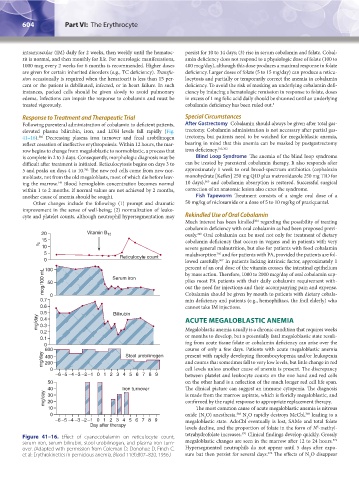
               Response to Treatment and Therapeutic Trial            Special Circumstances
               Following parenteral administration of cobalamin to deficient patients,   After Gastrectomy  Cobalamin should always be given after total gas-
               elevated plasma bilirubin, iron, and LDH levels fall rapidly (Fig.   trectomy. Cobalamin administration is not necessary after partial gas-
               41–16).  Decreasing plasma iron turnover and fecal urobilinogen   trectomy, but patients need to be watched for megaloblastic anemia,
                     360
               reflect cessation of ineffective erythropoiesis. Within 12 hours, the mar-  bearing in mind that this anemia can be masked by postgastrectomy
               row begins to change from megaloblastic to normoblastic, a process that   iron deficiency. 352,362
               is complete in 2 to 3 days. Consequently, morphologic diagnosis may be   Blind Loop Syndrome  The anemia of the blind loop syndrome
               difficult after treatment is initiated. Reticulocytosis begins on days 3 to   can be treated by parenteral cobalamin therapy. It also responds after
                                    361
               5 and peaks on days 4 to 10.  The new red cells come from new nor-  approximately 1 week to oral broad-spectrum antibiotics (cephalexin
               moblasts, not from the old megaloblasts, most of which die before leav-  monohydrate [Keflex] 250 mg QID plus metronidazole 250 mg TID for
                                                                             363
               ing the marrow.  Blood hemoglobin concentration becomes normal   10 days),  and cobalamin absorption is restored. Successful surgical
                           149
               within 1 to 2 months. If normal values are not achieved by 2 months,   correction of an anatomic lesion also cures the syndrome.
               another cause of anemia should be sought.                  Fish Tapeworm  Treatment consists of a single oral dose of a
                   Other changes include the following: (1) prompt and dramatic   50 mg/kg of niclosamide or a dose of 5 to 10 mg/kg of praziquantel.
               improvement in the sense of well-being; (2) normalization of leuko-
               cyte and platelet counts, although neutrophil hypersegmentation may   Rekindled Use of Oral Cobalamin
                                                                                             364
                                                                      Much interest has been kindled  regarding the possibility of treating
                                                                      cobalamin deficiency with oral cobalamin as had been proposed previ-
                      20             Vitamin B 12                     ously.  Oral cobalamin can be used not only for treatment of dietary
                                                                          365
                      15                                              cobalamin deficiency that occurs in vegans and in patients with very
                     %  10                                            severe general malnutrition, but also for patients with food cobalamin
                       5                                              malabsorption  and for patients with PA, provided the patients are fol-
                                                                                 366
                       0 100                    Reticulocyte count    lowed carefully.  In patients lacking intrinsic factor, approximately 1
                                                                                 367
                                                                      percent of an oral dose of the vitamin crosses the intestinal epithelium
                      mcg/100 mL  50          Serum iron              by mass action. Therefore, 1000 to 2000 mcg/day of oral cobalamin sup-
                                                                      plies most PA patients with their daily cobalamin requirement with-
                                                                      out the need for injections and their accompanying pain and expense.
                                                                      min deficiency and patients (e.g., hemophiliacs, the frail elderly) who
                     0.7  0                                           Cobalamin should be given by mouth to patients with dietary cobala-
                     0.6                                              cannot take IM injections.
                    mg/day 0.5                Bilirubin               ACUTE MEGALOBLASTIC ANEMIA
                     0.4
                     0.3
                     0.2                                              Megaloblastic anemia usually is a chronic condition that requires weeks
                     0.1                                              or months to develop, but a potentially fatal megaloblastic state result-
                       0                                              ing from acute tissue folate or cobalamin deficiency can arise over the
                                                                      course of only a few days. Patients with acute megaloblastic anemia
                      mg/day 600                  Stool urobilinogen  present with rapidly developing thrombocytopenia and/or leukopenia
                       400
                                                                      and counts that sometimes fall to very low levels, but little change in red
                       200
                         0                                            cell levels unless another cause of anemia is present. The discrepancy
                           –6 –5 –4 –3 –2 –1 0123456789               between platelet and leukocyte counts on the one hand and red cells
                        50                       Iron turnover        on the other hand is a reflection of the much longer red cell life span.
                                                                      The clinical picture can suggest an immune cytopenia. The diagnosis
                       mg/day 40                                      is made from the marrow aspirate, which is floridly megaloblastic, and
                        30
                                                                      confirmed by the rapid response to appropriate replacement therapy.
                        20
                        10                                                The most common cause of acute megaloblastic anemia is nitrous
                                                                                       368
                                                                                                              369
                         0                                            oxide (N O) anesthesia.  N O rapidly destroys MeCbl,  leading to a
                                                                                           2
                                                                            2
                          –6 –5 –4 –3 –2 –1 012 3 456789              megaloblastic state. AdoCbl eventually is lost, SAMe and total folate
                                      Day after therapy
                                                                      levels decline, and the proportion of folate in the form of N -methyl-
                                                                                                                  5
                                                                      tetrahydrofolate increases.  Clinical findings develop quickly. Grossly
                                                                                         370
               Figure 41–16.  Effect of cyanocobalamin on reticulocyte count,                                          371
               serum iron, serum bilirubin, stool urobilinogen, and plasma iron turn-  megaloblastic changes are seen in the marrow after 12 to 24 hours.
               over. (Adapted with permission from Coleman D, Donohue D, Finch C,   Hypersegmented neutrophils do not appear until 5 days after expo-
                                                                                                  372
               et al: Erythrokinetics in pernicious anemia. Blood 11(9):807–820, 1956.)   sure but then persist for several days.  The effects of N O disappear
                                                                                                                2
          Kaushansky_chapter 41_p0583-0616.indd   604                                                                   9/17/15   6:24 PM

