


Page 632 - Williams Hematology ( PDFDrive )
P. 632
606  Part VI:  The Erythrocyte                  Chapter 41:  Folate, Cobalamin, and Megaloblastic Anemias             607


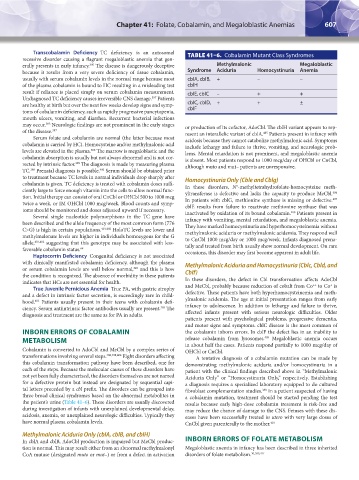
                     Transcobalamin Deficiency  TC deficiency is an autosomal   TABLE 41–6.  Cobalamin Mutant Class Syndromes
                  recessive disorder causing a flagrant megaloblastic anemia that gen-
                  erally presents in early infancy.  The disease is dangerously deceptive   Methylmalonic      Megaloblastic
                                        395
                  because it results from a very severe deficiency of tissue cobalamin,   Syndrome  Aciduria  Homocystinuria  Anemia
                  usually with serum cobalamin levels in the normal range because most   cblA, cblB,  +  –     –
                  of the plasma cobalamin is bound to HC resulting in a misleading test   cblH
                  result if reliance is placed simply on serum cobalamin measurement.   cblE, cblC  –  +       +
                  Undiagnosed TC deficiency causes irreversible CNS damage.  Patients
                                                             397
                  are healthy at birth but over the next few weeks develop signs and symp-  cblC, cblD,  +  +  ±
                  toms of cobalamin deficiency, such as rapidly progressive pancytopenia,   cblF
                  mouth ulcers, vomiting, and diarrhea. Recurrent bacterial infections
                  may occur.  Neurologic findings are not prominent in the early stages   or production of its cofactor, AdoCbl. The cblH variant appears to rep-
                          395
                  of the disease. 397                                   resent an interallelic variant of cblA.  Patients present in infancy with
                                                                                                   405
                     Serum folate and cobalamin are normal (the latter because most   acidosis because they cannot catabolize methylmalonic acid. Symptoms
                  cobalamin is carried by HC). Homocysteine and/or methylmalonic acid   include lethargy and failure to thrive, vomiting, and neurologic prob-
                  levels are elevated in the plasma.  The marrow is megaloblastic and the   lems. Mental retardation is not prominent, and megaloblastic anemia
                                         398
                  cobalamin absorption is usually but not always abnormal and is not cor-  is absent. Most patients respond to 1000 mcg/day of OHCbl or CnCbl,
                  rected by intrinsic factor.  The diagnosis is made by measuring plasma   although muto and mut– patients are unresponsive.
                                    399
                  TC.  Prenatal diagnosis is possible.  Serum should be obtained prior
                    389
                                            400
                  to treatment because TC levels in normal individuals drop sharply after   Homocystinuria Only (Cble and Cblg)
                  cobalamin is given. TC deficiency is treated with cobalamin doses suffi-  In these disorders,  N -methyltetrahydrofolate-homocysteine meth-
                                                                                          5
                  ciently large to force enough vitamin into the cells to allow normal func-  yltransferase is defective and lacks the capacity to produce MeCbl.
                                                                                                                          406
                  tion. Initial therapy can consist of oral CnCbl or OHCbl 500 to 1000 mcg   In patients with cblG, methionine synthase is missing or defective.
                                                                                                                          407
                  twice a week, or IM OHCbl 1000 mcg/week. Blood counts and symp-  cblE  results  from  failure  to  reactivate  methionine  synthase  that  was
                  toms should be monitored and doses adjusted upward if necessary.  inactivated by oxidation of its bound cobalamin.  Patients present in
                                                                                                            408
                     Several single nucleotide polymorphisms in the TC gene have   infancy with vomiting, mental retardation, and megaloblastic anemia.
                  been described and the allele frequency of the most common form (776   They have marked homocystinuria and hyperhomocysteinemia without
                  C>G) is high in certain populations. 401,402  HoloTC levels are lower and   methylmalonic aciduria or methylmalonic acidemia. They respond well
                  methylmalonate levels are higher in individuals homozygous for the G   to CnCbl 1000 mcg/day or 1000 mcg/week. Infants diagnosed prena-
                  allele, 401,402  suggesting that this genotype may be associated with less-  tally and treated from birth usually show normal development. On rare
                  favorable cobalamin status. 64                        occasions, this disorder may first become apparent in adult life.
                     Haptocorrin Deficiency  Congenital deficiency is not associated
                  with clinically manifested cobalamin deficiency, although the plasma   Methylmalonic Aciduria and Homocystinuria (Cblc, Cbld, and
                  or serum cobalamin levels are well below normal,  and this is how
                                                       345
                  the condition is recognized. The absence of morbidity in these patients   Cblf)
                  indicates that HCs are not essential for health.      In these disorders, the defect in Cbl transformation affects AdoCbl
                                                                                                                         +
                                                                                                                   ++
                     True Juvenile Pernicious Anemia  True PA, with gastric atrophy   and MeCbl, probably because reduction of cobalt from Co  to Co  is
                  and a defect in intrinsic factor secretion, is exceedingly rare in child-  defective. These patients have both hyperhomocysteinemia and meth-
                  hood.  Patients usually present in their teens with cobalamin defi-  ylmalonic acidemia. The age at initial presentation ranges from early
                      403
                  ciency. Serum antiintrinsic factor antibodies usually are present.  The   infancy to adolescence. In addition to lethargy and failure to thrive,
                                                                265
                  diagnosis and treatment are the same as for PA in adults.  affected infants present with serious neurologic difficulties. Older
                                                                        patients present with psychological problems, progressive dementia,
                                                                        and motor signs and symptoms. cblC disease is the most common of
                  INBORN ERRORS OF COBALAMIN                            the cobalamin inborn errors. In cblF the defect lies in an inability to
                                                                                                   409
                  METABOLISM                                            release cobalamin from lysosomes.  Megaloblastic anemia occurs
                                                                        in about half the cases. Patients respond partially to 1000 mcg/day of
                  Cobalamin is converted to AdoCbl and MeCbl by a complex series of   OHCbl or CnCbl.
                  transformations involving several steps. 388,398,404  Eight disorders affecting   A tentative diagnosis of  a cobalamin mutation can be  made  by
                  this cobalamin transformation pathway have been described, one for   demonstrating methylmalonic aciduria and/or homocystinuria in a
                  each of the steps. Because the molecular causes of these disorders have   patient with the clinical findings described above in “Methylmalonic
                  not yet been fully characterized, the disorders themselves are not named   Aciduria Only” or “Homocystinuria Only,” respectively. Establishing
                  for a defective protein but instead are designated by sequential capi-  a diagnosis requires a specialized laboratory equipped to do cultured
                  tal letters preceded by a cbl prefix. The disorders can be grouped into   fibroblast complementation studies.  In a patient suspected of having
                                                                                                  388
                  three broad clinical syndromes based on the abnormal metabolites in   a cobalamin mutation, treatment should be started pending the test
                  the patient’s urine (Table 41–6). These disorders are usually discovered   results because early high-dose cobalamin treatment is risk-free and
                  during investigation of infants with unexplained developmental delay,   may reduce the chance of damage to the CNS. Fetuses with these dis-
                  acidosis, anemia, or unexplained neurologic difficulties. Typically they   eases have been successfully treated in utero with very large doses of
                  have normal plasma cobalamin levels.                  CnCbl given parenterally to the mother. 410
                  Methylmalonic Aciduria Only (cblA, cblB, and cblH)
                  In cblA and cblB, AdoCbl production is impaired but MeCbl produc-  INBORN ERRORS OF FOLATE METABOLISM
                  tion is normal. This may result either from an abnormal methylmalonyl   Megaloblastic anemia in infancy has been described in three inherited
                  CoA mutase (designated muto or mut–) or from a defect in activation   disorders of folate metabolism. 30,389,411


          Kaushansky_chapter 41_p0583-0616.indd   607                                                                   9/17/15   6:24 PM

