


Page 850 - Williams Hematology ( PDFDrive )
P. 850
824  Part VI:  The Erythrocyte                Chapter 54:  Hemolytic Anemia Resulting from Immune Injury              825


                  pathogenic significance of these associations is poorly understood, but   secondary (1) when AHA and the underlying disease occur together
                  most of the associated diseases involve components of the immune sys-  with greater frequency than can be accounted for by chance alone; (2)
                  tem, either by neoplasia or by aberrant immunopathologic responses.  when the AHA reverses simultaneously with correction of the associ-
                                                                        ated disease; or (3) when AHA and the associated disease are related
                  Drug-Mediated Cases                                   by evidence of immunologic aberration.  Using these criteria, the fre-
                                                                                                      11
                  Certain drugs also mediate immune injury to RBCs, and three general   quency of primary warm-antibody AHA probably is closer to 50 percent
                  mechanisms are recognized (see Table  54–1 and Fig. 54–1). This classi-  of all cases. Careful followup of patients with primary AHA is essential,
                  fication is based on the effector mechanism of RBC injury, because the   because hemolytic anemia may be the presenting finding in a patient
                  induction mechanism for formation of drug-related RBC antibodies is   who subsequently develops overt evidence of an underlying disorder.
                  unknown. Two of the mechanisms, hapten-drug adsorption and ternary   For example, in one series, 18 of 107 patients with AHA developed a
                  complex formation, involve drug-dependent antibodies. In the third   malignant lymphoproliferative disorder at a median of 26.5 months
                  mechanism, the drugs in question appear to induce formation of true   after diagnosis of the AHA. 119
                  autoantibodies capable of reacting with human RBCs in the absence   Warm-antibody AHA has been diagnosed in people of all ages,
                  of the inciting drug. These types of drug-mediated immune injury to   from infants to the elderly. The majority of patients are older than 40
                  RBCs often are referred to collectively as drug-immune hemolytic ane-  years of age, with peak incidence around the seventh decade. This age
                  mia to distinguish them from de novo AHA. Distinguishing among the   distribution probably reflects, in part, the increased frequency of lym-
                  mechanisms is not always possible, and some cases involve a combina-  phoproliferative malignancies in the elderly, resulting in an age-related
                  tion of mechanisms. In addition, drug-related non-immunologic pro-  increase in the frequency of secondary AHA. Although multiple cases
                  tein adsorption by RBCs may result in a positive DAT without actual   are occasionally observed in families, 120–122  most cases of primary AHA
                  RBC injury. This phenomenon should be distinguished from the three   arise sporadically. Development of AHA does not have an apparent
                  forms of drug-immune RBC injury. Table 54–2 lists drugs documented   association with any particular human leukocyte antigen (HLA) haplo-
                  to cause either immune injury or a positive DAT.      type or other genetic factor.
                                                                            Cold agglutinin disease is less common than warm-antibody
                                                                                                                          24
                     EPIDEMIOLOGY                                       AHA, with a prevalence of approximately 14 per 1 million population,
                                                                                                                      Women
                                                                                                                 10,11,123
                                                                        accounting for only 10 to 20 percent of all cases of AHA.
                  The annual incidence of warm-antibody AHA is 1 per 75,000 to 80,000   are affected more commonly than men. 10,11  No genetic or racial factors
                  population.  Estimates of the frequency of primary (idiopathic) AHA   are known to contribute to the pathogenesis of this disease.
                          11
                  vary from 20 to 80 percent of all types of AHA, depending on the refer-  Secondary cold agglutinin disease is  seen most commonly in
                  ral patterns of the reporting center. 11,20,118  In general, AHA is considered   adolescents or young adults as a self-limited process associated with


                                    Fab                       Fab

                                                                             Fab
                                    Membrane
                                    protein
                                                                                                   TF  Alb    IgG  Fibr.


                      A                         B                         C                        D
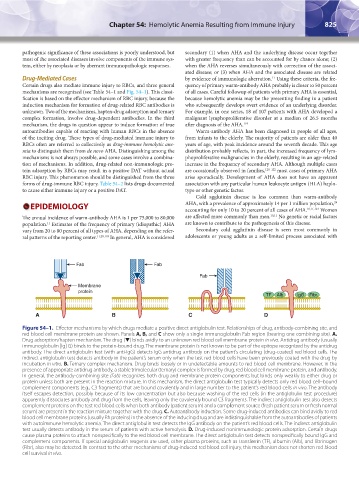
                  Figure 54–1.  Effector mechanisms by which drugs mediate a positive direct antiglobulin test. Relationships of drug, antibody-combining site, and
                  red blood cell membrane protein are shown. Panels A, B, and C show only a single immunoglobulin Fab region (bearing one combining site). A.
                  Drug adsorption/hapten mechanism. The drug (▼) binds avidly to an unknown red blood cell membrane protein in vivo. Antidrug antibody (usually
                  immunoglobulin [Ig] G) binds to the protein-bound drug. The membrane protein is not known to be part of the epitope recognized by the antidrug
                  antibody. The direct antiglobulin test (with anti-IgG) detects IgG antidrug antibody on the patient’s circulating (drug-coated) red blood cells. The
                  indirect antiglobulin test detects antibody in the patient’s serum only when the test red blood cells have been previously coated with the drug by
                  incubation in vitro. B. Ternary complex mechanism. Drug binds loosely or in undetectable amounts to red blood cell membrane. However, in the
                  presence of appropriate antidrug antibody, a stable trimolecular (ternary) complex is formed by drug, red blood cell membrane protein, and antibody.
                  In general, the antibody-combining site (Fab) recognizes both drug and membrane protein components but binds only weakly to either drug or
                  protein unless both are present in the reaction mixture. In this mechanism, the direct antiglobulin test typically detects only red blood cell–bound
                  complement components (e.g., C3 fragments) that are bound covalently and in large number to the patient’s red blood cells in vivo. The antibody
                  itself escapes detection, possibly because of its low concentration but also because washing of the red cells (in the antiglobulin test procedure)
                  apparently dissociates antibody and drug from the cells, leaving only the covalently bound C3 fragments. The indirect antiglobulin test also detects
                  complement proteins on the test red blood cells when both antibody (patient serum) and a complement source (fresh patient serum or fresh normal
                  serum) are present in the reaction mixture together with the drug. C. Autoantibody induction. Some drug-induced antibodies can bind avidly to red
                  blood cell membrane proteins (usually Rh proteins) in the absence of the inducing drug and are indistinguishable from the autoantibodies of patients
                  with autoimmune hemolytic anemia. The direct antiglobulin test detects the IgG antibody on the patient’s red blood cells. The indirect antiglobulin
                  test usually detects antibody in the serum of patients with active hemolysis. D. Drug-induced nonimmunologic protein adsorption. Certain drugs
                  cause plasma proteins to attach nonspecifically to the red blood cell membrane. The direct antiglobulin test detects nonspecifically bound IgG and
                  complement components. If special antiglobulin reagents are used, other plasma proteins, such as transferrin (TF), albumin (Alb), and fibrinogen
                  (Fibr), also may be detected. In contrast to the other mechanisms of drug-induced red blood cell injury, this mechanism does not shorten red blood
                  cell survival in vivo.


          Kaushansky_chapter 54_p0823-0846.indd   825                                                                   9/19/15   12:27 AM

