


Page 873 - Williams Hematology ( PDFDrive )
P. 873
848            Part VI:  The Erythrocyte                                                                                                          Chapter 55:  Alloimmune Hemolytic Disease of the Fetus and Newborn               849


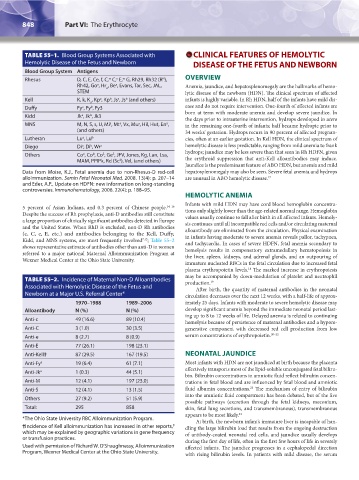
                TABLE 55–1.  Blood Group Systems Associated with           CLINICAL FEATURES OF HEMOLYTIC
                Hemolytic Disease of the Fetus and Newborn               DISEASE OF THE FETUS AND NEWBORN
                Blood Group System Antigens
                Rhesus            D, C, E, Ce, f, C,  C,  E,  G, Rh29, Rh32 (R ),   OVERVIEW
                                                 w
                                                              N
                                               x
                                            w
                                  Rh42, Go , Hr , Be , Evans, Tar, Sec, JAL,   Anemia, jaundice, and hepatosplenomegaly are the hallmarks of hemo-
                                               a
                                        a
                                           o
                                  STEM                                lytic disease of the newborn (HDN). The clinical spectrum of affected
                Kell              K, k, K , Kp , Kp , Js , Js  (and others)  infants is highly variable. In Rh HDN, half of the infants have mild dis-
                                                  b
                                               a
                                             b
                                         a
                                      o
                Duffy             Fy , Fy , Fy3                       ease and do not require intervention. One-fourth of affected infants are
                                      b
                                   a
                                                                      born at term with moderate anemia and develop severe jaundice. In
                Kidd              Jk , Jk , Jk3                       the days prior to intrauterine intervention, hydrops developed in utero
                                      b
                                   a
                MNS               M, N, S, s, U, Mi , Mt , Vx, Mur, Hil, Hut, En ,   in the remaining one-fourth of infants; half became hydropic prior to
                                                a
                                                                a
                                             a
                                  (and others)                        34 weeks’ gestation. Hydrops recurs in 90 percent of affected pregnan-
                Lutheran          Lu , Lu b                           cies, often at an earlier gestation. In Kell HDN, the clinical spectrum of
                                    a
                Diego             Di , Di , Wr a                      hemolytic disease is less predictable, ranging from mild anemia to frank
                                      b
                                   a
                                                                      hydrops; jaundice may be less severe than that seen in Rh HDFN, given
                                    a
                Others            Co , Co , Co , Ge , JFV, Jones, Kg, Lan, Lsa,   the  erythroid  suppression  that anti-Kell  alloantibodies  may  induce.
                                       b
                                          3
                                              3
                                  MAM, PPIPk, Rd (Sc ), Vel, (and others)
                                                4
                                                                      Jaundice is the predominant feature of ABO HDN, but anemia and mild
               Data from Moise, K.J., Fetal anemia due to non-Rhesus-D red-cell   hepatosplenomegaly may also be seen. Severe fetal anemia and hydrops
               alloimmunization. Semin Fetal Neonatal Med, 2008. 13(4): p. 207–14   are unusual in ABO hemolytic disease. 17
               and Eder, A.F., Update on HDFN: new information on long-standing
               controversies. Immunohematology, 2006. 22(4): p. 188–95.
                                                                      HEMOLYTIC ANEMIA
                                                                      Infants with mild HDN may have cord blood hemoglobin concentra-
               5 percent of Asian Indians, and 0.3 percent of Chinese people. 14–16    tions only slightly lower than the age-related normal range. Hemoglobin
               Despite the success of Rh prophylaxis, anti-D antibodies still constitute   values usually continue to fall after birth in all affected infants. Hemoly-
               a large proportion of clinically significant antibodies detected in Europe   sis continues until all incompatible red cells and/or circulating maternal
               and the United States. When RhD is excluded, non-D Rh antibodies   alloantibody are eliminated from the circulation. Physical examination
               (c, C,  e, E,  etc.)  and  antibodies  belonging  to  the  Kell,  Duffy,   in infants having moderate to severe anemia reveals pallor, tachypnea,
                                                        7,13
               Kidd, and MNS systems, are most frequently involved ; Table 55–2   and tachycardia. In cases of severe HDFN, fetal anemia secondary to
               shows representative estimate of antibodies other than anti-D in women   hemolysis results in compensatory extramedullary hematopoiesis in
               referred to a major national Maternal Alloimmunization Program at   the liver, spleen, kidneys, and adrenal glands, and an outpouring of
               Wexner Medical Center at the Ohio State University.
                                                                      immature nucleated RBCs in the fetal circulation due to increased fetal
                                                                      plasma erythropoietin levels.  The marked increase in erythropoiesis
                                                                                           18
                                                                      may be accompanied by down-modulation of platelet and neutrophil
                TABLE 55–2.  Incidence of Maternal Non-D Alloantibodies   production. 19
                Associated with Hemolytic Disease of the Fetus and        After birth, the quantity of maternal antibodies in the neonatal
                Newborn at a Major U.S. Referral Center*              circulation decreases over the next 12 weeks, with a half-life of approx-
                                 1970–1988        1989–2006           imately 25 days. Infants with moderate to severe hemolytic disease may
                Alloantibody     N (%)            N (%)               develop significant anemia beyond the immediate neonatal period last-
                                                                      ing up to 8 to 12 weeks of life. Delayed anemia is related to continuing
                Anti-c           49 (16.6)        89 (10.4)
                                                                      hemolysis because of persistence of maternal antibodies and a hypore-
                Anti-C           3 (1.0)          30 (3.5)            generative component with decreased red cell production from low
                Anti-e           8 (2.7)          8 (0.9)             serum concentrations of erythropoietin. 20–22
                Anti-E           77 (26.1)        198 (23.1)
                Anti-Kell†       87 (29.5)        167 (19.5)          NEONATAL JAUNDICE
                Anti-Fy a        19 (6.4)         61 (7.1)            Most infants with HDN are not jaundiced at birth because the placenta
                                                                      effectively transports most of the lipid-soluble unconjugated fetal biliru-
                Anti-Jk a        1 (0.3)          44 (5.1)
                                                                      bin. Bilirubin concentrations in amniotic fluid reflect bilirubin concen-
                Anti-M           12 (4.1)         197 (23.0)          trations in fetal blood and are influenced by fetal blood and amniotic
                                                                                            23
                Anti-S           12 (4.1)         13 (1.5)            fluid albumin concentrations.  The mechanism of entry of bilirubin
                                                                      into the amniotic fluid compartment has been debated, but of the five
                Others           27 (9.2)         51 (5.9)
                                                                      possible pathways (excretion through the fetal kidneys, meconium,
                Total:           295              858                 skin, fetal lung secretions, and transmembranous), transmembranous
                                                                      appears to be most likely. 24
               *The Ohio State University RBC Alloimmunization Program.   At birth, the newborn infant’s immature liver is incapable of han-
                                                                  8
               †Incidence of Kell alloimmunization has increased in other reports,    dling the large bilirubin load that results from the ongoing destruction
               which may be explained by geographic variations in gene frequency   of antibody-coated neonatal red cells, and jaundice usually develops
               or transfusion practices.                              during the first day of life, often in the first few hours of life in severely
               Used with permission of Richard W. O’Shaughnessy, Alloimmunization   affected infants. The jaundice progresses in a cephalopedal direction
               Program, Wexner Medical Center at the Ohio State University.  with  rising  bilirubin  levels.  In  patients  with  mild  disease,  the  serum
          Kaushansky_chapter 55_p0847-0862.indd   848                                                                   9/18/15   11:52 PM

