


Page 891 - Williams Hematology ( PDFDrive )
P. 891
866            Part VI:  The Erythrocyte                                                                                                                                 Chapter 56:  Hypersplenism and Hyposplenism               867


                TABLE 56–2.  Causes of Massive Splenomegaly           patients develop marked blood cytopenias is not clear, although folate
                                                                      deficiency is a factor in some instances. The presence of thrombocy-
                1.  Myeloproliferative disorders                      topenia or leukopenia in patients with chronic liver disease is associated
                   a.  Primary myelofibrosis                          with increased mortality. 37
                   b.  Chronic myeloid leukemia                           Ultrasound-guided fine-needle biopsy of the spleen can be use-
                2.  Lymphomas                                         ful in circumstances in which the spleen holds the tissue required for
                   a.  Hairy cell leukemia                            diagnosis, such as splenic lymphoma. However, fine-needle aspiration
                                                                      is rarely a definitive diagnostic tool but can indicate monoclonality of
                   b.   Chronic lymphocytic leukemia (especially prolymphocytic   splenic lymphocytes, which is helpful and forces further diagnostic
                     variant)                                         evaluation. Aspiration cytology and core biopsy can be obtained with
                3.  Infectious                                        relative safety in experienced hands using image-guided fine needles. 38
                   a.  Malaria                                            The response to transfusion of blood products, especially platelets,
                   b.  Leishmaniasis (kala azar)                      may be significantly impaired in patients with massive splenomegaly. 39
                4.  Extramedullary hematopoiesis
                   a.  Thalassemia major                              THERAPY, COURSE, AND PROGNOSIS
                5.  Infiltrative                                      Total Splenectomy
                   a.  Gaucher disease                                Splenectomy  is  indicated  as  an  emergency  procedure  after  abdominal
                                                                      trauma and partial rupture of the spleen. It also may be indicated when
                                                                      splenic size or infarcts causes sustained left upper abdominal pain or dis-
               The diagnosis of splenoptosis may be made coincidentally on an imaging   comfort.  Splenectomy  has  been used  for  the  treatment  of  functionally
                                                                                          39
               study.  The condition may be accompanied by signs of hypersplenism,   significant blood cytopenias.  In such circumstances, case reports have
                    31
               hyposplenism, and often, when developing slowly, is initially mistaken   described dramatic restoration of blood counts to normal levels within
               for a pelvic or lower abdominal tumor.                 days to weeks after splenectomy; however, the only controlled trial evalu-
                                                                      ating relief of cytopenias showed no improvement.  Orthotopic liver trans-
                                                                                                         6
               LABORATORY FEATURES                                    plant corrects the cytopenias in the majority of patients with cirrhosis. 40
                                                                          Hereditary spherocytosis, immune thrombocytopenic purpura,
               The characteristic features of hypersplenism are splenomegaly, blood   and immune hemolytic anemia are the most common indications for
               cytopenias, and absence of other causes of cytopenias (e.g., anemia   splenectomy. Splenectomy exerts its effect in autoimmune cytopenias
               caused by bleeding). The blood cell morphology usually is normal,   by improving cell survival and also by decreasing autoantibody pro-
               although a few spherocytes may result from metabolic conditioning of   duction. In thalassemia major, an improvement in the anemia is well
               red cells during repeated slow transits through the expanded red pulp.   described after splenectomy. In such cases, splenectomy may improve
               Tests, such as epinephrine mobilization, were used in the past to try   the response to transfusion. Some children with sickle cell anemia may
               to distinguish sequestration from ineffective cellular production, but   benefit from splenectomy if repeated sequestration crises with abdom-
               results are difficult to interpret as epinephrine also releases platelets and   inal pain occur before autosplenectomy renders the spleen atrophic. 41
               neutrophils from marginal pools. 32                        Splenectomy in patients with a massive spleen size (>1500 g), espe-
                   Thrombocytopenia is a common finding in patients with hepatic   cially in primary myelofibrosis, is accompanied by higher morbidity and
               cirrhosis, portal hypertension, and splenomegaly. In a retrospective   mortality than is removal of the spleen for immune blood cytopenia.
                                                                                                                        42
               study, 64 percent of patients with nonalcoholic cirrhosis had thrombo-  Possible postoperative complications include extensive adhesions with
               cytopenia.  Other studies have found that approximately one-third of   collateral blood vessels, hepatic or portal vein thrombosis, injury to the tail
                       33
               patients with cirrhosis develop severe thrombocytopenia or neutrope-  of the pancreas, operative site infections, and subdiaphragmatic abscesses.
               nia. 34,35  Decompensated liver disease and history of alcohol consump-  Laparoscopic splenectomy performed by experienced surgeons for
               tion are independent risk factors for hypersplenism,  but why some   suitable hematologic conditions can result in less abdominal trauma
                                                      36


                           A                           B                           C

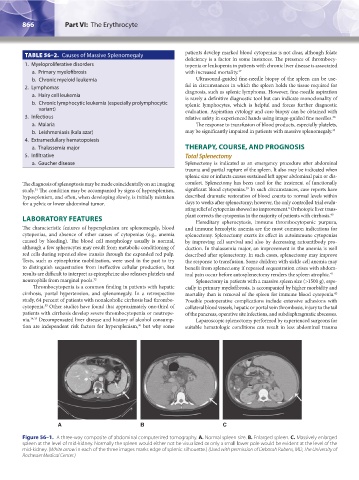
               Figure 56–1.  A three-way composite of abdominal computerized tomography. A. Normal spleen size. B. Enlarged spleen. C. Massively enlarged
               spleen at the level of mid-kidney. Normally the spleen would either not be visualized or only a small lower pole would be evident at the level of the
               mid-kidney. (White arrow in each of the three images marks edge of splenic silhouette.) (Used with permission of Deborah Rubens, MD, The University of
               Rochester Medical Center.)


          Kaushansky_chapter 56_p0863-0870.indd   866                                                                   9/17/15   3:05 PM

