


Page 892 - Williams Hematology ( PDFDrive )
P. 892
866  Part VI:  The Erythrocyte                               Chapter 56:  Hypersplenism and Hyposplenism              867


                      A                                                B
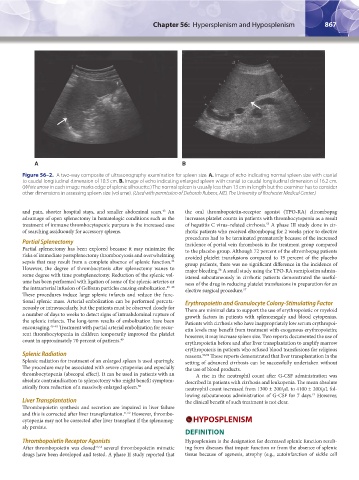
                  Figure 56–2.  A two-way composite of ultrasonography examination for spleen size. A. Image of echo indicating normal spleen size with cranial
                  to caudal longitudinal dimension of 10.3 cm. B. Image of echo indicating enlarged spleen with cranial to caudal longitudinal dimension of 16.2 cm.
                  (White arrow in each image marks edge of splenic silhouette.) The normal spleen is usually less than 13 cm in length but the examiner has to consider
                  other dimensions in assessing spleen size (volume). (Used with permission of Deborah Rubens, MD, The University of Rochester Medical Center.)


                                                                 43
                  and pain, shorter hospital stays, and smaller abdominal scars.  An   the  oral  thrombopoietin-receptor  agonist (TPO-RA)  eltrombopag
                  advantage of open splenectomy in hematologic conditions such as the   increases platelet counts in patients with thrombocytopenia as a result
                  treatment of immune thrombocytopenic purpura is the increased ease   of hepatitis C virus–related cirrhosis.  A phase III study done in cir-
                                                                                                    55
                  of searching assiduously for accessory spleens.       rhotic patients who received eltrombopag for 2 weeks prior to elective
                                                                        procedures had to be terminated prematurely because of the increased
                  Partial Splenectomy                                   incidence of portal vein thrombosis in the treatment group compared
                  Partial splenectomy has been explored because it may minimize  the   to the placebo group. Although 72 percent of the eltrombopag patients
                  risks of immediate postsplenectomy thrombocytosis and overwhelming   avoided platelet transfusions compared to 19 percent of the placebo
                                                                    44
                  sepsis that may result from a complete absence of splenic function.    group patients, there was no significant difference in the incidence of
                  However, the  degree  of  thrombocytosis after splenectomy wanes to   major bleeding.  A small study using the TPO-RA romiplostim admin-
                                                                                    56
                  some degree with time postsplenectomy. Reduction of the splenic vol-  istered subcutaneously in cirrhotic patients demonstrated the useful-
                  ume has been performed with ligation of some of the splenic arteries or   ness of the drug in reducing platelet transfusions in preparation for an
                  the intraarterial infusion of Gelfoam particles causing embolization. 45–48    elective surgical procedure. 57
                  These procedures induce large splenic infarcts and reduce the func-
                  tional splenic mass. Arterial embolization can be performed percuta-  Erythropoietin and Granulocyte Colony-Stimulating Factor
                  neously or intravascularly, but the patients must be observed closely for   There are minimal data to support the use of erythropoietic or myeloid
                  a number of days to weeks to detect signs of intraabdominal rupture of   growth factors in patients with splenomegaly and blood cytopenias.
                  the splenic infarcts. The long-term results of embolization have been   Patients with cirrhosis who have inappropriately low serum erythropoi-
                  encouraging. 46–48  Treatment with partial arterial embolization for recur-  etin levels may benefit from treatment with exogenous erythropoietin;
                  rent thrombocytopenia in children temporarily improved the platelet   however, it may increase spleen size. Two reports documented the use of
                  count in approximately 70 percent of patients. 49     erythropoietin before and after liver transplantation to amplify marrow
                                                                        erythropoiesis in patients who refused blood transfusions for religious
                  Splenic Radiation                                     reasons. 58,59  These reports demonstrated that liver transplantation in the
                  Splenic radiation for treatment of an enlarged spleen is used sparingly.   setting of advanced cirrhosis can be successfully undertaken without
                  The procedure may be associated with severe cytopenias and especially   the use of blood products.
                  thrombocytopenia (abscopal effect). It can be used in patients with an   A rise in the neutrophil count after G-CSF administration was
                  absolute contraindication to splenectomy who might benefit symptom-  described in patients with cirrhosis and leukopenia. The mean absolute
                  atically from reduction of a massively enlarged spleen. 50  neutrophil count increased from 1300 ± 200/μL to 4100 ± 200/μL fol-
                                                                                                                   19
                                                                        lowing subcutaneous administration of G-CSF for 7 days.  However,
                  Liver Transplantation                                 the clinical benefit of such treatment is not clear.
                  Thrombopoietin synthesis and secretion are impaired in liver failure
                  and this is corrected after liver transplantation. 51,52  However, thrombo-
                  cytopenia may not be corrected after liver transplant if the splenomeg-    HYPOSPLENISM
                  aly persists.
                                                                        DEFINITION
                  Thrombopoietin Receptor Agonists                      Hyposplenism is the designation for decreased splenic function result-
                  After thrombopoietin was cloned 53,54  several thrombopoietin mimetic   ing from diseases that impair function or from the absence of splenic
                  drugs have been developed and tested. A phase II study reported that   tissue because of agenesis, atrophy (e.g., autoinfarction of sickle cell


          Kaushansky_chapter 56_p0863-0870.indd   867                                                                   9/17/15   3:05 PM

