


Page 893 - Williams Hematology ( PDFDrive )
P. 893
868            Part VI:  The Erythrocyte                                                                                                                                 Chapter 56:  Hypersplenism and Hyposplenism               869


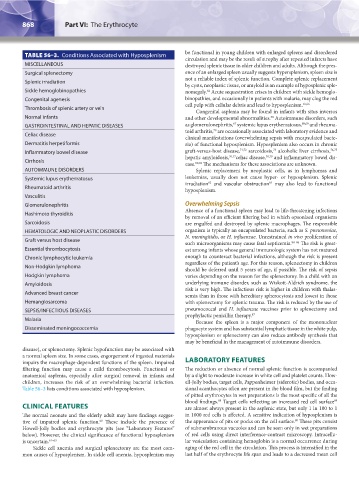
                TABLE 56–3.  Conditions Associated with Hyposplenism  be functional in young children with enlarged spleens and disordered
                                                                      circulation and may be the result of atrophy after repeated infarcts have
                MISCELLANEOUS                                         destroyed splenic tissue in older children and adults. Although the pres-
                Surgical splenectomy                                  ence of an enlarged spleen usually suggests hypersplenism, spleen size is
                                                                      not a reliable index of splenic function. Complete splenic replacement
                Splenic irradiation
                                                                      by cysts, neoplastic tissue, or amyloid is an example of hyposplenic sple-
                Sickle hemoglobinopathies                             nomegaly.  Acute sequestration crises in children with sickle hemoglo-
                                                                             64
                Congenital agenesis                                   binopathies, and occasionally in patients with malaria, may clog the red
                                                                      cell pulp with cellular debris and lead to hyposplenism. 65,66
                Thrombosis of splenic artery or vein
                                                                          Congenital asplenia may be found in infants with situs inversus
                Normal infants                                        and other developmental abnormalities.  Autoimmune disorders, such
                                                                                                   38
                                                                                      67
                GASTROINTESTINAL AND HEPATIC DISEASES                 as glomerulonephritis,  systemic lupus erythematosus, 68,69  and rheuma-
                                                                               70
                                                                      toid arthritis,  are occasionally associated with laboratory evidence and
                Celiac disease
                                                                      clinical manifestations (overwhelming sepsis with encapsulated bacte-
                Dermatitis herpetiformis                              ria) of functional hyposplenism. Hyposplenism also occurs in chronic
                                                                                                    73
                Inflammatory bowel disease                            graft-versus-host disease, 71,72  sarcoidosis,  alcoholic liver cirrhosis, 74,75
                                                                      hepatic amyloidosis, 76,77 celiac disease, 78,79  and inflammatory bowel dis-
                Cirrhosis
                                                                      ease. 80,81  The mechanisms for these associations are unknown.
                AUTOIMMUNE DISORDERS                                      Splenic replacement by neoplastic cells, as in lymphomas and
                Systemic lupus erythematosus                          leukemias, usually does not cause hyper- or hyposplenism. Splenic
                                                                              82
                                                                      irradiation  and vascular obstruction  may also lead to functional
                                                                                                  83
                Rheumatoid arthritis
                                                                      hyposplenism.
                Vasculitis
                Glomerulonephritis                                    Overwhelming Sepsis
                                                                      Absence of a functional spleen may lead to life-threatening infections
                Hashimoto thyroiditis
                                                                      by removal of an efficient filtering bed in which opsonized organisms
                Sarcoidosis                                           are engulfed and destroyed by splenic macrophages. The responsible
                HEMATOLOGIC AND NEOPLASTIC DISORDERS                  organism is typically an encapsulated bacteria, such as S. pneumoniae,
                                                                      N. meningitidis, or H. influenzae. Unrestrained in vivo proliferation of
                Graft versus host disease
                                                                      such microorganisms may cause fatal septicemia. 84–86  The risk is great-
                Essential thrombocytosis                              est among infants whose general immunologic system has not matured
                Chronic lymphocytic leukemia                          enough to counteract bacterial infections, although the risk is present
                                                                      regardless of the patient’s age. For this reason, splenectomy in children
                Non-Hodgkin lymphoma
                                                                      should be deferred until 5 years of age, if possible. The risk of sepsis
                Hodgkin lymphoma                                      varies depending on the reason for the splenectomy. In a child with an
                Amyloidosis                                           underlying immune disorder, such as Wiskott-Aldrich syndrome, the
                                                                      risk is very high. The infectious risk is higher in children with thalas-
                Advanced breast cancer
                                                                      semia than in those with hereditary spherocytosis and lowest in those
                Hemangiosarcoma                                       with splenectomy for splenic trauma. The risk is reduced by the use of
                SEPSIS/INFECTIOUS DISEASES                            pneumococcal and  H. influenzae vaccines prior to splenectomy and
                                                                      prophylactic penicillin therapy. 87
                Malaria
                                                                          Because the spleen is a major component of the mononuclear
                Disseminated meningococcemia                          phagocyte system and has substantial lymphatic tissue in the white pulp,
                                                                      hyposplenism or splenectomy can also reduce antibody synthesis that
                                                                      may be beneficial in the management of autoimmune disorders.
               disease), or splenectomy. Splenic hypofunction may be associated with
               a normal spleen size. In some cases, engorgement of ingested materials
               impairs the macrophage-dependent functions of the spleen. Impaired   LABORATORY FEATURES
               filtering function may cause a mild thrombocytosis. Functional or   The reduction or absence of normal splenic function is accompanied
               anatomical  asplenia, especially  after surgical removal  in infants and   by a slight to moderate increase in white cell and platelet counts. How-
               children, increases the risk of an overwhelming bacterial infection.    ell-Jolly bodies, target cells, Pappenheimer (siderotic) bodies, and occa-
               Table 56–3 lists conditions associated with hyposplenism.  sional acanthocytes often are present in the blood film, but the finding
                                                                      of pitted erythrocytes in wet preparations is the most specific of all the
                                                                      blood findings.  Target cells reflecting an increased red cell surface
                                                                                 88
                                                                                                                        89
               CLINICAL FEATURES                                      are almost always present in the asplenic state, but only 1 in 100 to 1
               The normal neonate and the elderly adult may have findings sugges-  in 1000 red cells is affected. A sensitive indication of hyposplenism is
               tive  of  impaired  splenic  function.   These  include  the  presence  of   the appearance of pits or pocks on the cell surface.  These pits consist
                                                                                                           90
                                         60
               Howell-Jolly bodies and erythrocyte pits (see “Laboratory Features”   of submembranous vacuoles and can be seen only in wet preparations
               below). However, the clinical significance of functional hyposplenism   of red cells using direct interference-contrast microscopy. Intracellu-
               is uncertain. 61–63                                    lar vesiculation containing hemoglobin is a normal occurrence during
                   Sickle cell anemia and surgical splenectomy are the most com-  aging of the red cell in the circulation. This process is intensified in the
               mon causes of hyposplenism. In sickle cell anemia, hyposplenism may   last half of the erythrocyte life span and leads to a decreased mean cell


          Kaushansky_chapter 56_p0863-0870.indd   868                                                                   9/17/15   3:05 PM

