


Page 908 - Williams Hematology ( PDFDrive )
P. 908
882  Part VI:  The Erythrocyte                          Chapter 57:  Primary and Secondary Erythrocytoses             883


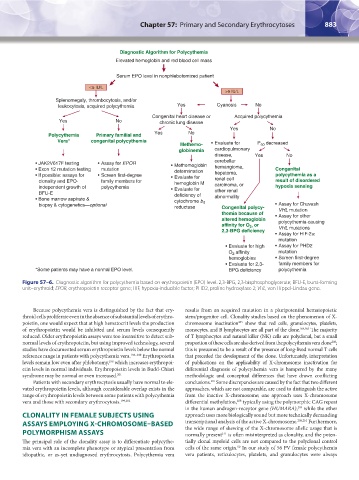
                  Figure 57–6.  Diagnostic algorithm for polycythemia based on erythropoietin (EPO) level. 2,3-BPG, 2,3-bisphosphoglycerate; BFU-E, burst-forming
                  unit–erythroid; EPOR, erythropoietin receptor gene; HIF, hypoxia-inducible factor; PHD2, proline hydroxylase 2; VHL, von Hippel-Lindau gene.


                     Because polycythemia vera is distinguished by the fact that ery-  results from an acquired mutation in a pluripotential hematopoietic
                  throid cells proliferate even in the absence of substantial levels of erythro-  stem/progenitor cell. Clonality studies based on the phenomenon of X-
                  poietin, one would expect that at high hematocrit levels the production   chromosome inactivation  show that red cells, granulocytes, platelets,
                                                                                          203
                  of erythropoietin would be inhibited and serum levels consequently   monocytes, and B lymphocytes are all part of the clone. 204,205  The majority
                  reduced. Older erythropoietin assays were too insensitive to detect sub-  of T lymphocytes and natural killer (NK) cells are polyclonal, but a small
                  normal levels of erythropoietin, but using improved technology, several   proportion of these cells are also derived from the polycythemia vera clone ;
                                                                                                                          206
                  studies have documented serum erythropoietin levels below the normal   this is presumed to be a result of the presence of long-lived normal T cells
                  reference range in patients with polycythemia vera. 198–200  Erythropoietin   that preceded the development of the clone. Unfortunately, interpretation
                  levels remain low even after phlebotomy,  which increases erythropoi-  of publications on the applicability of X-chromosome  inactivation  for
                                               198
                  etin levels in normal individuals. Erythropoietin levels in Budd-Chiari   differential diagnosis of polycythemia vera is hampered by the many
                  syndrome may be normal or even increased. 201         methodologic and conceptual differences that have drawn conflicting
                     Patients with secondary erythrocytosis usually have normal to ele-  conclusions.  Some discrepancies are caused by the fact that two different
                                                                                 207
                  vated erythropoietin levels, although considerable overlap exists in the   approaches, which are not comparable, are used to distinguish the active
                  range of erythropoietin levels between some patients with polycythemia   from the inactive X-chromosome; one approach uses X-chromosome
                  vera and those with secondary erythrocytosis. 199,202  differential methylation,  typically using the polymorphic CAG repeat
                                                                                          208
                                                                        in the human androgen-receptor gene (HUMARA),  while the other
                                                                                                              209
                  CLONALITY IN FEMALE SUBJECTS USING                    approach uses more biologically sound but more technically demanding
                  ASSAYS EMPLOYING X-CHROMOSOME–BASED                   transcriptional analysis of the active X-chromosome. 208,210  Furthermore,
                                                                        the wide range of skewing of the X-chromosome allelic usage that is
                  POLYMORPHISM ASSAYS                                   normally present  is often misinterpreted as clonality, and the poten-
                                                                                     211
                  The principal role of the clonality assay is to differentiate polycythe-  tially clonal myeloid cells are not compared to the polyclonal control
                  mia vera with an incomplete phenotype or atypical presentation from   cells of the same origin.  In our study of 56 PV female polycythemia
                                                                                          50
                  idiopathic, or as-yet undiagnosed erythrocytosis. Polycythemia vera   vera  patients, reticulocytes, platelets, and  granulocytes  were always


          Kaushansky_chapter 57_p0871-0888.indd   883                                                                   9/18/15   9:37 AM

