


Page 907 - Williams Hematology ( PDFDrive )
P. 907
882            Part VI:  The Erythrocyte                                                                                                                             Chapter 57:  Primary and Secondary Erythrocytoses             883


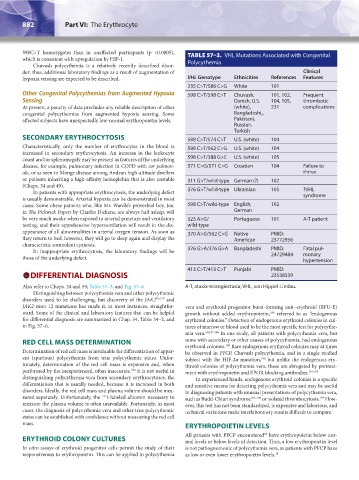
               598C>T homozygotes than in unaffected participants (p <0.0005),   TABLE 57–3.  VHL Mutations Associated with Congenital
               which is consistent with upregulation by HIF-1.
                   Chuvash polycythemia is a relatively recently described disor-  Polycythemia
               der; thus, additional laboratory findings as a result of augmentation of                       Clinical
               hypoxia sensing are expected to be described.           VHL Genotype   Ethnicities  References  Features
                                                                       235 C>T/586 C>G  White      101
               Other Congenital Polycythemias from Augmented Hypoxia   598 C>T/598 C>T  Chuvash,   101, 102,   Frequent
               Sensing                                                                Danish, U.S.   104, 105,   thrombotic
               At present, a paucity of data precludes any reliable description of other   (white),    231    complications
               congenital polycythemias from augmented hypoxia sensing. Some          Bangladeshi,,
               affected subjects have unexpectedly low-normal erythropoietin levels.  Pakistani,
                                                                                      Russian,
                                                                                      Turkish
               SECONDARY ERYTHROCYTOSIS                                598 C>T/574 C>T  U.S. (white)  104
               Characteristically, only  the  number  of  erythrocytes in  the  blood  is   598 C>T/562 C>G  U.S. (white)  104
               increased in secondary erythrocytosis. An increase in the leukocyte
               count and/or splenomegaly may be present as features of the underlying   598 C>T/388 G>C  U.S. (white)  105
               disease, for example, pulmonary infection in COPD with cor pulmon-  571 C>G/571 C>G  Croatian  104  Failure to
               ale, or as seen in Monge disease among Andean high-altitude dwellers                           thrive
               or patients inheriting a high-affinity hemoglobin that is also unstable   311 G>T/wild-type German (?)  102
               (Chaps. 34 and 49).
                   In patients with appropriate erythrocytosis, the underlying defect   376 G>T/wild-type Ukrainian  105  ?VHL
               is usually demonstrable. Arterial hypoxia can be demonstrated in most                          syndrome
               cases. Some obese patients who, like Mr. Wardle’s proverbial boy, Joe,   598 C>T/wild-type English,   102
               in The Pickwick Papers by Charles Dickens, are always half asleep, will   German
               be very much awake when exposed to arterial puncture and ventilatory   523 A>G/  Portuguese  101  A-T patient
               testing, and their apprehensive hyperventilation will result in the dis-  wild-type
               appearance of all abnormalities in arterial oxygen tension. As soon as   370 A>G/562 C>G  Native   PMID:
               they return to bed, however, they will go to sleep again and display the   American  23772956
               characteristic somnolent cyanosis.
                   In inappropriate erythrocytosis, the laboratory findings will be   376 G>A/376 G>A  Bangladeshi  PMID:   Fatal pul-
               those of the underlying defect.                                                     24729484   monary
                                                                                                              hypertension
                                                                       413 C>T/413 C>T  Punjabi    PMID:
                  DIFFERENTIAL DIAGNOSIS                                                           23538339

               Also refer to Chaps. 34 and 59, Table 57–3, and Fig. 57–6.  A-T, ataxia-telangiectasia; VHL, von Hippel-Lindau.
                   Distinguishing between polycythemia vera and other polycythemic
               disorders used to be challenging, but discovery of the  JAK2 V617F  and
               JAK2 exon 12 mutations has made it, in most instances, straightfor-  vera and erythroid progenitor burst-forming unit–erythroid (BFU-E)
               ward. Some of the clinical and laboratory features that can be helpful   growth without added erythropoietin,  referred to as “endogenous
                                                                                                  186
               for differential diagnosis are summarized in Chap. 34, Table  34–2, and   erythroid colonies.” Detection of endogenous erythroid colonies in cul-
               in Fig. 57–6.                                          tures of marrow or blood used to be the most specific test for polycythe-
                                                                      mia vera. 50,187,188  In one study, all patients with polycythemia vera, but
               RED CELL MASS DETERMINATION                            none with secondary or other causes of polycythemia, had endogenous
                                                                                    189
                                                                      erythroid colonies.  Rare endogenous erythroid colonies may at times
               Determination of red cell mass is invaluable for differentiation of appar-  be observed in PFCP, Chuvash polycythemia, and in a single studied
               ent (spurious) polycythemia from true polycythemic states. Unfor-  subject with the HIF-2α mutation,  but unlike the endogenous ery-
                                                                                               190
               tunately, determination of the red cell mass is expensive and, when   throid colonies of polycythemia vera, these are abrogated by pretreat-
                                                    185
               performed by the inexperienced, often inaccurate.  It is not useful in   ment with erythropoietin and EPOR-blocking antibodies. 191,192
               distinguishing polycythemia vera from secondary erythrocytoses, the   In experienced hands, endogenous erythroid colonies is a specific
               differentiation that is usually needed, because it is increased in both   and sensitive means for detecting polycythemia vera and may be useful
               disorders. Ideally, the red cell mass and plasma volume should be mea-  in diagnosing patients with unusual presentations of polycythemia vera,
               sured separately. Unfortunately, the  I-labeled albumin necessary to   such as Budd-Chiari syndrome 193–196  or isolated thrombocytosis.  How-
                                          131
                                                                                                                   197
               measure the plasma volume is often unavailable. Fortunately, in most   ever, this test has not been standardized, is expensive and laborious, and
               cases, the diagnosis of polycythemia vera and other true polycythemic   technical variations make interlaboratory results difficult to compare.
               states can be established with confidence without measuring the red cell
               mass.                                                  ERYTHROPOIETIN LEVELS
                                                                      All patients with PFCP encountered  have erythropoietin below nor-
                                                                                                54
               ERYTHROID COLONY CULTURES                              mal levels or below levels of detection. Thus, a low erythropoietin level
               In vitro assays of erythroid progenitor cells permit the study of their   is not pathognomonic of polycythemia vera, as patients with PFCP have
               responsiveness to erythropoietin. This can be applied to polycythemia   as low or even lower erythropoietin levels. 18


          Kaushansky_chapter 57_p0871-0888.indd   882                                                                   9/18/15   9:37 AM

