


Page 905 - Williams Hematology ( PDFDrive )
P. 905
880            Part VI:  The Erythrocyte                                                                                                                             Chapter 57:  Primary and Secondary Erythrocytoses             881


                     Hgb  Hct                                            CLINICAL FEATURES
                    (gm %) (%)
                     20                                               PRIMARY POLYCYTHEMIA
                         60                                           Primary Familial and Congenital Polycythemia
                                                                      Although PFCP is uncommon, it is frequently misdiagnosed.  Unlike
                                                                                                                   18
                     15  50                                           patients with polycythemia vera, patients with PFCP lack splenomegaly,
                                                                      neutrophilia, basophilia, thrombocytosis, and a JAK2 mutation. Unless
                                                                      exposed to alkylating agents or radioactive phosphorus, as many have
                         40
                                                                      been, these patients do not progress to acute leukemia or myelodysplas-
                                                                                159
                     10                                               tic syndrome.  Generally thought to be benign, this condition predis-
                         30
                               Hct         Hgb                        poses patients to severe cardiovascular problems because of chronic
                                                                      augmented erythropoietin signaling in all tissues bearing  EPOR.
                                                                                                                       160
                         20                                           An increased incidence of cardiovascular disease has been observed
                                                                                                   161
                      5                                               in affected members of PFCP families.  Erythrocytosis may be very
                         10                                           severe, with hemoglobin levels that typically exceed 20 g/dL in men and
                                                                      18 g/dL in women. Headaches are commonly present. Hypertension,
                                                                      coronary artery disease, and strokes have been reported, but do not
                      0   0                                           clearly appear to be related to an elevated hematocrit as they also occur
                              Methyl testosterone
                          100                                         in aggressively phlebotomized patients with normal hematocrits,  and
                                                                                                                    162
                     mg/day  0                                        are not a constant feature of the disorder. 163
                           50 Fluoxymesterone
                            0                                         Chuvash Polycythemia
                                                                      The recessive polycythemia that is endemic in the Chuvash Autono-
                    Months   0   2  4   6  8  10  12  14  16  18
                                                                      mous Republic of the Russian Federation is characterized by elevation
                                                                      of the hemoglobin level to a mean of 22.6 with a standard deviation of
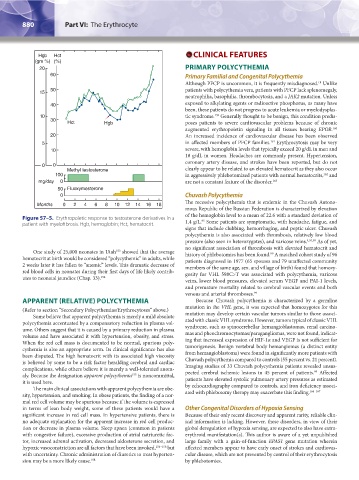
               Figure 57–5.  Erythropoietic response to testosterone derivatives in a   1.4 g/L.  Some patients are symptomatic, with headache, fatigue, and
                                                                            95
               patient with myelofibrosis. Hgb, hemoglobin; Hct, hematocrit.
                                                                      signs that include clubbing, hemorrhaging, and peptic ulcer. Chuvash
                                                                      polycythemia is also associated with thrombosis, relatively low blood
                                                                      pressure (also seen in heterozygotes), and varicose veins. 4,95,99  As of yet,
                                                                      no significant association of thrombosis with elevated hematocrit and
                   One study of 25,000 neonates in Utah  showed that the average   history of phlebotomies has been found.  A matched cohort study of 96
                                               153
                                                                                                   99
               hematocrit at birth would be considered “polycythemic” in adults, while   patients diagnosed in 1977 (65 spouses and 79 unaffected community
               2 weeks later it has fallen to “anemic” levels. This dramatic decrease of   members of the same age, sex, and village of birth) found that homozy-
               red blood cells in neonates during their first days of life likely contrib-  gosity for VHL 598C>T was associated with polycythemia, varicose
               utes to neonatal jaundice (Chap. 33). 154              veins, lower blood pressures, elevated serum VEGF and PAI-1 levels,
                                                                      and premature mortality related to cerebral vascular events and both
                                                                      venous and arterial thromboses. 99
               APPARENT (RELATIVE) POLYCYTHEMIA                           Because Chuvash polycythemia is characterized by a germline
               (Refer to section “Secondary Polycythemias/Erythrocytoses” above.)  mutation in the VHL gene, it was expected that homozygotes for this
                   Some believe that apparent polycythemia is merely a mild absolute   mutation may develop certain vascular tumors similar to those associ-
               polycythemia accentuated by a compensatory reduction in plasma vol-  ated with classic VHL syndrome. However, tumors typical of classic VHL
               ume. Others suggest that it is caused by a primary reduction in plasma   syndrome, such as spinocerebellar hemangioblastomas, renal carcino-
               volume and have associated it with hypertension, obesity, and stress.   mas and pheochromocytomas/paragangliomas, were not found, indicat-
               When the red cell mass is documented to be normal, spurious poly-  ing that increased expression of HIF-1α and VEGF is not sufficient for
               cythemia is also an appropriate term. Its clinical significance has also   tumorigenesis. Benign vertebral body hemangiomas (a distinct entity
               been disputed. The high hematocrit with its associated high viscosity   from hemangioblastoma) were found in significantly more patients with
               is believed by some to be a risk factor heralding cerebral and cardiac   Chuvash polycythemia compared to controls (55 percent vs. 21 percent).
               complications, while others believe it is merely a well-tolerated anom-  Imaging studies of 33 Chuvash polycythemia patients revealed unsus-
                                                                                                                 99
               aly. Because the designation apparent polycythemia  is noncommittal,   pected cerebral ischemic lesions in 45 percent of patients.  Affected
                                                    155
               it is used here.                                       patients have elevated systolic pulmonary artery pressures as estimated
                   The main clinical associations with apparent polycythemia are obe-  by echocardiography compared to controls, and iron deficiency associ-
                                                                                                                164–167
               sity, hypertension, and smoking. In obese patients, the finding of a nor-  ated with phlebotomy therapy may exacerbate this finding.
               mal red cell volume may be spurious because if the volume is expressed
               in  terms of  lean body weight, some  of these  patients would  have a   Other Congenital Disorders of Hypoxia Sensing
               significant increase in red cell mass. In hypertensive patients, there is   Because of their only recent discovery and apparent rarity, reliable clin-
               no adequate explanation for the apparent increase in red cell produc-  ical information is lacking. However, these disorders, in view of their
               tion or decrease in plasma volume. Sleep apnea (common in patients   global deregulation of hypoxia sensing, are expected to also have extra-
               with congestive failure), excessive production of atrial natriuretic fac-  erythroid manifestation(s). This author is aware of a yet unpublished
               tor, increased adrenal activation, decreased aldosterone secretion, and   large family with a gain-of-function  EPAS1 gene mutation wherein
               hypoxic vasoconstriction are all factors that have been invoked, 156–158  but   affected members appear to have early onset of strokes and cardiovas-
               with uncertainty. Chronic administration of diuretics to treat hyperten-  cular disease, which are not prevented by control of their erythrocytosis
               sion may be a more likely cause. 158                   by phlebotomies.


          Kaushansky_chapter 57_p0871-0888.indd   880                                                                   9/18/15   9:36 AM

