


Page 903 - Williams Hematology ( PDFDrive )
P. 903
878            Part VI:  The Erythrocyte                                                                                                                             Chapter 57:  Primary and Secondary Erythrocytoses             879


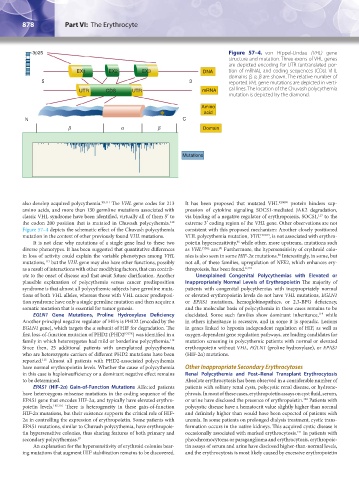
                   3p25                                                              Figure 57–4.  von Hippel-Lindau  (VHL)  gene
                                                                                     structure and mutation. Three exons of VHL genes
                                                                                     are depicted encoding for UTR (untranslated por-
                                  EX1       EX2        EX3                  DNA      tion of mRNA), and coding sequences (CDs). VHL
                                                                                     domains β, α, β are shown. The relative number of
                      5                                                3             reported VHL gene mutations are depicted in verti-
                                  UTR      CDS      UTR                     mRNA     cal lines. The location of the Chuvash polycythemia
                                                                                     mutation is depicted by the diamond.
                                                                           Amino
                                                                            acid
                N                                                    C
                               β                α            β              Domain


                                                                     Mutations


               also develop acquired polycythemia. 99,111  The VHL gene codes for 213   It has been proposed that mutated VHL R200W  protein hinders sup-
               amino acids, and more than 130 germline mutations associated with   pression of cytokine signaling SOCS1-mediated JAK2 degradation,
                                                                                                                   117
               classic VHL syndrome have been identified, virtually all of them 5′ to   via binding of a negative regulator of erythropoiesis, SOCS1,  to the
                                                                 112
               the codon 200 position that is mutated in Chuvash polycythemia.     extreme 3′ coding region of the VHL gene. Other observations are not
               Figure 57–4 depicts the schematic effect of the Chuvash polycythemia   consistent with this proposed mechanism: Another closely positioned
               mutation in the context of other previously found VHL mutations.  VHL polycythemia mutation, VHL H191D , is not associated with erythro-
                   It is not clear why mutations of a single gene lead to these two   poietin hypersensitivity,  while other, more upstream, mutations such
                                                                                       96
               diverse phenotypes. It has been suggested that quantitative differences   as VHL P138L  are.  Furthermore, the hypersensitivity of erythroid colo-
                                                                                 80
                                                                                                     86
               in loss of activity could explain the variable phenotypes among VHL   nies is also seen in some HIF-2α mutations.  Interestingly, in some, but
                       113
               mutations,  but the VHL gene may also have other functions, possibly   not all, of these families, upregulation of NFE2, which enhances ery-
               as a result of interactions with other modifying factors, that can contrib-  thropoiesis, has been found. 6,118
               ute to the onset of disease and that await future clarification. Another   Unexplained Congenital Polycythemias with Elevated or
               plausible explanation of polycythemia versus cancer predisposition   Inappropriately Normal Levels of Erythropoietin  The majority of
               syndrome is that almost all polycythemic subjects have germline muta-  patients with congenital polycythemias with inappropriately normal
               tions of both VHL alleles, whereas those with VHL cancer predisposi-  or elevated erythropoietin levels do not have VHL mutations, EGLN1
               tion syndrome have only a single germline mutation and then acquire a   or  EPAS1  mutations,  hemoglobinopathies,  or  2,3-BPG  deficiency,
               somatic mutation that is essential for tumor genesis.  and the molecular basis of polycythemia in these cases remains to be
                   EGLN1 Gene Mutations, Proline Hydroxylase Deficiency   elucidated.  Some  such  families  show  dominant  inheritance,   while
                                                                                                                   119
               Another principal negative regulator of HIFs is PHD2 (encoded by the   in others inheritance is recessive, and in some it is sporadic. Lesions
               EGLN1 gene), which targets the α subunit of HIF for degradation. The   in genes linked to hypoxia independent regulation of HIF, as well as
               first loss-of-function mutation of PHD2 (PHD2 P317R ) was identified in a   oxygen-dependent gene regulation pathways, are leading candidates for
               family in which heterozygotes had mild or borderline polycythemia.    mutation screening in polycythemic patients with normal or elevated
                                                                 114
               Since then, 25 additional patients with unexplained polycythemia   erythropoietin without VHL, EGLN1 (proline hydroxylase), or EPAS1
               who are heterozygote carriers of different PHD2 mutations have been   (HIF-2α) mutations.
               reported.  Almost all patients  with PHD2-associated polycythemia
                      115
               have normal erythropoietin levels. Whether the cause of polycythemia   Other Inappropriate Secondary Erythrocytoses
               in this case is haploinsufficiency or a dominant negative effect remains   Renal Polycythemia and Post–Renal  Transplant Erythrocytosis
               to be determined.                                      Absolute erythrocytosis has been observed in a considerable number of
                   EPAS1  (HIF-2α)  Gain-of-Function  Mutations  Affected patients   patients with solitary renal cysts, polycystic renal disease, or hydrone-
               have heterozygous missense mutations in the coding sequence of the   phrosis. In most of these cases, erythropoietin assays on cyst fluid, serum,
               EPAS1 gene that encodes HIF-2α, and typically have elevated erythro-  or urine have disclosed the presence of erythropoietin.  Patients with
                                                                                                              120
               poietin levels. 115,116  There is heterogeneity in these gain-of-function   polycystic disease have a hematocrit value slightly higher than normal
               HIF-2α mutations, but their existence supports the critical role of HIF-  and definitely higher than would have been expected of patients with
               2α in controlling the expression of erythropoietin. Some patients with   uremia. In some patients on prolonged dialysis treatment, cystic trans-
               EPAS1 mutations, similar to Chuvash polycythemia, have erythropoie-  formation occurs in the native kidneys. This acquired cystic disease is
                                                                                                            121
               tin hypersensitive colonies, thus sharing features of both primary and   occasionally associated with marked erythrocytosis.  In patients with
               secondary polycythemias. 97                            pheochromocytoma or paraganglioma and erythrocytosis, erythropoie-
                   An explanation for the hypersensitivity of erythroid colonies bear-  tin assays of serum and urine have disclosed higher-than-normal levels,
               ing mutations that augment HIF stabilization remains to be discovered.   and the erythrocytosis is most likely caused by excessive erythropoietin


          Kaushansky_chapter 57_p0871-0888.indd   878                                                                   9/18/15   9:36 AM

