


Page 921 - Williams Hematology ( PDFDrive )
P. 921
896            Part VI:  The Erythrocyte                                                                                                                                                    Chapter 58:  The Porphyrias            897


               greatest requirements for heme. The rate of heme synthesis in the liver
               is largely regulated by ALAS1 activity. The synthesis of ALAS1, in turn,
               is under feedback control by heme, which regulates ALAS1 at the lev-
               els of transcription, translation, and transfer into mitochondria. Many
               chemicals, hormones, and drugs increase the synthesis of hepatic CYPs,
               which increases the demand for heme and lead to induction of ALAS1.
               In addition, the ALAS1 gene contains upstream enhancer elements that
               are responsive to inducing chemicals and interact with the PXR. There-
               fore, ALAS1 and CYPs are subject to direct induction by xenobiotics
                              27
               and certain steroids.  Chemical exposures that induce hepatic heme
               oxygenase and accelerate the destruction of hepatic heme, or inhibit
               heme formation, can also induce hepatic ALAS1.
                   ALAS2 is not inducible in erythroid cells by drugs that induce
                                85
               ALAS1 in hepatocytes.  The synthesis of ALAS2 is uninfluenced, or
               often upregulated, by hemin, at both the transcriptional and the trans-
               lational levels. Hemin treatment of marrow cultures increases erythroid
                               86
               colony-forming units,  whereas hemin treatment of hepatocytes inhib-
               its synthesis of ALAS1 and CYPs. An additional distinct difference in
               these  ALAS isoforms is that  SCS-βA associates with ALAS2  but not
               with ALAS1, suggesting a tissue-specific difference in mitochondrial
               transport of these isoforms.


                  ERYTHROPOIETIC PORPHYRIAS
               There are two major erythropoietic porphyrias in humans. CEP is
               caused by mutations of the UROS gene. It is one of the least-common
               porphyrias, but is well known as a result of its long history and the
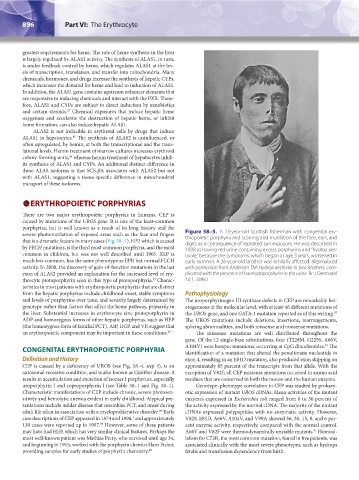
               severe photomutilation of exposed areas such as the face and fingers   Figure 58–5.  A 23-year-old Scottish fisherman with congenital ery-
               that is a dramatic feature in many cases (Fig. 58–5). EPP, which is caused   thropoietic porphyria and scarring and mutilation of the face, ears, and
                                                                      digits as a consequence of repeated sun exposure. He was described in
               by FECH mutations, is the third most common porphyria, and the most   1898 as having red urine containing excess porphyrins and “hydroa aes-
               common in children, but was not well described until 1965. XLP is   tivale,” because the symptoms, which began at age 3 years, worsened in
               much less common, has the same phenotype as EPP, but normal FECH   early summer. A 26-year-old brother was similarly affected. (Reproduced
               activity. In 2008, the discovery of gain-of-function mutations in the last   with permission from Anderson TM: Hydroa aestivale in two brothers, com-
               exon of ALAS2 provided an explanation for the increased level of ery-  plicated with the presence of haematoporphyrin in the urine. Br J Dermatol
               throcyte protoporphyrin seen in this type of protoporphyria.  Charac-  10:1, 1898.)
                                                           37
               teristics in most patients with erythropoietic porphyrias that are distinct
               from the hepatic porphyrias include childhood onset, stable symptoms   Pathophysiology
               and levels of porphyrins over time, and severity largely determined by   The uroporphyrinogen III synthase defects in CEP are remarkably het-
               genotype rather than factors that affect the heme pathway, primarily in   erogeneous at the molecular level, with at least 46 different mutations of
               the liver. Substantial increases in erythrocyte zinc protoporphyrin in   the UROS gene, and one GATA-1 mutation reported as of this writing.
                                                                                                                        87
               ADP and homozygous forms of other hepatic porphyrias, such as HEP   The  UROS  mutations  include  deletions,  insertions,  rearrangements,
               (the homozygous form of familial PCT), AIP, HCP, and VP, suggest that   splicing abnormalities, and both missense and nonsense mutations.
               an erythropoietic component may be important in these conditions. 87  The  missense  mutations  are  well  distributed  throughout  the
                                                                      gene. Of the 12 single-base substitutions, four (T228M, G225S, A66V,
                                                                                                                     91
               CONGENITAL ERYTHROPOIETIC PORPHYRIA                    A104V) were hotspot mutations, occurring at CpG dinucleotides.  The
                                                                      identification of a mutation that altered the penultimate nucleotide in
               Definition and History                                 exon 4, resulting in an E81D mutation, also produced exon skipping on
               CEP is caused by a deficiency of UROS (see Fig. 58–4, step 4), is an   approximately 85 percent of the transcripts from that allele. With the
               autosomal recessive condition, and is also known as Günther disease. It   exception of V82F, all CEP missense mutations occurred in amino acid
               results in accumulation and excretion of isomer I porphyrins, especially   residues that are conserved in both the mouse and the human enzyme.
               uroporphyrin I and coproporphyrin I (see Table  58–1 and Fig. 58–1).   Genotype–phenotype correlation in CEP was studied by prokary-
               Characteristic manifestations of CEP include chronic, severe photosen-  otic expression of mutant UROS cDNAs. Mean activities of the mutant
               sitivity and hemolytic anemia evident in early childhood. Atypical pre-  enzymes expressed in Escherichia coli ranged from 0 to 36 percent of
               sentations include milder disease that resembles PCT, and onset during   the activity expressed by the normal cDNA. The majority of the mutant
               adult life often in association with a myeloproliferative disorder.  Early   cDNAs expressed polypeptides with no enzymatic activity. However,
                                                             88
               case descriptions of CEP appeared in 1874 and 1898,  and approximately   V82F, E81D, A66V, A104V, and V99A showed 36, 30, 15, 8, and 6 per-
                                                    3
               130 cases were reported up to 1997.  However, some of these patients   cent enzyme activity, respectively, compared with the normal control.
                                         89
               may have had HEP, which has very similar clinical features. Perhaps the   A66V and V82F were thermodynamically unstable mutants.  Homoal-
                                                                                                                 91
               most well-known patient was Mathias Petry, who survived until age 34,   lelism for C73R, the most common mutation, found in five patients, was
               and beginning in 1915, worked with the porphyrin chemist Hans Fisher,   associated clinically with the most severe phenotypes, such as hydrops
               providing samples for early studies of porphyrin chemistry. 90  fetalis and transfusion dependency from birth.


          Kaushansky_chapter 58_p0889-0914.indd   896                                                                   9/18/15   5:58 PM

