


Page 923 - Williams Hematology ( PDFDrive )
P. 923
898            Part VI:  The Erythrocyte                                                                                                                                                    Chapter 58:  The Porphyrias            899


                   EPP was usually described in the past as an autosomal dominant   immunoglobulin, complement, and periodic acid-Schiff–positive
               disorder,  with  variable  penetrance.  However,  it  was  noted  that  EPP   mucopolysaccharides.  Basement membrane abnormalities are less
                                                                                      121
               patients have only 30 percent or less of normal FECH activity, rather than   marked than in other forms of porphyria. 122
               50 percent, which would be expected in an autosomal dominant condi-  Protoporphyric hepatopathy is a feared complication that develops
               tion. It was then shown that, in addition to a severe FECH mutation,   in less than 5 percent of patients, and is attributed to the cholestatic
               a low-expression (hypomorphic) intronic polymorphism (a –23C→T   effects of excess protoporphyrin presented to the liver. This complica-
               transition) is found in the other FECH allele of patients with EPP, which   tion may begin with chronic abnormalities in liver function tests and
               is inherited from the other parent. 107–109  This transition favors the use   then progress rapidly as a vicious cycle of increasing protoporphyrin
               of a cryptic acceptor splice site 63 bases upstream of the normal splice   levels in plasma and erythrocytes and worsening liver function and pho-
               site. The aberrantly spliced mRNA contains a premature stop codon and   tosensitivity. Hepatopathy is sometimes precipitated by another cause
                                                        109
               is degraded by a nonsense-mediated decay mechanism.  The result is   of liver dysfunction such as viral or alcoholic hepatitis. Protoporphyrin
               a lower steady-state level of wild-type  FECH mRNA. Coinheritance   is cholestatic, and can form crystalline structures in hepatocytes and
               of the hypomorphic allele in trans to a loss-of-function mutant allele   impair mitochondrial function, leading to decreased hepatic bile forma-
                                                   110
               was found in 98 percent of French cases with EPP,  and with a similar   tion and flow. 123,124  Accumulated protoporphyrin may appear as brown
                                          105
               frequency in South African patients.  The frequency of the IVS3–48C   pigment in hepatocytes, Kupffer cells, and biliary canaliculi, and these
               hypomorphic allele is common in the white population, and by itself has   deposits are doubly refractive with a Maltese cross appearance under
                                                                                      125
               no phenotype. Its frequency varies widely in different populations and   polarizing microscopy.  DNA microarray studies in explanted livers of
               relates to the observed differences in the prevalence of EPP. 103–105  patients with hepatopathy revealed significant changes in expression of
                   Other underlying genetic mechanisms must be considered in newly   several genes involved in wound-healing, organic anion transport, and
               identified EPP families. In a few families, a severe FECH mutation, at   oxidative stress. 126
               least one of which must produce some FECH enzyme, is inherited from
               each parent and the hypomorphic allele is not present. Interestingly,   Clinical Features
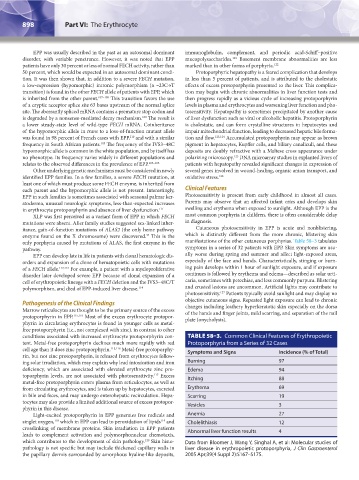
               EPP in such families is sometimes associated with seasonal palmar ker-  Photosensitivity is present from early childhood in almost all cases.
               atoderma, unusual neurologic symptoms, less-than-expected increases   Parents  may  observe  that  an  affected  infant  cries  and  develops  skin
               in erythrocyte protoporphyrin and absence of liver dysfunction. 111  swelling and erythema when exposed to sunlight. Although EPP is the
                   XLP was first perceived as a variant form of EPP in which FECH   most common porphyria in children, there is often considerable delay
               mutations were absent. After family studies suggested sex-linked inher-  in diagnosis.
               itance, gain-of-function mutations of ALAS2 (the only heme pathway   Cutaneous photosensitivity in EPP is acute and nonblistering,
               enzyme found on the X chromosome) were discovered.  This is the   which is distinctly different from the more chronic, blistering skin
                                                         37
               only porphyria caused by mutations of ALAS, the first enzyme in the   manifestations of the other cutaneous porphyrias. Table 58–3 tabulates
               pathway.                                               symptoms in a series of 32 patients with EPP. Skin symptoms are usu-
                   EPP can develop late in life in patients with clonal hematologic dis-  ally worse during spring and summer and affect light-exposed areas,
               orders and expansion of a clone of hematopoietic cells with mutations   especially of the face and hands. Characteristically, stinging or burn-
               of a FECH allele. 112,113  For example, a patient with a myeloproliferative   ing pain develops within 1 hour of sunlight exposure, and if exposure
               disorder later developed severe EPP because of clonal expansion of a   continues is followed by erythema and edema—described as solar urti-
               cell of erythropoietic lineage with a FECH deletion and the IVS3–48C/T   caria, sometimes with petechiae, and less commonly purpura. Blistering
               polymorphism, and died of EPP-induced liver disease. 114  and crusted lesions are uncommon. Artificial lights may contribute to
                                                                                  127
                                                                      photosensitivity.  Patients typically avoid sunlight and may display no
                                                                      objective cutaneous signs. Repeated light exposure can lead to chronic
               Pathogenesis of the Clinical Findings                  changes including leathery hyperkeratotic skin especially on the dorsa
               Marrow reticulocytes are thought to be the primary source of the excess   of the hands and finger joints, mild scarring, and separation of the nail
               protoporphyrin in EPP. 115,116  Most of the excess erythrocyte protopor-  plate (onycholysis).
               phyrin in circulating erythrocytes is found in younger cells as metal-
               free protoporphyrin (i.e., not complexed with zinc), in contrast to other
               conditions associated with increased erythrocyte protoporphyrin con-  TABLE 58–3.  Common Clinical Features of Erythropoietic
               tent. Metal-free protoporphyrin declines much more rapidly with red   Protoporphyria from a Series of 32 Cases
               cell age than it does zinc protoporphyrin. 115,116  Metal-free protoporphy-  Symptoms and Signs  Incidence (% of Total)
               rin, but not zinc protoporphyrin, is released from erythrocytes follow-
               ing solar irradiation, which may explain why lead intoxication and iron   Burning     97
               deficiency, which are associated with elevated erythrocyte zinc pro-  Edema           94
               toporphyrin levels, are not associated with photosensitivity.  Excess   Itching       88
                                                            117
               metal-free protoporphyrin enters plasma from reticulocytes, as well as
               from circulating erythrocytes, and is taken up by hepatocytes, excreted   Erythema    69
               in bile and feces, and may undergo enterohepatic recirculation. Hepa-  Scarring       19
               tocytes may also provide a limited additional source of excess protopor-  Vesicles    3
               phyrin in this disease.
                   Light-excited protoporphyrin in EPP generates free radicals and   Anemia          27
                                                              119
               singlet oxygen,  which in EPP can lead to peroxidation of lipids  and   Cholelithiasis  12
                          118
               crosslinking of membrane proteins. Skin irradiation in EPP patients   Abnormal liver function results  4
               leads to complement activation and polymorphonuclear chemotaxis,
               which contributes to the development of skin pathology.  Skin histo-  Data from Bloomer J, Wang Y, Singhal A, et al: Molecular studies of
                                                        120
               pathology is not specific but may include thickened capillary walls in   liver disease in erythropoietic protoporphyria,  J Clin Gastroenterol
               the papillary dermis surrounded by amorphous hyaline-like deposits,   2005 Apr;39(4 Suppl 2):S167–S175.


          Kaushansky_chapter 58_p0889-0914.indd   898                                                                   9/18/15   5:58 PM

