


Page 992 - Williams Hematology ( PDFDrive )
P. 992
966  Part VII:  Neutrophils, Eosinophils, Basophils, and Mast Cells  Chapter 63:  Basophils, Mast Cells, and Related Disorders  967


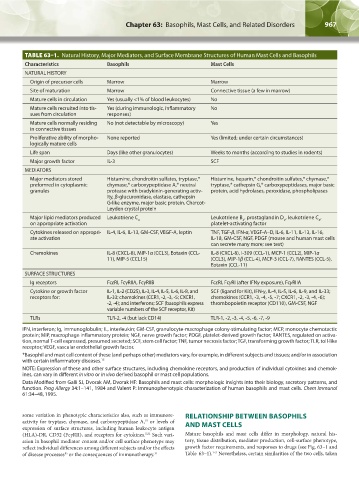
                   TABLE 63–1.  Natural History, Major Mediators, and Surface Membrane Structures of Human Mast Cells and Basophils
                   Characteristics            Basophils                          Mast Cells
                   NATURAL HISTORY
                    Origin of precursor cells  Marrow                            Marrow
                    Site of maturation        Marrow                             Connective tissue (a few in marrow)
                    Mature cells in circulation  Yes (usually <1% of blood leukocytes)  No
                    Mature cells recruited into tis-  Yes (during immunologic, inflammatory   No
                    sues from circulation     responses)
                    Mature cells normally residing   No (not detectable by microscopy)  Yes
                    in connective tissues
                    Proliferative ability of morpho-  None reported              Yes (limited; under certain circumstances)
                    logically mature cells
                    Life span                 Days (like other granulocytes)     Weeks to months (according to studies in rodents)
                    Major growth factor       IL-3                               SCF
                   MEDIATORS
                    Major mediators stored    Histamine, chondroitin sulfates, tryptase,*   Histamine, heparin,* chondroitin sulfates,* chymase,*
                    preformed in cytoplasmic   chymase,* carboxypeptidase A,* neutral   tryptase,* cathepsin G,* carboxypeptidases, major basic
                    granules                  protease with bradykinin-generating activ-  protein, acid hydrolases, peroxidase, phospholipases
                                              ity, β-glucuronidase, elastase, cathepsin
                                              G-like enzyme, major basic protein, Charcot-
                                              Leyden crystal protein
                    Major lipid mediators produced  Leukotriene C 4              Leukotriene B , prostaglandin D , leukotriene C ,
                                                                                            4
                                                                                                          2
                                                                                                                     4
                    on appropriate activation                                    platelet-activating factor
                    Cytokines released on appropri-  IL-4, IL-6, IL-13, GM-CSF, VEGF-A, leptin  TNF, TGF-β, IFN-α, VEGF-A–D, IL-6, IL-11, IL-13, IL-16,
                    ate activation                                               IL-18, GM-CSF, NGF, PDGF (mouse and human mast cells
                                                                                 can secrete many more; see text)
                    Chemokines                IL-8 (CXCL-8), MIP-1α (CCL3), Eotaxin (CCL-  IL-8 (CXCL-8), I-309 (CCL-1), MCP-1 (CCL2), MIP-1α
                                              11), MIP-5 (CCL15)                 (CCL3), MIP-1β (CCL-4), MCP-3 (CCL-7), RANTES (CCL-5),
                                                                                 Eotaxin (CCL-11)
                   SURFACE STRUCTURES
                    Ig receptors              FcεRI, FcγRIIA, FcγRIIB            FcεRI, FcγRI (after IFNγ exposure), FcγRIIA
                    Cytokine or growth factor   IL-1, IL-2 (CD25), IL-3, IL-4, IL-5, IL-6, IL-8, and   SCF (ligand for Kit), IFN-γ, IL-4, IL-5, IL-6, IL-9, and IL-33;
                    receptors for:            IL-33; chemokines (CCR1, -2, -3, -5; CXCR1,    chemokines (CCR1, -3, -4, -5, -7; CXCR1, -2, -3, -4, -6);
                                              -2, -4); and interferons; SCF (basophils express   thrombopoietin receptor (CD110), GM-CSF, NGF
                                              variable numbers of the SCF receptor, Kit)
                    TLRs                      TLR-2, -4 (but lack CD14)          TLR-1, -2, -3, -4, -5, -6, -7, -9
                  IFN, interferon; Ig, immunoglobulin; IL, interleukin; GM-CSF, granulocyte-macrophage colony-stimulating factor; MCP, monocyte chemotactic
                  protein; MIP, macrophage inflammatory protein; NGF, nerve growth factor; PDGF, platelet-derived growth factor; RANTES, regulated on activa-
                  tion, normal T-cell expressed, presumed secreted; SCF, stem cell factor; TNF, tumor necrosis factor; TGF, transforming growth factor; TLR, toll-like
                  receptor; VEGF, vascular endothelial growth factor.
                  *Basophil and mast cell content of these (and perhaps other) mediators vary, for example, in different subjects and tissues; and/or in association
                  with certain inflammatory diseases. 15
                  NOTE: Expression of these and other surface structures, including chemokine receptors, and production of individual cytokines and chemok-
                  ines, can vary in different in vitro or in vivo derived basophil or mast cell populations.
                  Data Modified from Galli SJ, Dvorak AM, Dvorak HF: Basophils and mast cells: morphologic insights into their biology, secretory patterns, and
                  function. Prog Allergy 34:1–141, 1984 and Valent P: Immunophenotypic characterization of human basophils and mast cells. Chem Immunol
                  61:34–48, 1995.


                  some variation in phenotypic characteristics also, such as immunore-  RELATIONSHIP BETWEEN BASOPHILS
                                                           15
                  activity for tryptase, chymase, and carboxypeptidase A,  or levels of   AND MAST CELLS
                  expression of  surface  structures,  including  human  leukocyte  antigen
                                                           5,31
                  (HLA)-DR, CD32 (FcγRII), and receptors for cytokines.  Such vari-  Mature basophils and mast cells differ in morphology, natural his-
                  ation in basophil mediator content and/or cell surface phenotype may   tory, tissue distribution, mediator production, cell-surface phenotype,
                  reflect individual differences among different subjects and/or the effects   growth factor requirements, and responses to drugs (see Fig. 63–1 and
                                                                                  1–5
                                15
                  of disease processes  or the consequences of immunotherapy. 31  Table  63–1).  Nevertheless, certain similarities of the two cells, taken


          Kaushansky_chapter 63_p0965-0982.indd   967                                                                   9/18/15   11:01 PM

