


Page 997 - Williams Hematology ( PDFDrive )
P. 997
972            Part VII:  Neutrophils, Eosinophils, Basophils, and Mast Cells                                                                                   Chapter 63:  Basophils, Mast Cells, and Related Disorders          973


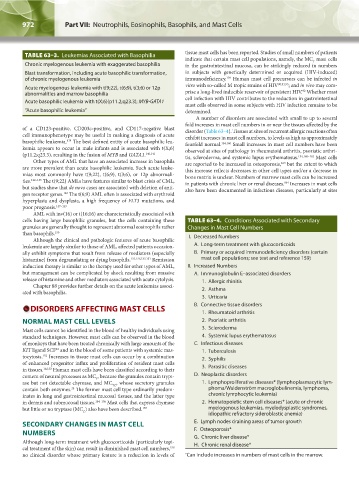
                TABLE 63–3.  Leukemias Associated with Basophilia     tissue mast cells has been reported. Studies of small numbers of patients
                                                                      indicate that certain mast cell populations, namely, the MC  mast cells
                                                                                                                 T
                Chronic myelogenous leukemia with exaggerated basophilia  in the gastrointestinal mucosa, can be strikingly reduced in numbers
                Blast transformation, including acute basophilic transformation,   in subjects with genetically determined or acquired (HIV-induced)
                                                                                    159
                of chronic myelogenous leukemia                       immunodeficiency.  Human mast cell precursors can be infected in
                Acute myelogenous leukemia with t(9;22), t(6;9), t(3;6) or 12p   vitro with so-called M tropic strains of HIV 90,91,93 ; and in vivo may com-
                                                                                                             92
                abnormalities and marrow basophilia                   prise a long-lived inducible reservoir of persistent HIV.  Whether mast
                Acute basophilic leukemia with t(X;6)(p11.2;q23.3); MYB-GATA1  cell infection with HIV contributes to the reduction in gastrointestinal
                                                                      mast cells observed in some subjects with HIV infection remains to be
                “Acute basophilic leukemia”                           determined.
                                                                          A number of disorders are associated with small to up to several
                                                                      fold increases in mast cell numbers in or near the tissues affected by the
               of a CD123-positive, CD203c-positive, and CD117-negative blast   disorder (Table 63–4). Tissues at sites of recurrent allergic reactions often
               cell immunophenotype may be useful in making a diagnosis of acute   exhibit increases in mast cell numbers, to levels as high as approximately
               basophilic leukemia.  The best defined entity of acute basophilic leu-  fourfold normal. 154,160  Small increases in mast cell numbers have been
                              139
               kemia appears to occur in male infants and is associated with t(X;6)  observed at sites of pathology in rheumatoid arthritis, psoriatic arthri-
               (p11.2;q23.3), resulting in the fusion of MYB and GATA1. 140,141  tis, scleroderma, and systemic lupus erythematosus. 154,160–162  Mast cells
                   Other types of AML that have an associated increase in basophils   are reported to be increased in osteoporosis,  but the extent to which
                                                                                                      163
               are more prevalent than acute basophilic leukemia. Such acute leuke-  this increase reflects decreases in other cell types and/or a decrease in
               mias most commonly have t(9;22), t(6;9), t(3;6), or 12p abnormali-  bone matrix is unclear. Numbers of marrow mast cells can be increased
               ties. 142–145  The t(9;22) AMLs have features similar to blast crisis of CML,   in patients with chronic liver or renal diseases.  Increases in mast cells
                                                                                                       164
               but studies show that de novo cases are associated with deletion of anti-  also have been documented in infectious diseases, particularly at sites
               gen receptor genes.  The t(6;9) AML often is associated with erythroid
                             146
               hyperplasia and dysplasia, a high frequency of  FLT3 mutations, and
               poor prognosis. 147–149
                   AML with inv(16) or t(16;16) are characteristically associated with
               cells having large basophilic granules, but the cells containing these   TABLE 63–4.  Conditions Associated with Secondary
               granules are generally thought to represent abnormal eosinophils rather   Changes in Mast Cell Numbers
               than basophils. 150
                   Although the clinical and pathologic features of acute basophilic   I.  Decreased Numbers
               leukemia are largely similar to those of AML, affected patients occasion-  A.  Long-term treatment with glucocorticoids
               ally exhibit symptoms that result from release of mediators (especially   B.   Primary or acquired immunodeficiency disorders (certain
               histamine) from degranulating or dying basophils. 125,126,132,151  Remission   mast cell populations; see text and reference 159)
               induction therapy is similar to the therapy used for other types of AML,   II.  Increased Numbers
               but management can be complicated by shock resulting from massive   A.  Immunoglobulin E–associated disorders
               release of histamine and other mediators associated with acute cytolysis.  1.  Allergic rhinitis
                   Chapter 88 provides further details on the acute leukemias associ-
               ated with basophilia.                                        2.  Asthma
                                                                            3.  Urticaria
                    DISORDERS AFFECTING MAST CELLS                       B.  Connective tissue disorders
                                                                            1.  Rheumatoid arthritis
               NORMAL MAST CELL LEVELS                                      2.  Psoriatic arthritis
               Mast cells cannot be identified in the blood of healthy individuals using   3.  Scleroderma
               standard techniques. However, mast cells can be observed in the blood   4.  Systemic lupus erythematosus
               of monkeys that have been treated chronically with large amounts of the   C.  Infectious diseases
                           22
               KIT ligand SCF  and in the blood of some patients with systemic mas-  1.  Tuberculosis
                      152
               tocytosis.  Increases in tissue mast cells can occur by a combination   2.  Syphilis
               of enhanced progenitor influx and proliferation of resident mast cells
               in tissues. 16,153  Human mast cells have been classified according to their   3.  Parasitic diseases
               content of neutral proteases as MC , because the granules contain trypt-  D.  Neoplastic disorders
                                        T
               ase but not detectable chymase, and MC , whose secretory granules   1.   Lymphoproliferative diseases* (lymphoplasmacytic lym-
                                              TC
                                29
               contain both enzymes.  The former mast cell type ordinarily predom-  phoma/Waldenström macroglobulinemia, lymphoma,
               inates in lung and gastrointestinal mucosal tissues, and the latter type   chronic lymphocytic leukemia)
               in dermis and submucosal tissues. 154–156  Mast cells that express chymase   2.   Hematopoietic stem cell diseases* (acute or chronic
               but little or no tryptase (MC ) also have been described. 157  myelogenous leukemias, myelodysplastic syndromes,
                                    C
                                                                              idiopathic refractory sideroblastic anemia)
               SECONDARY CHANGES IN MAST CELL                            E.  Lymph nodes draining areas of tumor growth
               NUMBERS                                                   F.  Osteoporosis*
                                                                         G.  Chronic liver disease*
               Although long-term treatment with glucocorticoids (particularly topi-  H.  Chronic renal disease*
                                                                 158
               cal treatment of the skin) can result in diminished mast cell numbers,
               no clinical disorder whose primary feature is a reduction in levels of   * Can include increases in numbers of mast cells in the marrow.


          Kaushansky_chapter 63_p0965-0982.indd   972                                                                   9/18/15   11:01 PM

