


Page 996 - Williams Hematology ( PDFDrive )
P. 996
970  Part VII:  Neutrophils, Eosinophils, Basophils, and Mast Cells  Chapter 63:  Basophils, Mast Cells, and Related Disorders  971


                  BASOPHILOPENIA                                        and significant drop in blood basophil levels of up to 50 percent has
                                                                                               108
                  Because numbers of blood basophils can be very low even in apparently   been documented at ovulation.  A few patients with an apparent total
                                                                                                   32,34
                  normal individuals, 8–10,102  determining whether examples of basophilope-  lack of basophils have been reported.
                  nia reflect pathologic processes as opposed to normal variation can be   A morphologic abnormality expressed in the majority of eosino-
                  difficult. Nevertheless, reduced numbers of circulating basophils have   phils and basophils but not in other leukocytes or mast cells has been
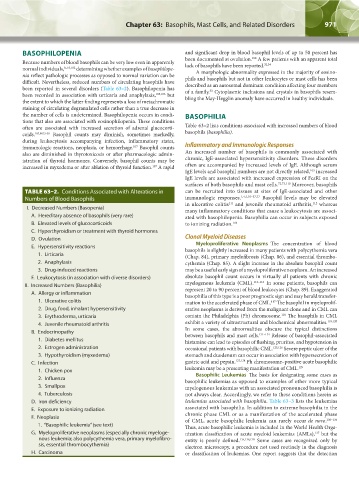
                  been reported in several disorders (Table 63–2). Basophilopenia has   described as an autosomal dominant condition affecting four members
                                                                                 33
                  been recorded in association with urticaria and anaphylaxis, 105,106  but   of a family.  Cytoplasmic inclusions and crystals in basophils resem-
                  the extent to which the latter finding represents a loss of metachromatic   bling the May-Hegglin anomaly have occurred in healthy individuals.
                  staining of circulating degranulated cells rather than a true decrease in
                  the number of cells is undetermined. Basophilopenia occurs in condi-  BASOPHILIA
                  tions that also are associated with eosinophilopenia. These conditions
                  often are associated with increased secretion of adrenal glucocorti-  Table  63–2 lists conditions associated with increased numbers of blood
                  coids. 102,107,108  Basophil counts may diminish, sometimes markedly,   basophils (basophilia).
                  during leukocytosis accompanying infection, inflammatory states,
                  immunologic reactions, neoplasia, or hemorrhage.  Basophil counts   Inflammatory and Immunologic Responses
                                                       107
                  also are diminished in thyrotoxicosis or after pharmacologic admin-  An increased number of basophils is commonly associated with
                  istration of thyroid hormones. Conversely, basophil counts may be   chronic, IgE-associated hypersensitivity disorders. These disorders
                  increased in myxedema or after ablation of thyroid function.  A rapid   often are accompanied by increased levels of IgE. Although serum
                                                             107
                                                                        IgE levels and basophil numbers are not directly related,  increased
                                                                                                                  109
                                                                        IgE levels are associated with increased expression of FcεRI on the
                                                                        surfaces of both basophils and mast cells. 72,73,110  Moreover, basophils
                   TABLE 63–2.  Conditions Associated with Alterations in   can be recruited into tissues at sites of IgE-associated and other
                   Numbers of Blood Basophils                           immunologic responses. 1,4,5,55–57,77  Basophil levels may be elevated
                                                                        in ulcerative colitis  and juvenile rheumatoid arthritis,  whereas
                                                                                                                   112
                                                                                       111
                   I.  Decreased Numbers (Basopenia)                    many inflammatory conditions that cause a leukocytosis are associ-
                     A.  Hereditary absence of basophils (very rare)    ated with basophilopenia. Basophilia can occur in subjects exposed
                     B.  Elevated levels of glucocorticoids             to ionizing radiation. 113
                     C.  Hyperthyroidism or treatment with thyroid hormones
                     D.  Ovulation                                      Clonal Myeloid Diseases
                                                                            Myeloproliferative Neoplasms  The concentration of blood
                     E.  Hypersensitivity reactions                     basophils is slightly increased in many patients with polycythemia vera
                       1.  Urticaria                                    (Chap. 84), primary myelofibrosis (Chap. 86), and essential thrombo-
                       2.  Anaphylaxis                                  cythemia (Chap. 85). A slight increase in the absolute basophil count
                       3.  Drug-induced reactions                       may be a useful early sign of a myeloproliferative neoplasm. An increased
                     F.  Leukocytosis (in association with diverse disorders)  absolute  basophil  count  occurs in  virtually  all  patients  with  chronic
                   II.  Increased Numbers (Basophilia)                  myelogenous leukemia (CML). 114–116  In some patients, basophils can
                     A.  Allergy or inflammation                        represent 20 to 90 percent of blood leukocytes (Chap. 89). Exaggerated
                                                                        basophilia of this type is a poor prognostic sign and may herald transfor-
                       1.  Ulcerative colitis                           mation to the accelerated phase of CML.  The basophil in myeloprolif-
                                                                                                     117
                       2.  Drug, food, inhalant hypersensitivity        erative neoplasms is derived from the malignant clone and in CML can
                                                                                                         118
                       3.  Erythroderma, urticaria                      contain the Philadelphia (Ph) chromosome.  The basophils in CML
                       4.  Juvenile rheumatoid arthritis                exhibit a variety of ultrastructural and biochemical abnormalities. 119,120
                     B.  Endocrinopathy                                 In some cases, the abnormalities obscure the typical distinctions
                                                                        between basophils and mast cells.
                                                                                                      Release of basophil-associated
                                                                                                 121–124
                       1.  Diabetes mellitus                            histamine can lead to episodes of flushing, pruritus, and hypotension in
                       2.  Estrogen administration                      occasional patients with basophilic CML. 125,126  Severe peptic ulcer of the
                       3.  Hypothyroidism (myxedema)                    stomach and duodenum can occur in association with hypersecretion of
                     C.  Infection                                      gastric acid and pepsin. 127,128  Ph chromosome–positive acute basophilic
                       1.  Chicken pox                                  leukemia may be a presenting manifestation of CML. 129
                                                                            Basophilic Leukemias  The basis for designating some cases as
                       2.  Influenza                                    basophilic leukemias as opposed to examples of other more typical
                       3.  Smallpox                                     myelogenous leukemias with an associated pronounced basophilia is
                       4.  Tuberculosis                                 not always clear. Accordingly, we refer to these conditions herein as
                     D.  Iron deficiency                                leukemias associated with basophilia. Table 63–3 lists the leukemias
                     E.  Exposure to ionizing radiation                 associated with basophilia. In addition to extreme basophilia in the
                     F.  Neoplasia                                      chronic phase CML or as a manifestation of the accelerated phase
                                                                        of CML, acute basophilic leukemia can rarely occur  de novo.
                                                                                                                        130–136
                       1.  “Basophilic leukemia” (see text)             Thus, acute basophilic leukemia is included in the World Health Orga-
                     G.   Myeloproliferative neoplasms (especially chronic myeloge-  nization classification of acute myeloid leukemias (AMLs),  but the
                                                                                                                    137
                       nous leukemia; also polycythemia vera, primary myelofibro-  entity is poorly defined. 135,136,138  Some cases are recognized only by
                       sis, essential thrombocythemia)                  electron microscopy, a procedure not used routinely in the diagnosis
                     H.  Carcinoma                                      or classification of leukemias. One report suggests that the detection


          Kaushansky_chapter 63_p0965-0982.indd   971                                                                   9/18/15   11:01 PM

