


Page 998 - Williams Hematology ( PDFDrive )
P. 998
972  Part VII:  Neutrophils, Eosinophils, Basophils, and Mast Cells  Chapter 63:  Basophils, Mast Cells, and Related Disorders  973


                  of infection with parasites such as Strongyloides, in which a greater than   ligand-independent activation of the KIT receptor, was first identified
                                                                                                                  177
                  fourfold increase in mast cell numbers can occur.  In such settings,   in a long-term cell line derived from a patient with MCL.  It then was
                                                       165
                  mast cell numbers return toward normal upon resolution of the infec-  detected in mononuclear cells in the blood of patients with mastocytosis
                                                                                                         178
                  tion. Finally, mast cell numbers can be increased several-fold in lymph   who had an associated hematologic disorder,  as a somatic mutation
                  nodes draining areas of tumor growth 164,166  and in subjects with stem   in lesional tissue obtained from one patient with an aggressive form of
                                                                                                                          179
                  cell diseases and lymphoproliferative diseases, including lymphoma in   mastocytosis and from a second patient with an indolent form of UP,
                  the marrow and in association with CML. 164,167–169   and in the skin, but not the marrow and blood, of an 11-month-old
                                                                        child with mastocytosis. 180
                                                                            Together these findings suggest the mutation occurs initially in a
                       DISORDERS OF MAST CELLS:                         mast cell progenitor and that, as the clone expands, it becomes detect-
                     HYPERPLASIA AND NEOPLASIA                          able in the marrow, blood, and skin lesions. The Asp816Val mutation, or
                                                                        similar 816 activating mutations that result in the substitution of pheny-
                  DEFINITION AND HISTORY                                lalanine or tyrosine for aspartate, now are believed to occur in more than
                                                                                                           181
                  A group of systemic disorders associated with significant increases in mast   90 percent of adult patients with mastocytosis.  Mutations at codon
                  cell numbers in the skin and internal organs have been brought together   816 have been identified in a subset of pediatric patients, whereas other
                  under the term mastocytosis. The first report of a primary mast cell dis-  pediatric patients exhibit  KIT mutations elsewhere, including within
                  order is attributed to Unna  who, in 1887, reported that the skin lesions   the extracellular domain. These other mutations also cause constitutive
                                     170
                  of urticaria pigmentosa (UP) 171,172  contained numerous mast cells. Ellis    activation in KIT to a varying degree. 181
                                                                   173
                  recognized the systemic nature of the disorder in 1949. In addition to the   The extent to which the presence of various KIT mutations, and the
                  systemic disorders classified as mastocytosis, localized cutaneous aggre-  anatomical distribution of the affected cells, can be used to predict prog-
                  gates of mast cells, ranging from mast cell nevi and mastocytomas in infants   nosis or disease severity in patients with mastocytosis remains under
                  and children to multiple nodules in older children, may occur. 174,175  investigation. Moreover, additional “gain-of-function” mutations of KIT
                     The clinical pattern of disease in mastocytosis and its prognosis   in human subjects with mastocytosis have been reported. For example,
                  can vary substantially among patients (see “Course and Prognosis”   a novel form of mastocytosis with a KIT mutation in the transmem-
                                                                                                          182
                  below). A consensus classification for mastocytosis has been developed   brane domain (Phe522Cys) has been described.  In a second example,
                  to address the issue and to provide guidelines regarding prognosis and   a PRKG2-PDGFRB fusion was identified in a patient presenting with
                                                                                                                    183
                  treatment (Table 63–5).  Patients with indolent disease, who compose   increased numbers of mast cells and peripheral basophilia.  The lat-
                                   176
                  the great majority of subjects with mastocytosis, can expect a normal   ter case falls within the World Health Organization category of myeloid
                  life span. Patients with systemic mastocytosis with associated clonal,   neoplasms with  PDGFRB rearrangements, rather than being catego-
                  hematologic non–mast-cell-lineage  disease  (SM-AHNMD)  have  a   rized as a subvariant of mastocytosis. Gain-of-function mutations of
                                                                                                                     184
                  prognosis determined by the associated hematologic disorder. Patients   KIT also have been reported in gastrointestinal stromal tumors.  Addi-
                  with aggressive systemic mastocytosis (ASM) generally have a 3- to   tional genetic lesions have been reported in aggressive mastocytosis and
                  5-year survival. Mast cell leukemia (MCL) is often rapidly fatal.  in  patients  with  SM-AHNMD,  including  mutations  in  JAK2,  TET2,
                                                                        NRAS, and KRAS. 185
                  ETIOLOGY AND PATHOGENESIS
                  Activating mutations in KIT, which encodes the SCF receptor, a mem-  CLINICAL FEATURES
                  ber of the type III receptor tyrosine kinase family, have been docu-  The organs most frequently involved in systemic mastocytosis are the
                  mented in patients with mastocytosis. Several lines of evidence indicate   skin, lymph nodes, liver, spleen, marrow, and gastrointestinal tract.
                  such mutations can be involved in the pathogenesis of the disease.
                  The most common of these mutations (Asp816Val), which results in   The Skin
                                                                        The usual presenting lesion of mastocytosis in the skin is UP/maculopap-
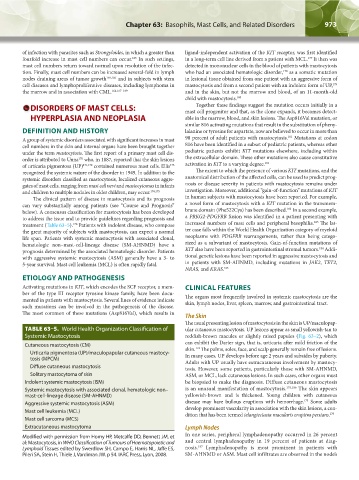
                   TABLE 63–5.  World Health Organization Classification of   ular cutaneous mastocytosis. UP lesions appear as small yellowish-tan to
                   Systemic Mastocytosis                                reddish-brown macules or slightly raised papules (Fig. 63–2), which
                   Cutaneous mastocytosis (CM)                          can exhibit the Darier sign, that is, urticaria after mild friction of the
                                                                            174
                    Urticaria pigmentosa (UP)/maculopapular cutaneous mastocy-  skin.  The palms, soles, face, and scalp generally remain free of lesions.
                                                                        In many cases, UP develops before age 2 years and subsides by puberty.
                    tosis (MPCM)                                        Adults with UP usually have extracutaneous involvement by mastocy-
                    Diffuse cutaneous mastocytosis                      tosis. However, some patients, particularly those with SM-AHNMD,
                    Solitary mastocytoma of skin                        ASM, or MCL, lack cutaneous lesions. In such cases, other organs must
                   Indolent systemic mastocytosis (ISM)                 be biopsied to make the diagnosis. Diffuse cutaneous mastocytosis
                   Systemic mastocytosis with associated clonal, hematologic non–  is an unusual manifestation of mastocytosis. 175,186  The skin appears
                   mast-cell-lineage disease (SM-AHNMD)                 yellowish-brown  and  is  thickened. Young children with cutaneous
                                                                                                                175
                   Aggressive systemic mastocytosis (ASM)               disease  may  have  bullous  eruptions  with  hemorrhage.   Some  adults
                   Mast cell leukemia (MCL)                             develop prominent vascularity in association with the skin lesions, a con-
                                                                        dition that has been termed telangiectasia macularis eruptiva perstans.
                                                                                                                         175
                   Mast cell sarcoma (MCS)
                   Extracutaneous mastocytoma                           Lymph Nodes
                  Modified with permission from Horny HP, Metcalfe DD, Bennett JM, et   In one series, peripheral lymphadenopathy occurred in 26 percent
                  al: Mastocytosis, in WHO Classification of Tumours of Haematopoietic and   and central lymphadenopathy in 19 percent of patients at diag-
                                                                             187
                  Lymphoid Tissues edited by Swerdlow SH, Campo E, Harris NL, Jaffe ES,   nosis.  Lymphadenopathy is most prominent in patients with
                  Pileri SA, Stein H, Thiele J, Vardiman JW. p 54. IARC Press, Lyon, 2008.  SM-AHNMD or ASM. Mast cell infiltrates are observed in the node’s


          Kaushansky_chapter 63_p0965-0982.indd   973                                                                   9/18/15   11:01 PM

