


Page 999 - Williams Hematology ( PDFDrive )
P. 999
974            Part VII:  Neutrophils, Eosinophils, Basophils, and Mast Cells                                                                                   Chapter 63:  Basophils, Mast Cells, and Related Disorders          975


                                                                      Spleen
                                                                      Splenic involvement at diagnosis has been reported in approximately
                                                                      half of patients with systemic disease. 187,189  Mast cells most commonly
                                                                      occurred in a paratrabecular distribution, followed by perifollicu-
                                                                      lar, follicular, and diffuse infiltrates. Trabecular and capsular fibrosis
                                                                      and eosinophilic infiltration also were observed, and extramedullary
                                                                      hematopoiesis was present in most cases. On H&E stained sections,
                                                                      the infiltrates of mast cells produced lesions that may resemble those
                                                                      of T-cell lymphoma, follicular hyperplasia, follicular lymphoma, mye-
                                                                      loproliferative neoplasms, hairy cell leukemia, or a granulomatous pro-
                                                                      cess. Splenomegaly has also been reported in the absence of infiltration
                                                                      of the spleen by mast cells.  Increased splenic weights greater than
                                                                                          190
                                                                      700 g generally occurred in patients within unfavorable categories of
                                                                      mastocytosis.
                                                                      Marrow
                                                                      The majority of adults with systemic mast cell disease have focal mast
                                                                      cell lesions in the marrow, 189,191–194  typically appearing as foci of spin-
                                                                      dle-shaped mast cells in a fibrotic background (Fig. 63–3), sometimes
                                                                      with associated eosinophils and T and B lymphocytes. These focal mast
                                                                      cell lesions are the major criterion in the diagnosis of systemic mastocy-
                                                                      tosis (Table 63–6).  Reticulin staining may be increased, and Masson
                                                                                   176
                                                                      trichome staining may reveal collagen deposition. In specimens exten-
                                                                      sively involved by mast cell lesions, the bony trabeculae may be moder-
                                                                      ately to markedly thickened. Aggressive variants of mastocytosis, such
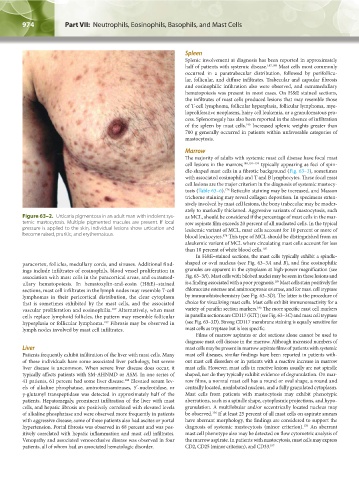
               Figure 63–2.  Urticaria pigmentosa in an adult man with indolent sys-  as MCL, should be considered if the percentage of mast cells in the mar-
               temic mastocytosis. Multiple pigmented macules are present. If local   row aspirate film exceeds 20 percent of all nucleated cells. In the typical
               pressure is applied to the skin, individual lesions show urtication and   leukemic variant of MCL, mast cells account for 10 percent or more of
               become raised, pruritic, and erythematous.             blood leukocytes.  This type of MCL should be distinguished from an
                                                                                   176
                                                                      aleukemic variant of MCL where circulating mast cells account for less
                                                                      than 10 percent of white blood cells. 195
                                                                          In H&E–stained sections, the mast cells typically exhibit a spindle-
               paracortex, follicles, medullary cords, and sinuses. Additional find-  shaped or oval nucleus (see Fig. 63–3A and B), and fine eosinophilic
               ings include infiltrates of eosinophils, blood vessel proliferation in   granules are apparent in the cytoplasm at high-power magnification (see
               association with mast cells in the paracortical areas, and extramed-  Fig. 63–3B). Mast cells with bilobed nuclei may be seen in these lesions and
                                                                                                    189
               ullary hematopoiesis. In hematoxylin-and-eosin (H&E)–stained   is a finding associated with a poor prognosis.  Mast cells stain positively for
               sections, mast cell infiltrates in the lymph nodes may resemble T-cell   chloracetate esterase and aminocaproate esterase, and for mast cell tryptase
               lymphomas in their pericortical distribution, the clear cytoplasm   by immunohistochemistry (see Fig. 63–3D). The latter is the procedure of
               that is sometimes exhibited by the mast cells, and the associated   choice for visualizing mast cells. Mast cells exhibit immunoreactivity for a
                                                                                              196
                                             187
               vascular proliferation and eosinophilia.  Alternatively, when mast   variety of paraffin section markers.  The more specific mast cell markers
               cells replace lymphoid follicles, the pattern may resemble follicular   in paraffin sections are CD117 (KIT) (see Fig. 63–3C) and mast cell tryptase
                                           187
               hyperplasia or follicular lymphoma.  Fibrosis may be observed in   (see Fig. 63–3D). Strong CD117 membrane staining is equally sensitive for
               lymph nodes involved by mast cell infiltrates.         mast cells as tryptase but is less specific.
                                                                          Films of marrow aspirates or clot sections alone cannot be used to
                                                                      diagnose mast cell disease in the marrow. Although increased numbers of
               Liver                                                  mast cells may be present in marrow aspirate films of patients with systemic
               Patients frequently exhibit infiltration of the liver with mast cells. Many   mast cell diseases, similar findings have been reported in patients with-
               of these individuals have some associated liver pathology, but severe   out mast cell disorders or in patients with a reactive increase in marrow
               liver disease is uncommon. When severe liver disease does occur, it   mast cells. However, mast cells in reactive lesions usually are not spindle
               typically affects patients with SM-AHNMD or ASM. In one series of   shaped, nor do they typically exhibit evidence of degranulation. On mar-
               41 patients, 61 percent had some liver disease.  Elevated serum lev-  row films, a normal mast cell has a round or oval shape, a round and
                                                  188
               els of alkaline phosphatase, aminotransaminases, 5′-nucleotidase, or   centrally located, nonlobated nucleus, and a fully granulated cytoplasm.
               γ-glutamyl transpeptidase was detected in approximately half of the   Mast cells from patients with mastocytosis may exhibit phenotypic
               patients. Hepatomegaly, prominent infiltration of the liver with mast   aberrations, such as a spindle shape, cytoplasmic projections, and hypo-
               cells, and hepatic fibrosis are positively correlated with elevated levels   granulation. A multilobular and/or eccentrically located nucleus may
                                                                               176
               of alkaline phosphatase and were observed more frequently in patients   be observed.  If at least 25 percent of all mast cells on aspirate smears
               with aggressive disease; some of these patients also had ascites or portal   have aberrant morphology, the findings are considered to support the
                                                                                                              176
               hypertension. Portal fibrosis was observed in 68 percent and was pos-  diagnosis of systemic  mastocytosis (minor criterion).  An aberrant
               itively correlated with hepatic inflammation and mast cell infiltrates.   mast cell phenotype also may be detected on flow cytometric analysis of
               Venopathy and associated venoocclusive disease was observed in four   the marrow aspirate. In patients with mastocytosis, mast cells may express
               patients, all of whom had an associated hematologic disorder.  CD2, CD25 (minor criterion), and CD33. 197


          Kaushansky_chapter 63_p0965-0982.indd   974                                                                   9/18/15   11:01 PM

