


Page 1102 - Clinical Immunology_ Principles and Practice ( PDFDrive )
P. 1102
1066         ParT EIGhT  Immunology of Neoplasia


           The guiding principles of the  World Health Organization   (GEP) in lymphomas has generated distinct molecular “signatures”
        (WHO) classification of neoplasms of the hematopoietic and   for a variety of disease entities, in some cases corresponding
        lymphoid tissues, published in 2001 and updated in 2008 and   more closely to different stages of lymphoid differentiation
            2
        2016,  were based on the Revised European American Classification   and  in  other  instances  offering  insights  into  mechanisms  of
        of Lymphoid Neoplasms (REAL), which was published by the   neoplastic transformation with delineation of alterations in
        International Lymphoma Study group in 1994. The focus was   specific pathways. The advent of whole-genome sequencing
        on the identification of individual diseases based on an integration   contributes additional new insights into pathogenetic mechanisms.
        of morphological, immunophenotypic, genetic, and clinical   Recently, a revision of the nearly 8-year-old WHO classification
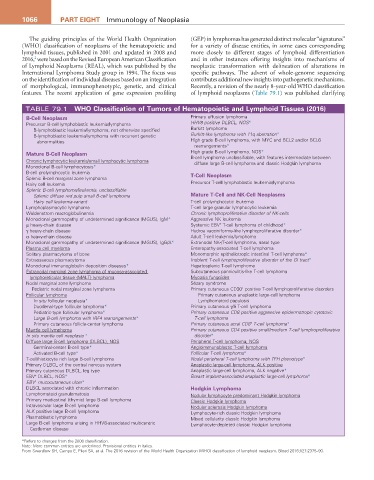
        features. The recent application of gene expression profiling   of lymphoid neoplasms (Table 79.1) was published clarifying

         TABLE 79.1  WhO Classification of Tumors of hematopoietic and Lymphoid Tissues (2016)
          B-Cell Neoplasm                                      Primary effusion lymphoma
          Precursor B-cell lymphoblastic leukemia/lymphoma     HHV8 positive DLBCL, NOS*
            B-lymphoblastic leukemia/lymphoma, not otherwise specified  Burkitt lymphoma
            B-lymphoblastic leukemia/lymphoma with recurrent genetic   Burkitt-like lymphoma with 11q aberration*
             abnormalities                                     High grade B-cell lymphoma, with MYC and BCL2 and/or BCL6
                                                                 rearrangements*
          Mature B-Cell Neoplasm                               High grade B-cell lymphoma, NOS*
                                                               B-cell lymphoma unclassifiable, with features intermediate between
          Chronic lymphocytic leukemia/small lymphocytic lymphoma  diffuse large B-cell lymphoma and classic Hodgkin lymphoma
          Monoclonal B-cell lymphocytosis*
          B-cell prolymphocytic leukemia                       T-Cell Neoplasm
          Splenic B-cell marginal zone lymphoma
          Hairy cell leukemia                                  Precursor T-cell lymphoblastic leukemia/lymphoma
          Splenic B-cell lymphoma/leukemia, unclassifiable
            Splenic diffuse red pulp small B-cell lymphoma     Mature T-Cell and NK-Cell Neoplasms
            Hairy cell leukemia-variant                        T-cell prolymphocytic leukemia
          Lymphoplasmacytic lymphoma                           T-cell large granular lymphocytic leukemia
          Waldenstrom macroglobulinemia                        Chronic lymphoproliferative disorder of NK-cells
          Monoclonal gammopathy of undetermined significance (MGUS), IgM*  Aggressive NK leukemia
                                                                         +
          µ heavy-chain disease                                Systemic EBV  T-cell lymphoma of childhood*
          γ heavy-chain disease                                Hydroa vacciniforme-like lymphoproliferative disorder*
          α heavy-chain disease                                Adult T-cell leukemia/lymphoma
          Monoclonal gammopathy of undetermined significance (MGUS), IgG/A*  Extranodal NK-/T-cell lymphoma, nasal type
          Plasma cell myeloma                                  Enteropathy-associated T-cell lymphoma
          Solitary plasmacytoma of bone                        Monomorphic epitheliotropic intestinal T-cell lymphoma*
          Extraosseous plasmacytoma                            Indolent T-cell lymphoproliferative disorder of the GI tract*
          Monoclonal immunoglobulin deposition diseases*       Hepatosplenic T-cell lymphoma
          Extranodal marginal zone lymphoma of mucosa-associated   Subcutaneous panniculitis-like T-cell lymphoma
           lymphoreticular tissue (MALT) lymphoma              Mycosis fungoides
          Nodal marginal zone lymphoma                         Sézary syndrome
                                                                                +
           Pediatric nodal marginal zone lymphoma              Primary cutaneous CD30  positive T-cell lymphoproliferative disorders
          Follicular lymphoma                                     Primary cutaneous anaplastic large-cell lymphoma
            In situ follicular neoplasia*                         Lymphomatoid papulosis
            Duodenal-type follicular lymphoma*                 Primary cutaneous γ/δ T-cell lymphoma
            Pediatric-type follicular lymphoma*                Primary cutaneous CD8 positive aggressive epidermotropic cytotoxic
            Large B-cell lymphoma with IRF4 rearrangements*      T-cell lymphoma
                                                                                   +
            Primary cutaneous follicle-center lymphoma         Primary cutaneous acral CD8  T-cell lymphoma*
          Mantle cell lymphoma                                 Primary cutaneous CD4 positive small/medium T-cell lymphoproliferative
          In situ mantle cell neoplasia *                        disorder*
          Diffuse large B-cell lymphoma (DLBCL), NOS           Peripheral T-cell lymphoma, NOS
            Germinal-center B-cell type*                       Angioimmunoblastic T-cell lymphoma
            Activated B-cell type*                             Follicular T-cell lymphoma*
          T-cell/histiocyte rich large B-cell lymphoma         Nodal peripheral T-cell lymphoma with TFH phenotype*
          Primary DLBCL of the central nervous system          Anaplastic large-cell lymphoma, ALK positive
          Primary cutaneous DLBCL, leg type                    Anaplastic large-cell lymphoma, ALK negative*
          EBV  DLBCL, NOS*                                     Breast implant-associated anaplastic large-cell lymphoma*
            +
            +
          EBV  mucocutaneous ulcer*
          DLBCL associated with chronic inflammation           hodgkin Lymphoma
          Lymphomatoid granulomatosis                          Nodular lymphocyte predominant Hodgkin lymphoma
          Primary mediastinal (thymic) large B-cell lymphoma   Classic Hodgkin lymphoma
          Intravascular large B-cell lymphoma                  Nodular sclerosis Hodgkin lymphoma
          ALK positive large B-cell lymphoma                   Lymphocyte-rich classic Hodgkin lymphoma
          Plasmablastic lymphoma                               Mixed cellularity classic Hodgkin lymphoma
          Large B-cell lymphoma arising in HHV8-associated multicentric   Lymphocyte-depleted classic Hodgkin lymphoma
           Castleman disease
        *Refers to changes from the 2008 classification.
        Note: More common entities are underlined. Provisional entities in italics.
        From Swerdlow SH, Campo E, Pileri SA, et al. The 2016 revision of the World Health Organization (WHO) classification of lymphoid neoplasm. Blood 2016;127:2375–90.

