


Page 1106 - Clinical Immunology_ Principles and Practice ( PDFDrive )
P. 1106
1070         ParT EIGhT  Immunology of Neoplasia


           Histologically, the spleen shows expansion of the white pulp   In terms of morphology and phenotype, DLBCL is one of
        with a characteristic biphasic pattern—central zone of small   the most heterogeneous categories in the WHO classification;
        lymphocytes surrounded by a peripheral zone of larger cells   currently, several morphological variants as well as specific
                                                                                    2
        resembling marginal zone cells. The residual polytypic mantle   subtypes are recognized.  There has been a great interest in
        is not present in this instance. The abundant pale cytoplasm   identifying DLBCL features that might be prognostically relevant.
        evident in tissue sections may also be seen in peripheral blood   To address issues traditionally not resolved by morphological
        smears, and the cytological features may be mistaken for those   or immunophenotypic features, DLBCL was among the first
        of hairy-cell leukemia. The phenotype resembles other marginal   lymphomas  to  be  analyzed  by  complementary  DNA  (cDNA)
        zone B-cell lymphomas with a more frequent sIgD expression.  microarray. Based on the differential expression of a large set of
           Deletion of 7q31 has been described in SMZL; although it   genes by GEP,  germinal-center B cell–like (GCB) group and
                                                                                                              22
        can also be seen in isolated cases of splenic B-cell lymphoma or   activated B cell–like (ABC) group have been identified,  in
        leukemia unclassifiable, it has not been detected in other splenic   addition to the previously recognized primary mediastinal (thymic)
                  21
        lymphomas.  Studies of the Ig variable genes and IgD expression   large B-cell lymphoma (PMBCL). GCB DLBCLs express a set of
        have revealed two groups of naïve and memory B-cell origin.  genes that are associated with normal germinal-center B cells,
                                                               whereas ABC DLBCLs show downregulation of these genes and
            CLINICaL PEarLS                                    share similarities with post–germinal-center B cells.
                                                                  The t(14;18) translocation involving BCL2 and immunoglobu-
         Aggressive Lymphomas                                  lin heavy-chain gene has been detected in the GCB subtype, but
                                                               not in the other subtypes. Previous studies have shown reduced
          •  Natural history: survival measured in months.     disease-free survival in DLBCL cases with BCL2 overexpression,
          •  Successful therapy can be achieved with combination chemotherapy.
          •  Relapses from chemotherapy-induced remission may be cured with   irrespective of the translocation. Although no absolute correlation
           high-dose chemotherapy with hematopoietic support.  between morphology and GEP has been established, interestingly,
          •  In addition to the International Prognostic Index (IPI), gene expression   the majority of DLBCLs with centroblastic morphology falls
           profiling can be useful in predicting prognosis and survival of individual   into the GCB subtype, whereas those with immunoblastic
           patients.                                           morphology usually correlate with the ABC subtype.
                                                                  DLBCL has an aggressive natural history but generally responds
                                                               well to chemotherapy. The complete remission rate with modern
        Diffuse Large B-Cell Lymphoma, Not                     regimens is 75–80%. Currently, with R-CHOP (rituximab–
        Otherwise Specified                                    cyclophosphamide,  doxorubicin,  vincristine, and  prednisone)
        Diffuse large B-cell lymphoma, not otherwise specified (DLBCL,   regimen, the 10-year progression-free and overall survival rates
        NOS) is one of the more common subtypes of non-HL, represent-  for older patients with advanced-stage DLBCL are 36.5% and
        ing up to 40% of cases. This diagnosis is used for both primary   43.5%, respectively. 23
        DLBCL as well as for cases that transformed from a low-grade   Immunophenotype-based algorithms using CD10/BCL6
        lymphoma. It may be nodal or involve extranodal sites, including   positivity for GCB and MUM1/IRF4 expression for the
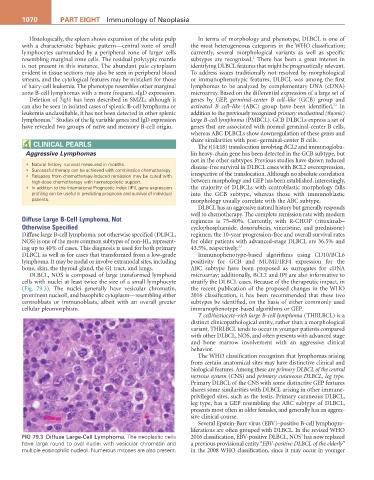
        bone, skin, the thyroid gland, the GI tract, and lungs.  ABC subtype have been proposed as surrogates for cDNA
           DLBCL, NOS is composed of large transformed lymphoid   microarray; additionally, BCL2 and IPI are also informative to
        cells with nuclei at least twice the size of a small lymphocyte   stratify the DLBCL cases. Because of the therapeutic impact, in
        (Fig. 79.3). The nuclei generally have vesicular chromatin,   the recent publication of the proposed changes in the WHO
        prominent nucleoli, and basophilic cytoplasm—resembling either   2016 classification, it has been recommended that these two
        centroblasts or immunoblasts, albeit with an overall greater   subtypes be identified, on the basis of either commonly used
        cellular pleomorphism.                                 immunophenotype-based algorithms or GEP.
                                                                  T cell/histiocyte–rich large B-cell lymphoma (THRLBCL) is a
                                                               distinct clinicopathological entity, rather than a morphological
                                                               variant. THRLBCL tends to occur in younger patients compared
                                                               with other DLBCL, NOS, and often presents with advanced stage
                                                               and bone marrow involvement with an aggressive clinical
                                                               behavior.
                                                                  The WHO classification recognizes that lymphomas arising
                                                               from certain anatomical sites may have distinctive clinical and
                                                               biological features. Among these are primary DLBCL of the central
                                                               nervous system (CNS) and primary cutaneous DLBCL, leg type.
                                                               Primary DLBCL of the CNS with some distinctive GEP features
                                                               shares some similarities with DLBCL arising in other immune-
                                                               privileged sites, such as the testis. Primary cutaneous DLBCL,
                                                               leg type, has a GEP resembling the ABC subtype of DLBCL,
                                                               presents most often in older females, and generally has an aggres-
                                                               sive clinical course.
                                                                  Several Epstein-Barr virus (EBV)–positive B-cell lymphopro-
                                                               liferations are often grouped with DLBCL. In the revised WHO
                                                                                                   3
        FIG 79.3  Diffuse Large-Cell Lymphoma. The neoplastic cells   2016 classification, EBV-positive DLBCL, NOS  has now replaced
        have large round to oval nuclei with vesicular chromatin and   a previous provisional entity “EBV-positive DLBCL of the elderly”
        multiple eosinophilic nucleoli. Numerous mitoses are also present.   in the 2008 WHO classification, since it may occur in younger

