


Page 1101 - Clinical Immunology_ Principles and Practice ( PDFDrive )
P. 1101
79


                                                                                             Lymphomas


                                                                Stefania Pittaluga, Tapan Bhavsar, Elaine S. Jaffe


           The classification of malignant lymphomas continues to undergo    KEY CONCEPTS
           revision  based on  insights  gained  through  the  application of   Lymphoma
           immunological and molecular techniques and the application of
           these discoveries to individualized therapeutic approaches. Early   •  Classification consists of a list of individual disease entities defined
           classifications were based on morphological characteristics of the   by morphological, immunophenotypic, genetic, and clinical features.
           neoplastic elements; however, with increasing knowledge of the   •  Neoplastic cells are related to the postulated normal counterpart,
           complexity of the immune system, a more functional approach was   when possible.
           sought. Differentiation schemes provided a useful starting point for   •  Histological grade should be applied within individual diseases.
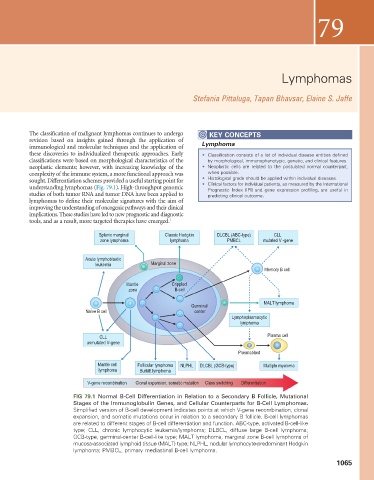
           understanding lymphomas (Fig. 79.1). High-throughput genomic   •  Clinical factors for individual patients, as measured by the International
                                                                     Prognostic Index (IPI) and gene expression profiling, are useful in
           studies of both tumor RNA and tumor DNA have been applied to   predicting clinical outcome.
           lymphomas to define their molecular signatures with the aim of
           improving the understanding of oncogenic pathways and their clinical
           implications. These studies have led to new prognostic and diagnostic
           tools, and as a result, more targeted therapies have emerged. 1

                                 Splenic marginal      Classic Hodgkin  DLCBL (ABC-type)   CLL
                                  zone lymphoma          lymphoma          PMBCL       mutated V -gene


                             Acute lymphoblastic
                                leukemia          Marginal zone
                                                                                        Memory B cell

                                          Mantle         Crippled
                                           zone           B-cell

                                                                                       MALT lymphoma
                                                                Germinal
                             NaÏve B cell                        center
                                                                             Lymphoplasmacytic
                                                                                lymphoma

                                  CLL                                                    Plasma cell
                             unmutated V-gene
                                                                               Plasmablast

                                 Mantle cell   Follicular lymphoma  NLPHL  DLCBL (GCB-type)  Multiple myeloma
                                 lymphoma      Burkitt lymphoma

                              V-gene recombination  Clonal expansion, somatic mutation  Class switching  Differentiation
                         FIG  79.1  Normal  B-Cell  Differentiation  in  Relation  to  a Secondary B  Follicle,  Mutational
                         Stages of the Immunoglobulin Genes, and Cellular Counterparts for B-Cell Lymphomas.
                         Simplified version of B-cell development indicates points at which V-gene recombination, clonal
                         expansion, and somatic mutations occur in relation to a secondary B follicle. B-cell lymphomas
                         are related to different stages of B-cell differentiation and function. ABC-type, activated B-cell-like
                         type; CLL, chronic lymphocytic leukemia/lymphoma; DLBCL, diffuse large B-cell lymphoma;
                         GCB-type, germinal-center B-cell-like type; MALT lymphoma, marginal zone B-cell lymphoma of
                         mucosa-associated lymphoid tissue (MALT) type; NLPHL, nodular lymphocyte-predominant Hodgkin
                         lymphoma; PMBCL, primary mediastinal B-cell lymphoma.

                                                                                                               1065

