


Page 1105 - Clinical Immunology_ Principles and Practice ( PDFDrive )
P. 1105
ChaPTEr 79  Lymphomas               1069


           This entity usually presents with low clinical stage and large or   (q32;q21), t(3;14)(q27;q32), and t(3;14)(p14.1;q32); these
           localized inguinal tumors. 17                          abnormalities are observed with variable frequency, often depend-
                                                                                       19
             FL is indolent but is still incurable with available therapeutic   ing on the anatomical site.  Although several genes are involved
           modalities. The occurrence of  BCL2 translocation at a very    in these translocations, at least three of them—t(11;18), t(1;14),
           early stage of B-cell development  might be contributory     and t(14;18)—share a common pathway, leading to the activation
                                                                                                20
           to the difficulty of eradicating the neoplastic clone with chemo-  of NFκB and its downstream targets.  By genome-wide DNA
           therapy. Clinical parameters have been used to develop prognostic   profiling integrated with GEP, differences were detected among
           indexes (e.g., the Follicular Lymphoma International Prognostic   the three main types of marginal zone lymphomas, lending
           Index, adjusted from the International Prognostic Index for   support to the current WHO classification that separates these
                                                                            18
           aggressive B-cell lymphoma). Recently, much has also been learned   three entities.  The translocation t(11;18)(q21;q21) is associated
           about the mutational landscape of FL. Mutations in CREBBP,   exclusively with low-grade extranodal MALT and is not detected
           MLL2, and  EZH2 have been shown as extremely common    in cases with concurrent low-grade and high-grade tumors, or
                                                        18
           early events and may be potential therapeutic targets.  The    in primary extranodal large-cell lymphomas—raising doubts
           natural history of the disease is associated with histological     whether these primary extranodal lymphomas are, in fact, related
           progression at both cellular composition and overall pattern    to low-grade MALT. The term extranodal marginal zone lymphoma
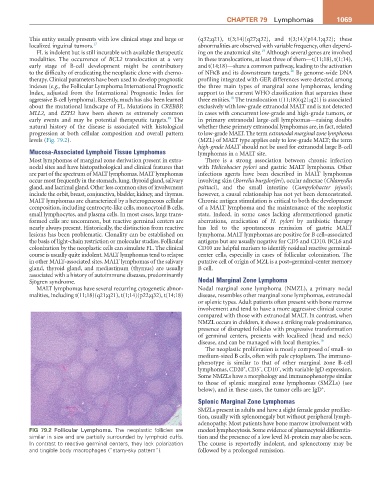
           levels (Fig. 79.2).                                    (MZL) of MALT type applies only to low-grade MALT; the term
                                                                  high-grade MALT should not be used for extranodal large B-cell
           Mucosa-Associated Lymphoid Tissue Lymphomas            lymphomas in a MALT site.
           Most lymphomas of marginal zone derivation present in extra-  There is a strong association between chronic infection
           nodal sites and have histopathological and clinical features that   with  Helicobacter pylori and gastric MALT lymphoma. Other
           are part of the spectrum of MALT lymphomas. MALT lymphomas   infectious agents have been described in MALT lymphomas
           occur most frequently in the stomach, lung, thyroid gland, salivary   involving skin (Borrelia burgdorferi), ocular adnexae (Chlamydia
           gland, and lacrimal gland. Other less common sites of involvement   psittaci), and the small intestine (Campylobacter jejuni);
           include the orbit, breast, conjunctiva, bladder, kidney, and thymus.   however, a causal relationship has not yet been demonstrated.
           MALT lymphomas are characterized by a heterogeneous cellular   Chronic antigen stimulation is critical to both the development
           composition, including centrocyte-like cells, monocytoid B cells,   of a MALT lymphoma and the maintenance of the neoplastic
           small lymphocytes, and plasma cells. In most cases, large trans-  state. Indeed, in some cases lacking aforementioned genetic
           formed cells are uncommon, but reactive germinal centers are   aberrations, eradication of  H. pylori by antibiotic therapy
           nearly always present. Historically, the distinction from reactive   has led to the spontaneous remission of gastric MALT
           lesions has been problematic. Clonality can be established on   lymphoma. MALT lymphomas are positive for B cell–associated
           the basis of light-chain restriction or molecular studies. Follicular   antigens but are usually negative for CD5 and CD10. BCL6 and
           colonization by the neoplastic cells can simulate FL. The clinical   CD10 are helpful markers to identify residual reactive germinal-
           course is usually quite indolent. MALT lymphomas tend to relapse   center cells, especially in cases of follicular colonization. The
           in other MALT-associated sites. MALT lymphomas of the salivary   putative cell of origin of MZL is a post–germinal-center memory
           gland, thyroid gland, and mediastinum (thymus) are usually   B cell.
           associated with a history of autoimmune diseases, predominantly
           Sjögren syndrome.                                      Nodal Marginal Zone Lymphoma
             MALT lymphomas have several recurring cytogenetic abnor-  Nodal marginal zone lymphoma (NMZL), a primary nodal
           malities, including t(11;18)(q21;q21), t(1;14)(p22;q32), t(14;18)  disease, resembles other marginal zone lymphomas, extranodal
                                                                  or splenic types. Adult patients often present with bone marrow
                                                                  involvement and tend to have a more aggressive clinical course
                                                                  compared with those with extranodal MALT. In contrast, when
                                                                  NMZL occurs in children, it shows a striking male predominance,
                                                                  presence of disrupted follicles with progressive transformation
                                                                  of  germinal  centers, presents with  localized (head and  neck)
                                                                  disease, and can be managed with local therapies. 19
                                                                    The neoplastic proliferation is mostly composed of small- to
                                                                  medium-sized B cells, often with pale cytoplasm. The immuno-
                                                                  phenotype is similar to that of other marginal zone B-cell
                                                                                      −
                                                                                            −
                                                                                 +
                                                                  lymphomas, CD20 , CD5 , CD10 , with variable IgD expression.
                                                                  Some NMZLs have a morphology and immunophenotype similar
                                                                  to those of splenic marginal zone lymphomas (SMZLs) (see
                                                                                                          +
                                                                  below), and in these cases, the tumor cells are IgD .
                                                                  Splenic Marginal Zone Lymphomas
                                                                  SMZLs present in adults and have a slight female gender predilec-
                                                                  tion, usually with splenomegaly but without peripheral lymph-
                                                                  adenopathy. Most patients have bone marrow involvement with
           FIG 79.2  Follicular Lymphoma. The neoplastic follicles are   modest lymphocytosis. Some evidence of plasmacytoid differentia-
           similar in size and are partially surrounded by lymphoid cuffs.   tion and the presence of a low level M-protein may also be seen.
           In contrast to reactive germinal centers, they lack polarization   The  course  is  reportedly  indolent,  and  splenectomy  may be
           and tingible body macrophages (“starry-sky pattern”).   followed by a prolonged remission.

