


Page 1143 - Clinical Immunology_ Principles and Practice ( PDFDrive )
P. 1143
CHaPter 81  Concepts and Challenges in Organ Transplantation                1109


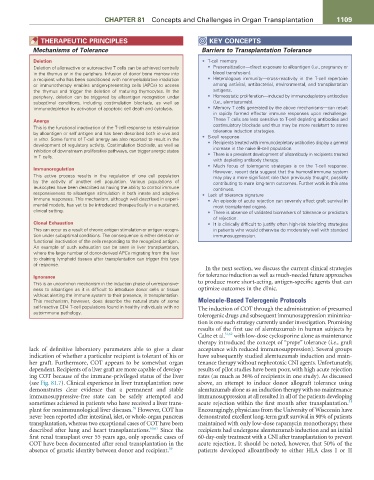
               tHeraPeUtiC PriNCiPLeS                                 KeY CONCePtS
            Mechanisms of Tolerance                                Barriers to Transplantation Tolerance

            Deletion                                               •  T-cell memory
            Deletion of alloreactive or autoreactive T cells can be achieved centrally   •  Presensitization—direct exposure to alloantigen (i.e., pregnancy or
            in the thymus or in the periphery. Infusion of donor bone marrow into   blood transfusion).
            a recipient who has been conditioned with nonmyeloablative irradiation   •  Heterologous  immunity—cross-reactivity in  the  T-cell  repertoire
            or immunotherapy enables antigen-presenting cells (APCs) to access   among antiviral, antibacterial, environmental, and transplantation
            the thymus and trigger the deletion of maturing thymocytes. In the   antigens.
            periphery, deletion can be triggered by alloantigen recognition under   •  Homeostatic proliferation—induced by immunodepletory antibodies
            suboptimal conditions, including costimulation blockade, as well as   (i.e., alemtuzumab).
            immunodepletion by activation of apoptotic cell death and cytolysis.  •  Memory T cells generated by the above mechanisms—can result
                                                                       in rapidly formed effector immune responses upon rechallenge.
            anergy                                                     These T cells are less sensitive to T-cell depleting antibodies and
            This is the functional inactivation of the T-cell response to restimulation   costimulatory blockade and thus may be more resistant to some
                                                                       tolerance induction strategies.
            by alloantigen or self antigen and has been described both in vivo and   •  B-cell response
            in vitro. Some forms of T-cell anergy are also reported to result in the
            development of regulatory activity. Costimulation blockade, as well as   •  Recipients treated with immunodepletory antibodies display a general
                                                                       increase in the naïve B-cell population.
            inhibition of downstream proliferative pathways, can trigger anergic states
            in T cells.                                              •  There is a prevalent development of alloantibody in recipients treated
                                                                       with depleting antibody therapy.
                                                                     •  Much focus of tolerogenic strategies is on the T-cell response.
            immunoregulation                                           However, recent data suggest that the humoral immune system
            This  active  process  results  in  the  regulation  of  one  cell  population    may play a more significant role than previously thought, possibly
            by the activity of another cell population. Various populations of     contributing to more long-term outcomes. Further work in this area
            leukocytes have been described as having the ability to control immune   continues.
            responsiveness to alloantigen stimulation in both innate and adaptive   •  Lack of tolerance signature
            immune responses. This mechanism, although well described in experi-  •  An episode of acute rejection can severely affect graft survival in
            mental models, has yet to be introduced therapeutically in a sustained,   most transplanted organs.
            clinical setting.                                        •  There is absence of validated biomarkers of tolerance or predictors
                                                                       of rejection.
            Clonal exhaustion                                        •  It is clinically difficult to justify often high-risk tolerizing strategies
            This can occur as a result of chronic antigen stimulation or antigen recogni-  in patients who would otherwise do moderately well with standard
            tion under suboptimal conditions. The consequence is either deletion or   immunosuppression.
            functional inactivation of the cells responding to the recognized antigen.
            An  example  of  such  exhaustion  can  be  seen  in  liver  transplantation,
            where the large number of donor-derived APCs migrating from the liver
            to draining lymphoid tissues after transplantation can trigger this type
            of response.
                                                                    In the next section, we discuss the current clinical strategies
            ignorance                                             for tolerance induction as well as much-needed future approaches
            This is an uncommon mechanism in the induction phase of unresponsive-  to produce more short-acting, antigen-specific agents that can
            ness to alloantigen as it is difficult to introduce donor cells or tissue   optimize outcomes in the clinic.
            without alerting the immune system to their presence, in transplantation.
            This mechanism, however, does describe the natural state of some   Molecule-Based Tolerogenic Protocols
            self-reactive CD4 T-cell populations found in healthy individuals with no   The induction of COT through the administration of presumed
            autoimmune pathology.
                                                                  tolerogenic drugs and subsequent immunosuppression minimiza-
                                                                  tion is one such strategy currently under investigation. Promising
                                                                  results of the first use of alemtuzumab in human subjects by
                                                                  Calne et al. 31,62  with low-dose cyclosporine alone as maintenance
                                                                  therapy introduced the concept of “prope” tolerance (i.e., graft
           lack of definitive laboratory parameters able to give a clear   acceptance with reduced immunosuppression). Several groups
           indication of whether a particular recipient is tolerant of his or   have subsequently studied alemtuzumab induction and main-
           her  graft. Furthermore, COT appears to  be  somewhat  organ   tenance therapy without nephrotoxic CNI agents. Unfortunately,
           dependent. Recipients of a liver graft are more capable of develop-  results of pilot studies have been poor, with high acute rejection
           ing COT because of the immune-privileged status of the liver   rates (as much as 36% of recipients in one study). As discussed
           (see Fig. 81.7). Clinical experience in liver transplantation now   above, an attempt to induce donor allograft tolerance using
           demonstrates clear  evidence that a permanent and stable   alemtuzumab alone as an induction therapy with no maintenance
           immunosuppressive-free state can be safely attempted and   immunosuppression at all resulted in all of the patients developing
                                                                                                                   31
           sometimes achieved in patients who have received a liver trans-  acute rejection within the first month after transplantation.
                                            59
           plant for nonimmunological liver diseases.  However, COT has   Encouragingly, physicians from the University of Wisconsin have
           never been reported after intestinal, islet, or whole-organ pancreas   demonstrated excellent long-term graft survival in 90% of patients
           transplantation, whereas two exceptional cases of COT have been   maintained with only low-dose rapamycin monotherapy; these
           described after lung and heart transplantations. 60,61  Since the   recipients had undergone alemtuzumab induction and an initial
           first renal transplant over 55 years ago, only sporadic cases of   60-day-only treatment with a CNI after transplantation to prevent
           COT have been documented after renal transplantation in the   acute rejection. It should be noted, however, that 50% of the
           absence of genetic identity between donor and recipient. 59  patients developed alloantibody to either HLA class I or II

