


Page 1171 - Clinical Immunology_ Principles and Practice ( PDFDrive )
P. 1171
CHAPTER 83  Hematopoietic Stem Cell Transplantation for Malignant Diseases                1135


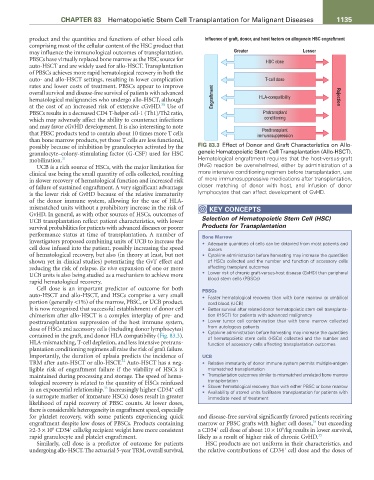
           product and the quantities and functions of other blood cells   Influence of graft, donor, and host factors on allogeneic HSC engraftment
           comprising most of the cellular content of the HSC product that
           may influence the immunological outcomes of transplantation.       Greater               Lesser
           PBSCs have virtually replaced bone marrow as the HSC source for              HSC dose
           auto-HSCT and are widely used for allo-HSCT. Transplantation
           of PBSCs achieves more rapid hematological recovery in both the
           auto- and allo-HSCT settings, resulting in lower complication                T-cell dose
           rates and lower costs of treatment. PBSCs appear to improve
           overall survival and disease-free survival of patients with advanced
           hematological malignancies who undergo allo-HSCT, although   Engraftment   HLA-compatibility        Rejection
                                                      30
           at the cost of an increased risk of extensive cGvHD.  Use of
           PBSCs results in a decreased CD4 T-helper cell-1 (Th1)/Th2 ratio,           Pretransplant
           which may adversely affect the ability to counteract infections             conditioning
           and may favor cGvHD development. It is also interesting to note             Posttransplant
           that PBSC products tend to contain about 10 times more T cells            immunosuppression
           than bone marrow products, yet those T cells are less functional,
           possibly because of inhibition by granulocytes activated by the   FIG 83.3  Effect of Donor and Graft Characteristics on Allo-
           granulocyte–colony-stimulating factor (G-CSF) used for HSC   geneic Hematopoietic Stem Cell Transplantation (Allo-HSCT).
           mobilization. 31                                       Hematological engraftment requires that the host-versus-graft
             UCB is a rich source of HSCs, with the major limitation for   (HvG) reaction be overwhelmed, either by administration of a
           clinical use being the small quantity of cells collected, resulting   more intensive conditioning regimen before transplantation, use
           in slower recovery of hematological function and increased risk   of more immunosuppressive medications after transplantation,
           of failure of sustained engraftment. A very significant advantage   closer matching of donor with host, and infusion of donor
           is the lower risk of GvHD because of the relative immaturity    lymphocytes that can affect development of GvHD.
           of the donor immune system, allowing for the use of HLA-
           mismatched units without a prohibitory increase in the risk of    KEY CONCEPTS
           GvHD. In general, as with other sources of HSCs, outcomes of
           UCB transplantation reflect patient characteristics, with lower   Selection of Hematopoietic Stem Cell (HSC)
           survival probabilities for patients with advanced diseases or poorer   Products for Transplantation
           performance status at time of transplantation.  A number of   Bone Marrow
           investigators proposed combining units of UCB to increase the   •  Adequate quantities of cells can be obtained from most patients and
           cell dose infused into the patient, possibly increasing the speed   donors
           of hematological recovery, but also (in theory at least, but not   •  Cytokine administration before harvesting may increase the quantities
           shown yet in clinical studies) potentiating the GvT effect and   of HSCs collected and the number and function of accessory cells
           reducing the risk of relapse. Ex vivo expansion of one or more   affecting transplant outcomes
           UCB units is also being studied as a mechanism to achieve more   •  Lower risk of chronic graft-versus-host disease (GvHD) than peripheral
           rapid hematological recovery.                             blood stem cells (PBSCs)
             Cell dose  is an important predictor of outcome  for both   PBSCs
           auto-HSCT and allo-HSCT, and HSCs comprise a very small   •  Faster hematological recovery than with bone marrow or umbilical
           portion (generally <1%) of the marrow, PBSC, or UCB product.   cord blood (UCB)
           It is now recognized that successful establishment of donor cell   •  Better survival after related-donor hematopoietic stem cell transplanta-
           chimerism after allo-HSCT is a complex interplay of pre- and   tion (HSCT) for patients with advanced malignancy
           posttransplantation suppression of the host immune system,   •  Lower tumor cell contamination than with bone marrow collected
           dose of HSCs and accessory cells (including donor lymphocytes)   from autologous patients
           contained in the graft, and donor HLA compatibility (Fig. 83.3).   •  Cytokine administration before harvesting may increase the quantities
                                                                     of hematopoietic stem cells (HSCs) collected and the number and
           HLA-mismatching, T-cell depletion, and less intensive pretrans-  function of accessory cells affecting transplantation outcomes
           plantation conditioning regimens all raise the risk of graft failure.
           Importantly, the duration of aplasia predicts the incidence of   UCB
                                         32
           TRM after auto-HSCT or allo-HSCT.  Auto-HSCT has a neg-  •  Relative immaturity of donor immune system permits multiple-antigen
           ligible risk of engraftment failure if the viability of HSCs is   mismatched transplantation
           maintained during processing and storage. The speed of hema-  •  Transplantation outcomes similar to mismatched unrelated bone marrow
           tological recovery is related to the quantity of HSCs reinfused   transplantation
                                                         +
                                   33
           in an exponential relationship.  Increasingly higher CD34  cell   •  Slower hematological recovery than with either PBSC or bone marrow
                                                                   •  Availability of stored units facilitates transplantation for patients with
           (a surrogate marker of immature HSCs) doses result in greater   immediate need of treatment
           likelihood of rapid recovery of PBSC counts. At lower doses,
           there is considerable heterogeneity in engraftment speed, especially
           for platelet recovery, with  some patients experiencing  quick   and disease-free survival significantly favored patients receiving
                                                                                                       34
           engraftment despite low doses of PBSCs. Products containing   marrow or PBSC grafts with higher cell doses,  but exceeding
                                                                        +
                        +
                                                                                             6
                  6
           ≥2-3 × 10  CD34  cells/kg recipient weight have more consistent   a CD34  cell dose of about 10 × 10 /kg results in lower survival,
           rapid granulocyte and platelet engraftment.            likely as a result of higher risk of chronic GvHD. 35
             Similarly, cell dose is  a predictor of  outcome  for patients   HSC products are not uniform in their characteristics, and
                                                                                              +
           undergoing allo-HSCT. The actuarial 5-year TRM, overall survival,   the relative contributions of CD34  cell dose and the doses of

