


Page 1169 - Clinical Immunology_ Principles and Practice ( PDFDrive )
P. 1169
CHAPTER 83  Hematopoietic Stem Cell Transplantation for Malignant Diseases                1133


            TABLE 83.2  Staging of Chronic Graft-Versus-Host Disease (GvHD)
            Target Organ       Score 0       Score 1                Score 2                     Score 3
            Performance score  KPS 100%      KPS 80–90%             KPS 60–70%                  KPS <60%
            Skin               No symptoms   <18% BSA               19–50% or sclerotic, still able to   >50% or “Hidebound”
                                                                     pinch
            Mouth              No symptoms   Mild symptoms, no      Moderate symptoms, decreased   Severe symptoms with
                                               limitations           oral intake                 major decrease in intake
            Eyes               No symptoms   Mild dry eyes          Moderate dry eyes, drops >3×/day  Severe dry eyes affecting
                                                                                                 daily activities
            Gastrointestinal tract  No symptoms  Symptoms without   Symptoms with moderate weight   Symptoms with weight loss
                                               weight loss           loss (5–15%)                >15%
            Liver              Normal LFTs   LFTs elevated <2× upper   LFTs elevated 2–5× upper limits   LFTs elevated >5× upper
                                               limits of normal      of normal                   limits of normal
            Lungs              No symptoms   Mild symptoms          Moderate symptoms           Severe symptoms
                                             FEV 60–79%             FEV 40–59%                  FEV <40%
            Joints and fascia  No symptoms   Mild tightness not     Tightness affecting daily activities  Contractures with significant
                                              affecting daily activities                         loss of range of motion
            Female genital tract  No symptoms  Symptomatic with middle   Symptomatic with dyspareunia  Symptomatic with strictures
                                              signs on examination
           At least one diagnostic and one distinctive sign is necessary to make a diagnosis of cGvHD.
           BSA, Body Surface Area; FEV, Forced Expiratory Volume; KPS, Karnofsky Performance Status; LFT, Liver Function Test.
           Adapted from: Filipovitch AH, Weisdorf D, Pavletic S, et al. National Institutes of Health Consensus Development Project on Criteria for Clinical Trials in Chronic Graft-versus-Host
           Disease: 1. Diagnosis and Staging Working Group Report. Biol Blood Marrow Transplant 2005; 11: 945–56.


               CLINICAL PEARLS                                      GvHD                                       GvT
            Factors Predicting Chronic Graft-Versus-Host
            Disease (GvHD)
            •  Degree of human leukocyte antigen (HLA) incompatibility  Target tissue-  Shared alloantigens:  Bcr-abl
              •  Major histocompatibility complex (MHC)                 restricted miHA  MHC, miHA  hematopoietic-restricted
              •  Minor histocompatibility antigens (miHAs) disparity                                miHA proteinase-3 c-akt
            •  Presence of prior acute GvHD
            •  Source of stem cells (higher risk in peripheral blood versus bone
              marrow)
            •  Donor gender (female donor → male recipient)
            •  Use of donor lymphocyte infusion (DLI) following hematopoietic stem
              cell transplantation (HSCT)
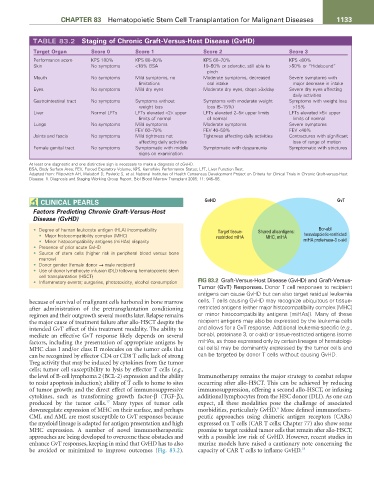
            •  Inflammatory events; surgeries, phototoxicity, alcohol consumption  FIG 83.2  Graft-Versus-Host Disease (GvHD) and Graft-Versus-
                                                                  Tumor (GvT) Responses. Donor T cell responses to recipient
                                                                  antigens can cause GvHD but can also target residual leukemia
           because of survival of malignant cells harbored in bone marrow   cells. T cells causing GvHD may recognize ubiquitous or tissue-
           after administration of the pretransplantation conditioning   restricted antigens (either major histocompatibility complex [MHC]
           regimen and their outgrowth several months later. Relapse remains   or minor histocompatibility antigens [miHAs]). Many of these
           the major cause of treatment failure after allo-HSCT despite the   recipient antigens may also be expressed by the leukemia cells
           intended GvT effect of this treatment modality. The ability to   and allows for a GvT response. Additional leukemia-specific (e.g.,
           mediate an effective GvT response likely depends on several   bcr-abl, proteinase 3, or c-akt) or tissue-restricted antigens (some
           factors, including the presentation of appropriate antigens by   miHAs, as those expressed only by certain lineages of hematologi-
           MHC class I and/or class II molecules on the tumor cells that   cal cells) may be dominantly expressed by the tumor cells and
           can be recognized by effector CD4 or CD8 T cells; lack of strong   can be targeted by donor T cells without causing GvHD.
           Treg activity that may be induced by cytokines from the tumor
           cells; tumor cell susceptibility to lysis by effector T cells (e.g.,
           the level of B-cell lymphoma 2 (BCL-2) expression and the ability   Immunotherapy remains the major strategy to combat relapse
           to resist apoptosis induction); ability of T cells to home to sites   occurring after allo-HSCT. This can be achieved by reducing
           of tumor growth; and the direct effect of immunosuppressive   immunosuppression, offering a second allo-HSCT, or infusing
           cytokines, such as transforming growth factor-β (TGF-β),   additional lymphocytes from the HSC donor (DLI). As one can
                                    17
           produced by the tumor cells.  Many types of tumor cells   expect, all these modalities pose the challenge of associated
                                                                                            6
           downregulate expression of MHC on their surface, and perhaps   morbidities, particularly GvHD.  More defined immunothera-
           CML and AML are most susceptible to GvT responses because   peutic approaches using chimeric antigen receptors (CARs)
           the myeloid lineage is adapted for antigen presentation and high   expressed on T cells (CAR T cells; Chapter 77) also show some
           MHC expression.  A number of novel immunotherapeutic   promise to target residual tumor cells that remain after allo-HSCT,
           approaches are being developed to overcome these obstacles and   with a possible low risk of GvHD. However, recent studies in
           enhance GvT responses, keeping in mind that GvHD has to also   murine models have raised a cautionary note concerning the
           be avoided or minimized to improve outcomes (Fig. 83.2).   capacity of CAR T cells to inflame GvHD. 18

