


Page 1166 - Clinical Immunology_ Principles and Practice ( PDFDrive )
P. 1166
1130         PART NINE  Transplantation


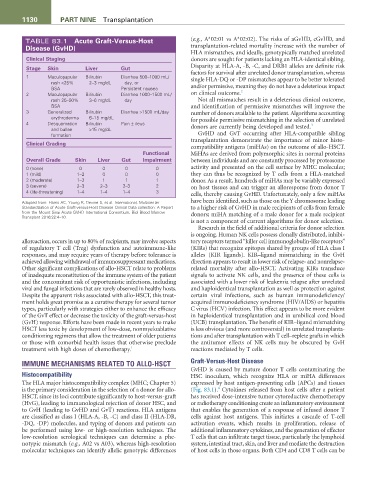
         TABLE 83.1  Acute Graft-Versus-Host                   (e.g., A*02:01 vs A*02:02). The risks of aGvHD, cGvHD, and
         Disease (GvHD)                                        transplantation-related mortality increase with the number of
                                                               HLA mismatches, and ideally, genotypically matched unrelated
          Clinical Staging                                     donors are sought for patients lacking an HLA-identical sibling.
          Stage  Skin        Liver       Gut                   Disparity at HLA-A, -B, -C, and DRB1 alleles are definite risk
                                                               factors for survival after unrelated donor transplantation, whereas
          1      Maculopapular   Bilirubin   Diarrhea 500–1000 mL/  single HLA-DQ or -DP mismatches appear to be better tolerated
                  rash <25%   2–3 mg/dL   day, or
                  BSA                    Persistent nausea     and/or permissive, meaning they do not have a deleterious impact
                                                                                2
          2      Maculopapular   Bilirubin   Diarrhea 1000–1500 mL/  on clinical outcome.
                  rash 25–50%   3–6 mg/dL  day                    Not all mismatches result in a deleterious clinical outcome,
                  BSA                                          and identification of permissive mismatches will improve the
          3      Generalized   Bilirubin   Diarrhea >1500 mL/day  number of donors available to the patient. Algorithms accounting
                  erythroderma  6–15 mg/dL                     for possible permissive mismatching in the selection of unrelated
          4      Desquamation   Bilirubin   Pain ± ileus       donors are currently being developed and tested. 3
                  and bullae   >15 mg/dL
                  formation                                       GvHD  and GvT occurring  after HLA-compatible sibling
                                                               transplantation demonstrate the importance of minor histo-
          Clinical Grading
                                                               compatibility antigens (miHAs) on the outcome of allo-HSCT.
                                                Functional     MiHAs are derived from polymorphic sites in normal proteins
          Overall Grade   Skin   Liver   Gut    Impairment     between individuals and are constantly processed by proteasome
          0 (none)         0       0      0         0          activity and presented on the cell surface by MHC molecules;
          1 (mild)        1–2      0      0         0          they can thus be recognized by T cells from a HLA-matched
          2 (moderate)    1–3      1      1         1          donor. As a result, hundreds of miHAs may be variably expressed
          3 (severe)      2–3     2–3    2–3        2          on host tissues and can trigger an alloresponse from donor T
          4 (life-threatening)  1–4  1–4  1–4       3          cells, thereby causing GvHD. Unfortunately, only a few miHAs

        Adapted from: Harris AC, Young R, Devine S, et al. International, Multicenter   have been identified, such as those on the Y chromosome leading
        Standardization of Acute Graft-versus-Host Disease Clinical Data collection: A Report   to a higher risk of GvHD in male recipients of cells from female
        from the Mount Sinai Acute GVHD International Consortium. Biol Blood Marrow   donors; miHA matching of a male donor for a male recipient
        Transplant 2016;22:4–10.
                                                               is not a component of current algorithms for donor selection.
                                                                  Research in the field of additional criteria for donor selection
                                                               is ongoing. Human NK cells possess clonally distributed, inhibi-
        alloreaction, occurs in up to 80% of recipients, may involve aspects   tory receptors termed “killer cell immunoglobulin-like receptors”
        of regulatory T cell (Treg) dysfunction and autoimmune-like   (KIRs) that recognize epitopes shared by groups of HLA class I
        responses, and may require years of therapy before tolerance is   alleles (KIR ligands). KIR–ligand mismatching in the GvH
        achieved allowing withdrawal of immunosuppressant medications.   direction appears to result in lower risk of relapse- and nonrelapse-
        Other significant complications of allo-HSCT relate to problems   related mortality after allo-HSCT.  Activating KIRs transduce
        of inadequate reconstitution of the immune system of the patient   signals to activate NK cells, and the presence of these cells is
        and the concomitant risk of opportunistic infections, including   associated with a lower risk of leukemia relapse after unrelated
        viral and fungal infections that are rarely observed in healthy hosts.   and haploidentical transplantation as well as protection against
        Despite the apparent risks associated with allo-HSCT, this treat-  certain viral infections, such as human immunodeficiency/
        ment holds great promise as a curative therapy for several tumor   acquired immunodeficiency syndrome (HIV/AIDS) or hepatitis
        types, particularly with strategies either to enhance the efficacy   C virus (HCV) infection. This effect appears to be more evident
        of the GvT effect or decrease the toxicity of the graft-versus-host   in haploidentical transplantation and in umbilical cord blood
        (GvH) response. Efforts have been made in recent years to make   (UCB) transplantation. The benefit of KIR–ligand mismatching
        HSCT less toxic by development of low-dose, nonmyeloablative   is less obvious (and more controversial) in unrelated transplanta-
        conditioning regimens that allow the treatment of older patients   tions and after transplantation with T cell–replete grafts in which
        or those with comorbid health issues that otherwise preclude   the antitumor effects of NK cells may be obscured by GvH
        treatment with high doses of chemotherapy. 1           reactions mediated by T cells.
        IMMUNE MECHANISMS RELATED TO ALLO-HSCT                 Graft-Versus-Host Disease
                                                               GvHD is caused by mature donor T cells contaminating the
        Histocompatibility                                     HSC inoculum, which recognize HLA or miHA differences
        The HLA major histocompatibility complex (MHC; Chapter 5)   expressed by host antigen-presenting cells (APCs) and tissues
                                                                        4
        is the primary consideration in the selection of a donor for allo-  (Fig. 83.1).  Cytokines released from host cells after a patient
        HSCT, since its loci contribute significantly to host-versus-graft   has received dose-intensive tumor cytoreductive chemotherapy
        (HvG), leading to immunological rejection of donor HSC, and   or radiotherapy conditioning create an inflammatory environment
        to GvH (leading to GvHD and GvT) reactions. HLA antigens   that enables the generation of a response of infused donor T
        are classified as class I (HLA-A, -B, -C) and class II (HLA-DR,   cells against host antigens. This initiates a cascade of T-cell
        -DQ, -DP) molecules, and typing of donors and patients can   activation events, which results in proliferation, release of
        be performed using low- or high-resolution techniques. The   additional inflammatory cytokines, and the generation of effector
        low-resolution serological techniques can determine a phe-  T cells that can infiltrate target tissue, particularly the lymphoid
        notypic mismatch (e.g., A02 vs A03), whereas high-resolution   system, intestinal tract, skin, and liver and mediate the destruction
        molecular techniques can identify allelic genotypic differences   of host cells in those organs. Both CD4 and CD8 T cells can be

