


Page 1191 - Clinical Immunology_ Principles and Practice ( PDFDrive )
P. 1191
1156         ParT TEN  Prevention and Therapy of Immunological Diseases


                                34
                                                 34  34


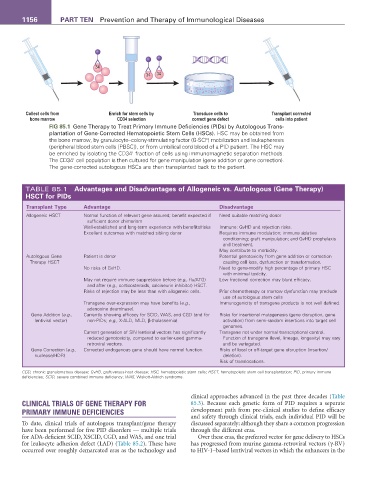
         Collect cells from          Enrich for stem cells by   Transduce cells to        Transplant corrected
           bone marrow                 CD34 selection           correct gene defect        cells into patient
                 FIG 85.1  Gene Therapy to Treat Primary Immune Deficiencies (PIDs) by Autologous Trans-
                 plantation of Gene-Corrected Hematopoietic Stem Cells (HSCs). HSC may be obtained from
                 the bone marrow, by granulocyte–colony-stimulating factor (G-SCF) mobilization and leukapheresis
                 (peripheral blood stem cells [PBSC]), or from umbilical cord blood of a PID patient. The HSC may
                                            +
                 be enriched by isolating the CD34  fraction of cells using immunomagnetic separation methods.
                         +
                 The CD34  cell population is then cultured for gene manipulation (gene addition or gene correction).
                 The gene-corrected autologous HSCs are then transplanted back to the patient.


         TABLE 85.1  advantages and Disadvantages of allogeneic vs. autologous (Gene Therapy)
         HSCT for PIDs

          Transplant Type   advantage                                    Disadvantage
          Allogeneic HSCT   Normal function of relevant gene assured; benefit expected if   Need suitable matching donor
                              sufficient donor chimerism
                            Well-established and long-term experience with benefits/risks  Immune: GvHD and rejection risks.
                            Excellent outcomes with matched sibling donor  Requires immune modulation: immune ablative
                                                                          conditioning; graft manipulation; and GvHD prophylaxis
                                                                          and treatment.
                                                                         May contribute to morbidity.
          Autologous Gene   Patient is donor                             Potential genotoxicity from gene addition or correction
           Therapy HSCT                                                   causing cell loss, dysfunction or transformation.
                            No risks of GvHD.                            Need to gene-modify high percentage of primary HSC
                                                                          with minimal toxicity.
                            May not require immune suppression before (e.g., flu/ATG)   Low fractional correction may blunt efficacy.
                              and after (e.g., corticosteroids, calcineurin inhibitor) HSCT.
                            Risks of rejection may be less than with allogeneic cells.  Prior chemotherapy or marrow dysfunction may preclude
                                                                          use of autologous stem cells
                            Transgene over-expression may have benefits (e.g.,   Immunogenicity of transgene products is not well defined.
                              adenosine deaminase).
           Gene Addition (e.g.,   Currently showing efficacy for SCID, WAS, and CGD (and for   Risks for insertional mutagenesis (gene disruption, gene
            lentiviral vector)  non-PIDs; e.g., X-ALD, MLD, β-thalassemia).  activation) from semi-random insertions into target cell
                                                                          genomes.
                            Current generation of SIN lentiviral vectors has significantly   Transgene not under normal transcriptional control.
                              reduced genotoxicity, compared to earlier-used gamma-  Function of transgene (level, lineage, longevity) may vary
                              retroviral vectors.                         and be variegated.
           Gene Correction (e.g.,   Corrected endogenous gene should have normal function.  Risks of local or off-target gene disruption (insertion/
            nuclease/HDR)                                                 deletion).
                                                                         Risk of translocations.
        CGD, chronic granulomatous disease; GvHD, graft-versus-host disease; HSC, hematopoietic stem cells; HSCT, hematopoietic stem cell transplantation; PID, primary immune
        deficiencies; SCID, severe combined immune deficiency; WAS, Wiskott-Aldrich syndrome.


                                                               clinical approaches advanced in the past three decades (Table
        CLINICAL TRIALS OF GENE THERAPY FOR                    85.3).  Because  each  genetic  form  of  PID  requires  a  separate
        PRIMARY IMMUNE DEFICIENCIES                            development path from pre-clinical studies to define efficacy
                                                               and safety through clinical trials, each individual PID will be
        To date, clinical trials of autologous transplant/gene therapy   discussed separately; although they share a common progression
        have been performed for five PID disorders — multiple trials   through the different eras.
        for ADA-deficient SCID, XSCID, CGD, and WAS, and one trial   Over these eras, the preferred vector for gene delivery to HSCs
        for leukocyte adhesion defect (LAD) (Table 85.2). These have   has progressed from murine gamma-retroviral vectors (γ-RV)
        occurred over roughly demarcated eras as the technology and   to HIV-1–based lentiviral vectors in which the enhancers in the

