


Page 1194 - Clinical Immunology_ Principles and Practice ( PDFDrive )
P. 1194
CHaPTEr 85  Gene Therapy for Primary Immune Deficiency Diseases                 1159


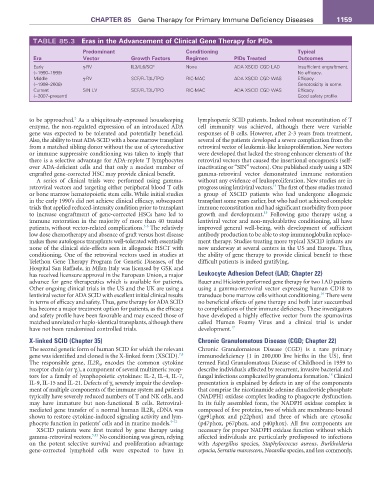
            TABLE 85.3  Eras in the advancement of Clinical Gene Therapy for PIDs
                            Predominant                       Conditioning                        Typical
            Era             Vector          Growth Factors    regimen         PIDs Treated        Outcomes
            Early           γ-RV            IL3/IL6/SCF       None            ADA XSCID CGD LAD   Insufficient engraftment.
            (~1990–1999)                                                                          No efficacy.
            Middle          γ-RV            SCF/FLT3L/TPO     RIC-MAC         ADA XSCID CGD WAS   Efficacy.
            (~1998–2006)                                                                          Genotoxicity in some.
            Current         SIN LV          SCF/FLT3L/TPO     RIC-MAC         ADA XSCID CGD WAS   Efficacy.
            (~2007–present)                                                                       Good safety profile.


                         2
           to be approached.  As a ubiquitously-expressed housekeeping   lymphopenic SCID patients. Indeed robust reconstitution of T
           enzyme, the non-regulated expression of an introduced ADA   cell immunity was achieved, although there were variable
           gene  was  expected  to be tolerated  and  potentially  beneficial.   responses of B cells. However, after 2-3 years from treatment,
           Also, the ability to treat ADA-SCID with a bone marrow transplant   several of the patients developed a severe complication from the
           from a matched sibling donor without the use of cytoreductive   retroviral vector of leukemia-like leukoproliferation. New vectors
           or immune suppressive conditioning was taken to imply that   were developed that lacked the strong enhancer elements of the
           there is a selective advantage for ADA-replete T lymphocytes   retroviral vectors that caused the insertional oncogenesis (self-
           over  ADA-deficient cells and that only a modest number of   inactivating or “SIN” vectors). One published study using a SIN
           engrafted gene-corrected HSC may provide clinical benefit.  gamma-retroviral vector demonstrated immune restoration
             A  series  of clinical  trials  were  performed  using  gamma-  without any evidence of leukoproliferation. New studies are in
                                                                                          14
           retroviral vectors and targeting either peripheral blood T cells   progress using lentiviral vectors.  The first of these studies treated
           or bone marrow hematopoietic stem cells. While initial studies   a group of XSCID patients who had undergone allogeneic
           in the early 1990’s did not achieve clinical efficacy, subsequent   transplant some years earlier, but who had not achieved complete
           trials that applied reduced-intensity condition prior to transplant   immune reconstitution and had significant morbidity from poor
                                                                                       15
           to  increase  engraftment  of  gene-corrected  HSCs  have  led  to   growth and development.  Following gene therapy using a
           immune restoration in the majority of more than 40 treated   lentiviral vector and non-myeloablative conditioning, all have
                                                3-6
           patients, without vector-related complications.  The relatively   improved general well-being, with development of sufficient
           low dose chemotherapy and absence of graft versus host disease   antibody production to be able to stop immunoglobulin replace-
           makes these autologous transplants well-tolerated with essentially   ment therapy. Studies treating more typical XSCID infants are
           none of the clinical side-effects seen in allogeneic HSCT with   now underway at several centers in the US and Europe. Thus,
           conditioning. One of the retroviral vectors used in studies at   the ability of gene therapy to provide clinical benefit to these
           Telethon Gene Therapy Program for Genetic Diseases, of the   difficult patients is indeed gratifying.
           Hospital San Raffaele, in Milan Italy was licensed by GSK and
           has received licensure approval in the European Union, a major   Leukocyte Adhesion Defect (LAD; Chapter 22)
           advance for gene therapeutics which is available for patients.   Bauer and Hickstein performed gene therapy for two LAD patients
           Other ongoing clinical trials in the US and the UK are using a   using a gamma-retroviral vector expressing human CD18 to
                                                                                                          16
           lentiviral vector for ADA SCID with excellent initial clinical results   transduce bone marrow cells without conditioning.  There were
           in terms of efficacy and safety. Thus, gene therapy for ADA SCID   no beneficial effects of gene therapy and both later succumbed
           has become a major treatment option for patients, as the efficacy   to complications of their immune deficiency. These investigators
           and safety profile have been favorable and may exceed those of   have developed a highly effective vector from the spumavirus
           matched unrelated or haplo-identical transplants, although there   called Human Foamy  Virus and a clinical trial is under
           have not been randomized controlled trials.            development. 17

           X-linked SCID (Chapter 35)                             Chronic Granulomatous Disease (CGD; Chapter 22)
           The second genetic form of human SCID for which the relevant   Chronic Granulomatous Disease (CGD) is a rare primary
                                                            7,8
           gene was identified and cloned is the X-linked form (XSCID).    immunodeficiency  (1  in  200,000  live  births  in  the  US),  first
           The responsible gene,  IL2R γ , encodes the common cytokine   termed Fatal Granulomatous Disease of Childhood in 1959 to
           receptor chain (or γ c ), a component of several multimeric recep-  describe individuals affected by recurrent, invasive bacterial and
                                                                                                             18
           tors for a family of lymphopoietic cytokines: IL-2, IL-4, IL-7,   fungal infections complicated by granuloma formation.  Clinical
           IL-9, IL-15 and IL-21. Defects of γ c  severely impair the develop-  presentation is explained by defects in any of the components
           ment of multiple components of the immune system and patients   that comprise the nicotinamide adenine dinucleotide phosphate
           typically have severely reduced numbers of T and NK cells, and   (NADPH) oxidase complex leading to phagocyte dysfunction.
           may have immature but non-functional B cells. Retroviral-  In its fully assembled form, the NADPH oxidase complex is
           mediated gene transfer of a normal human IL2R γ  cDNA was   composed of five proteins, two of which are membrane-bound
           shown to restore cytokine-induced signaling activity and lym-  (gp91phox and p22phox) and three of which are cytosolic
           phocyte function in patients’ cells and in murine models. 9-12  (p47phox, p67phox, and p40phox).  All five components are
             XSCID  patients  were  first  treated  by  gene  therapy  using   necessary for proper NADPH oxidase function without which
                               5,13
           gamma-retroviral vectors.  No conditioning was given, relying   affected individuals are particularly predisposed to infections
           on the potent selective survival and proliferation advantage   with  Aspergillus  species,  Staphylococcus  aureus,  Burkholderia
           gene-corrected lymphoid cells were expected to have  in   cepacia, Serratia marcescens, Nocardia species, and less commonly,

