


Page 1251 - Clinical Immunology_ Principles and Practice ( PDFDrive )
P. 1251
1212         Part ten  Prevention and Therapy of Immunological Diseases


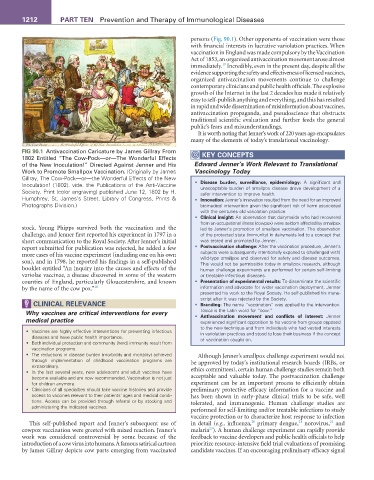
                                                               persons (Fig. 90.1). Other opponents of vaccination were those
                                                               with financial interests in lucrative variolation practices. When
                                                               vaccination in England was made compulsory by the Vaccination
                                                               Act of 1853, an organized antivaccination movement arose almost
                                                                          19
                                                               immediately.  Incredibly, even in the present day, despite all the
                                                               evidence supporting the safety and effectiveness of licensed vaccines,
                                                               organized antivaccination movements continue to challenge
                                                               contemporary clinicians and public health officials. The explosive
                                                               growth of the Internet in the last 2 decades has made it relatively
                                                               easy to self-publish anything and everything, and this has resulted
                                                               in rapid and wide dissemination of misinformation about vaccines,
                                                               antivaccination propaganda, and pseudoscience that obstructs
                                                               traditional scientific evaluation and further feeds the general
                                                               public’s fears and misunderstandings.
                                                                  It is worth noting that Jenner’s work of 220 years ago encapsulates
                                                               many of the elements of today’s translational vaccinology.
        FIG 90.1  Antivaccination Caricature by James Gillray From
        1802 Entitled “The Cow-Pock—or—The Wonderful Effects       KeY COnCePtS
        of the New Inoculation!” Directed Against Jenner and His   Edward Jenner’s Work Relevant to Translational
        Work to Promote Smallpox Vaccination. (Originally by James   Vaccinology Today
        Gillray, The Cow-Pock—or—the Wonderful Effects of the New
        Inoculation! (1802). vide. the Publications of the Anti-Vaccine   •  Disease burden, surveillance, epidemiology: A significant and
        Society. Print (color engraving) published June 12, 1802 by H.   unacceptable burden of smallpox disease drove development of a
                                                                   safer intervention to improve health.
        Humphrey, St. James’s Street. Library of Congress, Prints &   •  Innovation: Jenner’s innovation resulted from the need for an improved
        Photographs Division.)                                     biomedical intervention given the significant risk of harm associated
                                                                   with the centuries old variolation practice.
                                                                 •  Clinical insight: An observation that dairymaids who had recovered
                                                                   from an occupational illness (cowpox) were seldom affected by smallpox
        stock.  Young Phipps survived both the vaccination and the   led to Jenner’s promotion of smallpox vaccination. The observation
        challenge, and Jenner first reported his experiment in 1797 in a   of the protected state (immunity) in dairymaids led to a concept that
        short communication to the Royal Society. After Jenner’s initial   was tested and promoted by Jenner.
        report submitted for publication was rejected, he added a few   •  Postvaccination challenge: After the vaccination procedure, Jenner’s
        more cases of his vaccine experiment (including one on his own   subjects were subsequently intentionally exposed to (challenged with)
                                                                   wild-type smallpox and observed for safety and disease outcomes.
        son), and in 1798, he reported his findings in a self-published   This would not be permissible today in smallpox research, although
        booklet entitled “An inquiry into the causes and effects of the   human challenge experiments are performed for certain self-limiting
        variolae vaccinae, a disease discovered in some of the western   or treatable infectious diseases.
        counties of England, particularly Gloucestershire, and known   •  Presentation of experimental results: To disseminate the scientific
        by the name of the cow pox.” 18                            information and advocate for wider vaccination deployment, Jenner
                                                                   presented his work to the Royal Society. He self-published his manu-
                                                                   script after it was rejected by the Society.
            CLInICaL reLeVanCe                                   •  Branding: The name “vaccination” was applied to the intervention.
                                                                   Vacca is the Latin word for “cow.”
         Why vaccines are critical interventions for every       •  antivaccination movement and conflicts of interest: Jenner
         medical practice                                          experienced significant opposition to his vaccine from groups opposed
                                                                   to the new technique and from individuals who had vested interests
          •  Vaccines are highly effective interventions for preventing infectious   in variolation practices and stood to lose their business if the concept
           diseases and have public health importance.             of vaccination caught on.
          •  Both individual protection and community (herd) immunity result from
           vaccination programs.
          •  The reductions in disease burden (morbidity and mortality) achieved   Although Jenner’s smallpox challenge experiment would not
           through implementation of childhood vaccination programs are   be approved by today’s institutional research boards (IRBs, or
           extraordinary.
          •  In the last several years, new adolescent and adult vaccines have   ethics committees), certain human challenge studies remain both
           become available and are now recommended. Vaccination is not just   acceptable  and valuable today. The  postvaccination  challenge
           for children anymore.                               experiment can be an important process to efficiently obtain
          •  Clinicians of all specialties should take vaccine histories and provide   preliminary protective efficacy information for a vaccine and
           access to vaccines relevant to their patients’ ages and medical condi-  has been shown in early-phase clinical trials to be safe, well
           tions. Access can be provided through referral or by stocking and   tolerated, and immunogenic. Human challenge studies are
           administering the indicated vaccines.
                                                               performed for self-limiting and/or treatable infections to study
                                                               vaccine protection or to characterize host response to infection
                                                                                   20
                                                                                                   21
                                                                                                             22
           This self-published report and Jenner’s subsequent use of   in detail (e.g., influenza,  primary dengue,  norovirus,  and
                                                                     23
        cowpox vaccination were greeted with mixed reaction. Jenner’s   malaria ). A human challenge experiment can rapidly provide
        work was considered controversial by some because of the   feedback to vaccine developers and public health officials to help
        introduction of a cow virus into humans. A famous satirical cartoon   prioritize resource-intensive field trial evaluations of promising
        by James Gillray depicts cow parts emerging from vaccinated   candidate vaccines. If an encouraging preliminary efficacy signal

