


Page 1253 - Clinical Immunology_ Principles and Practice ( PDFDrive )
P. 1253
1214         Part ten  Prevention and Therapy of Immunological Diseases


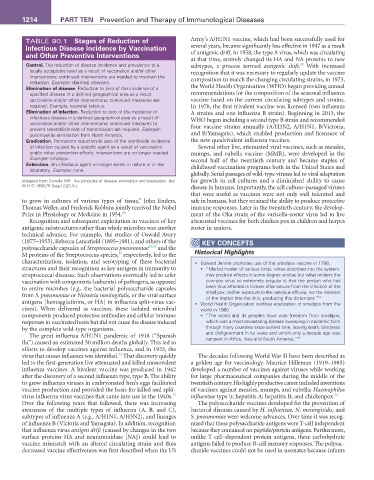
         TABLE 90.1  Stages of reduction of                    Army’s A/H1N1 vaccine, which had been successfully used for
         Infectious Disease Incidence by Vaccination           several years, became significantly less effective in 1947 as a result
         and Other Preventive Interventions                    of antigenic drift. In 1958, the type A virus, which was circulating
                                                               at that time, entirely changed its HA and NA proteins to new
                                                                                                   33
          Control. The reduction of disease incidence and prevalence to a   subtypes, a process termed  antigenic shift.  With  increased
           locally acceptable level as a result of vaccination and/or other   recognition that it was necessary to regularly update the vaccine
           interventions; continued interventions are needed to maintain the   composition to match the changing circulating strains, in 1973,
           reduction. Example: diarrheal diseases.
          elimination of disease. Reduction to zero of the incidence of a   the World Health Organization (WHO) began providing annual
           specified disease in a defined geographical area as a result   recommendations for the composition of the seasonal influenza
           vaccination and/or other interventions; continued measures are   vaccine based on the current circulating subtypes and strains.
           required. Example: neonatal tetanus.                In 1978, the first trivalent vaccine was licensed (two influenza
          elimination of infection. Reduction to zero of the incidence of   A strains and one influenza B strain). Beginning in 2013, the
           infectious disease in a defined geographical area as a result of   WHO began including a second type B strain and recommended
           vaccination and/or other interventions; continued measures to
           prevent reestablishment of transmission are required. Example:   four vaccine strains annually (A/H3N2,  A/H1N1, B/Victoria,
           poliomyelitis elimination from North America.       and B/Yamagata), which enabled production and licensure of
          eradication. Permanent reduction to zero of the worldwide incidence   the new quadrivalent influenza vaccines.
           of infection caused by a specific agent as a result of vaccination   Several other live, attenuated viral vaccines, such as measles,
           and/or other prevention efforts; interventions are no longer needed.   mumps,  and  rubella  vaccine  (MMR),  were developed in  the
           Example: smallpox.                                  second half of the twentieth century and became staples of
          extinction. An infectious agent no longer exists in nature or in the   childhood vaccination programs both in the United States and
           laboratory. Example: none.
                                                               globally. Serial passages of wild-type viruses led to viral adaptation
        (Adapted from Dowdle WR. The principles of disease elimination and eradication. Bull   for growth in cell cultures and a diminished ability to cause
        W H O 1998;76 Suppl 2:22–5.)                           disease in humans. Importantly, the cell culture–passaged viruses
                                                               that were useful as vaccines were not only well tolerated and
        to grow in cultures of various types of tissue,” John Enders,   safe in humans, but they retained the ability to produce protective
        Thomas Weller, and Frederick Robbins jointly received the Nobel   immune responses. Later in the twentieth century, the develop-
        Prize in Physiology or Medicine in 1954. 29            ment of the Oka strain of the varicella-zoster virus led to live
           Recognition and subsequent exploitation in vaccines of key   attenuated vaccines for both chicken pox in children and herpes
        antigenic substructures rather than whole microbes was another   zoster in seniors.
        technical advance. For example, the studies of Oswald Avery
        (1877–1955), Rebecca Lancefield (1895–1981), and others of the    KeY COnCePtS
        polysaccharide capsules of Streptococcus pneumoniae 30,31  and the
                                        32
        M proteins of the Streptococcus species,  respectively, led to the   Historical Highlights
        characterization, isolation, and serotyping of these bacterial   •  Edward Jenner promotes use of the smallpox vaccine in 1798.
        structures and their recognition as key antigens in immunity to   •  “Morbid matter of various kinds, when absorbed into the system,
        streptococcal diseases. Such observations eventually led to safer   may produce effects in some degree similar; but what renders the
        vaccination with components (subunits) of pathogens, as opposed   cow-pox virus so extremely singular is that the person who has
        to entire microbes (e.g., the bacterial polysaccharide capsules   been thus affected is forever after secure from the infection of the
        from S. pneumoniae or Neisseria meningitidis, or the viral surface   small-pox; neither exposure to the variolous effluvia, nor the insertion
                                                                                                         18
                                                                    of the matter into the skin, producing this distemper.”
        antigens [hemagglutinins, or HA] in influenza split-virus vac-  •  World Health Organization certifies eradication of smallpox from the
        cines).  When delivered as  vaccines, these  isolated microbial   world in 1980.
        components produced protective antibodies and cellular immune   •  “The  world  and  its  peoples  have  won  freedom  from  smallpox,
        responses in vaccinated hosts but did not cause the disease induced   which was a most devastating disease sweeping in epidemic form
        by the complete wild-type organisms.                        through many countries since earliest time, leaving death, blindness
           The  great  influenza A/H1N1  pandemic  of  1918  (“Spanish   and disfigurement in its wake and which only a decade ago was
                                                                    rampant in Africa, Asia and South America.”
                                                                                                  40
        flu”) caused an estimated 50 million deaths globally. This led to
        efforts to develop vaccines against influenza, and in 1933, the
                                        33
        virus that causes influenza was identified.  That discovery quickly   The decades following World War II have been described as
        led to the first-generation live attenuated and killed monovalent   a golden age for vaccinology. Maurice Hilleman (1919–1985)
        influenza vaccines. A bivalent vaccine was produced in 1942   developed a number of vaccines against viruses while working
        after the discovery of a second influenza type, type B. The ability   for large pharmaceutical companies during the middle of the
        to grow influenza viruses in embryonated hen’s eggs facilitated   twentieth century. His highly productive career included inventions
        vaccine production and provided the basis for killed and split-  of vaccines against measles, mumps, and rubella; Haemophilus
                                                         33
        virus influenza virus vaccines that came into use in the 1940s.    influenzae type b; hepatitis A; hepatitis B; and chickenpox. 34
        Over the following years that followed, there was increasing   The polysaccharide vaccines developed for the prevention of
        awareness of the multiple types of influenza (A, B, and C),   bacterial diseases caused by H. influenzae, N. meningitidis, and
        subtypes of influenza A (e.g., A/H1N1, A/H3N2), and lineages   S. pneumoniae were welcome advances. Over time it was recog-
        of influenza B (Victoria and Yamagata). In addition, recognition   nized that these polysaccharide antigens were T-cell independent
        that influenza virus antigen drift (caused by changes in the two   because they contained no peptide/protein antigens. Furthermore,
        surface proteins HA and neuraminidase [NA]) could lead to   unlike T cell–dependent protein antigens, these carbohydrate
        vaccine mismatch with an altered circulating strain and thus   antigens failed to produce B-cell memory responses. The polysac-
        decreased vaccine effectiveness was first described when the US   charide vaccines could not be used in neonates because infants

