


Page 1254 - Clinical Immunology_ Principles and Practice ( PDFDrive )
P. 1254
CHaPter 90  Vaccines            1215


           cannot mount an effective immune response against polysac-  TABLE 90.2  Historical Comparisons of
           charide antigens alone. The brilliant technical development that   Morbidity and Mortality for Vaccine-
           overcame this disadvantage for bacterial polysaccharide vaccines   Preventable Diseases in the United States
           was covalent coupling, or conjugation, of the glycan structure
           to a protein carrier, such as tetanus or diphtheria toxoids. This    Before
           maneuver converted the T cell–independent polysaccharide             Vaccination:  after
           vaccines into T cell–dependent protein–polysaccharide conjugate      estimated   Vaccination:
           vaccines, and this resulted in B-cell memory, much improved          annual      annual Cases
           immunity, usefulness in newborns, and even reduction in              average     (reported or
           nasopharyngeal carriage (not seen with the pure polysaccharide       number of   estimated) in
                                          35
           vaccines), thus creating herd immunity.  The observation that   Disease  Cases   Year 2006   % reduction
           protein conjugation to polysaccharide improved the immune   Diphtheria  21053          0       100
                                                     36
           response was made first by Avery and Goebel in 1929  but was   Measles  530217        55        99.9
           not utilized until Robbins et al. conjugated the  H. influenzae   Mumps  162344     6584        95.9
           type B polysaccharide. 37                               Pertussis      200752       15632       92.2
             Increasingly in the late twentieth century and early twenty-first   Paralytic   16316  0     100
           century, the molecular biology revolution and the fundamental   poliomyelitis
                                                                                                           99.9
           dissections of the innate and adaptive immune responses are   Rubella   47745         11       100
                                                                                   29005
                                                                   Smallpox
                                                                                                  0
           being exploited to produce new-generation vaccines. Some of   Tetanus     580         41        92.9
           these dimensions are discussed further in the sections below.  Hepatitis A  117333  15296       87
                                                                   Acute hepatitis B  66232    13169       80.1
                                                                                                <50
           ACCOMPLISHMENTS OF VACCINATION                          Invasive Hib    20000       41550       99.8
                                                                                                           34.1
                                                                                   63067
                                                                   Invasive
                                                                    pneumococcal
           It is generally believed that elimination of an infectious disease   disease
           from circulation in human populations through vaccination can   Varicella  4085120  48445       85
           only be achieved in the case of pathogens that have no animal
           reservoir and vaccination against which induces long-lasting   Hib, Haemplhilus influenzae type b.
           immunity (see Table 90.1). Smallpox eradication was, in fact,   (Adapted from Roush SW, Murphy TV, Vaccine-Preventable Disease Table Working
                                                                  Group. Historical comparisons of morbidity and mortality for vaccine-preventable
           achieved after a successful worldwide vaccination campaign and   diseases in the United States. JAMA 2007;298:2155–63.)
           is the signature accomplishment of vaccination. The fields of
           medicine and public health celebrate this remarkable vaccination
                                                                                                 42
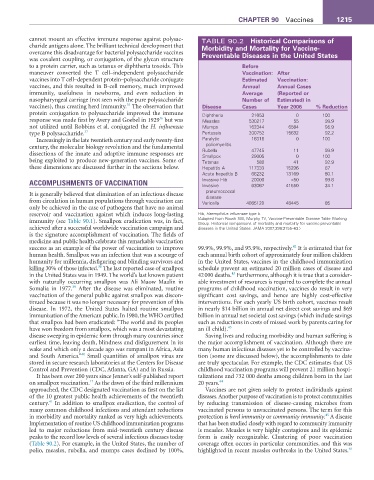
           success as an example of the power of vaccination to improve   99.9%, 99.9%, and 95.9%, respectively.  It is estimated that for
           human health. Smallpox was an infection that was a scourge of   each annual birth cohort of approximately four million children
           humanity for millennia, disfiguring and blinding survivors and   in the United States, vaccines in the childhood immunization
                                 38
           killing 30% of those infected.  The last reported case of smallpox   schedule prevent an estimated 20 million cases of disease and
                                                                             43
           in the United States was in 1949. The world’s last known patient   42 000 deaths.  Furthermore, although it is true that a consider-
           with  naturally occurring  smallpox  was  Ali  Maow  Maalin  in   able investment of resources is required to complete the annual
                         39
           Somalia in 1977.   After the disease was eliminated, routine   programs of childhood vaccination, vaccines do result in very
           vaccination of the general public against smallpox was discon-  significant  cost  savings,  and  hence  are  highly  cost-effective
           tinued because it was no longer necessary for prevention of this   interventions. For each yearly US birth cohort, vaccines result
           disease. In 1972, the United States halted routine smallpox   in nearly $14 billion in annual net direct cost savings and $69
           immunization of the American public. In 1980, the WHO certified   billion in annual net societal cost savings (which include savings
           that smallpox had been eradicated: “The world and its peoples   such as reductions in costs of missed work by parents caring for
           have won freedom from smallpox, which was a most devastating   an ill child). 43
           disease sweeping in epidemic form through many countries since   Saving lives and reducing morbidity and human suffering is
           earliest time, leaving death, blindness and disfigurement in its   the major accomplishment of vaccination. Although there are
           wake and which only a decade ago was rampant in Africa, Asia   many human infectious diseases yet to be controlled by vaccina-
                            40
           and South America.”  Small quantities of smallpox virus are   tion (some are discussed below), the accomplishments to date
           stored in secure research laboratories at the Centers for Disease   are truly spectacular. For example, the CDC estimates that US
           Control and Prevention (CDC, Atlanta, GA) and in Russia.  childhood vaccination programs will prevent 21 million hospi-
             It has been over 200 years since Jenner’s self-published report   talizations and 732 000 deaths among children born in the last
                              17
           on smallpox vaccination.  As the dawn of the third millennium   20 years. 44
           approached, the CDC designated vaccination as first on the list   Vaccines are not given solely to protect individuals against
           of the 10 greatest public health achievements of the twentieth   diseases. Another purpose of vaccination is to protect communities
                 41
           century.  In addition to smallpox eradication, the control of   by reducing transmission of disease-causing microbes from
           many common childhood infections and attendant reductions   vaccinated persons to unvaccinated persons. The term for this
                                                                                                           45
           in morbidity and mortality ranked as very high achievements.   protection is herd immunity or community immunity.  A disease
           Implementation of routine US childhood immunization programs   that has been studied closely with regard to community immunity
           led  to  major  reductions  from  mid-twentieth  century  disease    is measles. Measles is very highly contagious and its epidemic
           peaks to the record low levels of several infectious diseases today   form  is  easily  recognizable.  Clustering  of  poor  vaccination
           (Table 90.2). For example, in the United States, the number of   coverage often occurs in particular communities, and this was
                                                                                                                   46
           polio, measles, rubella, and mumps cases declined by 100%,   highlighted in recent measles outbreaks in the United States.

