


Page 1256 - Clinical Immunology_ Principles and Practice ( PDFDrive )
P. 1256
CHaPter 90  Vaccines            1217


           in the United States and offers advantages, such as protein purity   Year-round
           (because the genes-of-interest are expressed in relative isolation)   WHO surveillance and epidemiology of circulating influenza strains
           and vaccine safety (because it is no longer necessary to derive   Production timeline
           vaccines by partially purifying the HBsAg from paid-donor plasma   Feb  Mar  Apr  May  Jun  Jul  Aug
           of humans chronically infected with hepatitis B virus and
           potentially other viruses).                                                  Six months
             Another example of a highly effective recombinant vaccine   Feb
           is the HPV vaccine. Recombinant HPV L proteins expressed in   WHO announces influenza strain selections for trivalent and quadrivalent
           recombinant systems form VLPs that are purified and formulated    seasonal vaccines
           with or without an adjuvant. The most recent polyvalent vaccine
           expresses VLPs representing nine HPV serotypes. HPV vaccines   Mar
           are truly remarkable for their efficacy and safety and because   Manufacturers obtain influenza vaccine viruses from WHO
           they offer primary prevention against several types of cancer in
           both females and males.                                          Apr
             It is notable that several countries have recently licensed the   Cloning of recombinant viruses and adaptation for
                           51
           first dengue vaccine.  It is a recombinant live viral vector that   efficient egg growth
           is based on the yellow fever virus vaccine strain 17D but in which   May
           the E and preM genes of 17D have been replaced by the E and          Testing egg-grown viruses for antigenic stability;
           preM genes of dengue serotypes 1, 2, 3, and 4. Four separate         Expansion and growth of stocks
           recombinant vectors were developed, one for each of the four             June
           dengue  serotypes.  The  fact  that  the  dengue  virus  and  yellow     Production and purification of millions of
           fever virus are both flaviviruses with similar genetic organization      vaccine doses
           facilitated development of this chimeric yellow fever–dengue
           vaccine. The final formulation is a tetravalent mixture of recom-             July
           binant viruses representing all four dengue serotypes.                        Vialing, quality control, and
                                                                                         potency testing
             Over the last decade, systems biology, or systems vaccinology,
           approaches to vaccine development have captured considerable                      August
           interest. 52-55  The use of new high-throughput assays to assess                  Shipment and delivery to
           multiple dimensions of innate and adaptive immune responses                       clinical sites
           has generated very large data sets. In addition to the traditional
           cellular and humoral immunological assays (antibodies, T cells,   Sep – Mar
           B cells), multiple “-omics” assays, including transcriptomics,   Annual vaccine campaign
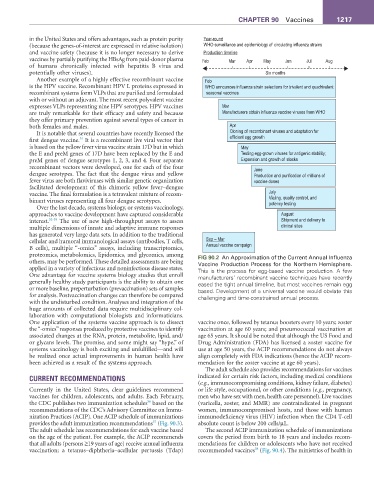
           proteomics, metabolomics, lipidomics, and glycomics, among   FIG 90.2  An Approximation of the Current Annual Influenza
           others, may be performed. These detailed assessments are being   Vaccine Production Process for the Northern Hemisphere.
           applied in a variety of infectious and noninfectious disease states.   This  is  the  process  for  egg-based  vaccine  production.  A  few
           One advantage for vaccine systems biology studies that enroll   manufacturers’ recombinant vaccine techniques have recently
           generally healthy study participants is the ability to obtain one   eased the tight annual timeline, but most vaccines remain egg
           or more baseline, preperturbation (prevaccination) sets of samples   based. Development of a universal vaccine would obviate this
           for analysis. Postvaccination changes can therefore be compared   challenging and time-constrained annual process.
           with the undisturbed condition. Analyses and integration of the
           huge amounts of collected data require multidisciplinary col-
           laboration with computational biologists and informaticians.
           One application of the systems vaccine approach is to dissect   vaccine once, followed by tetanus boosters every 10 years; zoster
           the “-omics” responses produced by protective vaccines to identify   vaccination at age 60 years; and pneumococcal vaccination at
           associated changes at the RNA, protein, metabolite, lipid, and/  age 65 years. It should be noted that although the US Food and
           or glycans levels. The promise, and some might say “hype,” of   Drug Administration (FDA) has licensed a zoster vaccine for
           systems vaccinology is both exciting and unfulfilled—and will   use at age 50 years, the ACIP recommendations do not always
           be realized once actual improvements in human health have   align completely with FDA indications (hence the ACIP recom-
           been achieved as a result of the systems approach.     mendation for the zoster vaccine at age 60 years).
                                                                    The adult schedule also provides recommendations for vaccines
           CURRENT RECOMMENDATIONS                                indicated for certain risk factors, including medical conditions
                                                                  (e.g., immunocompromising conditions, kidney failure, diabetes)
           Currently in  the United States, clear  guidelines recommend   or life style, occupational, or other conditions (e.g., pregnancy,
           vaccines for children, adolescents, and adults. Each February,   men who have sex with men, health care personnel). Live vaccines
                                                 56
           the CDC publishes two immunization schedules  based on the   (varicella, zoster, and MMR) are contraindicated in pregnant
           recommendations of the CDC’s Advisory Committee on Immu-  women, immunocompromised hosts, and those with human
           nization Practices (ACIP). One ACIP schedule of immunizations   immunodeficiency virus (HIV) infection when the CD4 T-cell
                                                   57
           provides the adult immunization recommendations  (Fig. 90.3).   absolute count is below 200 cells/µL.
           The adult schedule has recommendations for each vaccine based   The second ACIP immunization schedule of immunizations
           on the age of the patient. For example, the ACIP recommends   covers the period from birth to 18 years and includes recom-
           that all adults (persons ≥19 years of age) receive annual influenza   mendations for children or adolescents who have not received
                                                                                    58
           vaccination; a tetanus–diphtheria–acellular  pertussis (Tdap)   recommended vaccines  (Fig. 90.4). The ministries of health in

