


Page 1278 - Clinical Immunology_ Principles and Practice ( PDFDrive )
P. 1278
1240         Part ElEvEn  Diagnostic Immunology


                                 Photodetectors:                     1000
                                side scatter signal
                                Filters  Fluorescent signals
                                              PerCP                  800              Granulocytes
                                              PE
            Laser                             FITC                   600
          light source  Flow cell
                                             Photodetector:
                                           forward scatter signal  SSC-H: SSC-Height  400  Monocytes


                        Focused cell stream                          200
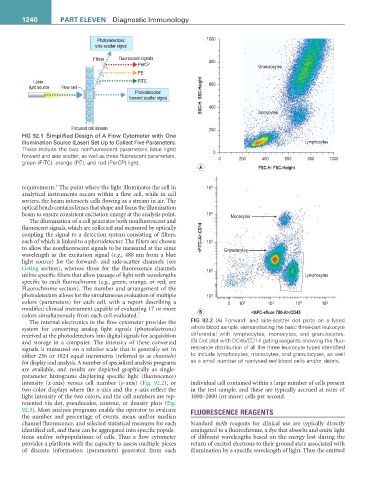
        FIG 92.1  Simplified Design of A Flow Cytometer with One
        Illumination Source (Laser) Set Up to Collect Five Parameters.                               Lymphocytes
        These include the two nonfluorescent parameters (blue light)
        forward and side scatter, as well as three fluorescent parameters,   0  0  200  400   600     800    1000
        green (FITC), orange (PE), and red (PerCP) light.
                                                                  A                   FSC-H: FSC-Height


                   6
        requirements.  The point where the light illuminates the cell in   10 5
        analytical instruments occurs within a flow cell, while in cell
        sorters, the beam intersects cells flowing as a stream in air. The
        optical bench contains lenses that shape and focus the illumination
        beam to ensure consistent excitation energy at the analysis point.  10 4  Monocytes
           The illumination of a cell generates both nonfluorescent and
        fluorescent signals, which are collected and measured by optically
        coupling the signal to a detection system consisting of filters,
        each of which is linked to a photodetector. The filters are chosen   <FITC-A>:CD14  10 3
        to allow the nonfluorescent signals to be measured at the same    Granulocytes
        wavelength as the excitation signal (e.g., 488 nm from a blue
        light  source)  for  the forward- and  side-scatter channels  (see
        Gating section), whereas those for the fluorescence channels   10 2
        utilize specific filters that allow passage of light with wavelengths                        Lymphocytes
        specific to each fluorochrome (e.g., green, orange, or red; see
        Fluorochrome section). The number and arrangement of the
        photodetectors allows for the simultaneous evaluation of multiple   10 0
        colors (parameters) for each cell, with a report describing a       0  10 2      10 3     10 4    10 5
        modified clinical instrument capable of evaluating 17 or more   B
        colors simultaneously from each cell evaluated. 7                          <APC-efluor 780-A>:CD45
           The internal electronics in the flow cytometer provides the   FIG 92.2  (A) Forward- and side-scatter dot plots on a lysed
        system for converting analog light signals (photoelectrons)   whole blood sample, demonstrating the basic three-part leukocyte
        received at the photodetectors into digital signals for acquisition   differential with lymphocytes, monocytes, and granulocytes.
        and storage in a computer. The intensity of these converted   (B) Dot plot with DC45/CD14 gating reagents showing the fluo-
        signals is measured on a relative scale that is generally set in   rescence distribution of all the three leukocyte types identified
        either 256 or 1024 equal increments (referred to as channels)   to include lymphocytes, monocytes, and granulocytes, as well
        for display and analysis. A number of specialized analysis programs   as a small number of nonlysed red blood cells and/or debris.
        are  available, and  results  are  depicted  graphically  as  single-
        parameter  histograms  displaying  specific  light  (fluorescence)
        intensity (x-axis) versus cell number (y-axis) (Fig. 92.2), or   individual cell contained within a large number of cells present
        two-color displays where the x-axis and the y-axis reflect the   in the test sample, and these are typically accrued at rates of
        light intensity of the two colors, and the cell numbers are rep-  1000–2000 (or more) cells per second.
        resented via dot, pseudocolor, contour, or density plots (Fig.
        92.3). Most analysis programs enable the operator to evaluate   FLUORESCENCE REAGENTS
        the number and percentage of events, mean and/or median
        channel fluorescence, and selected statistical measures for each   Standard  mAb  reagents  for  clinical  use  are  typically  directly
        identified cell, and these can be aggregated into specific popula-  conjugated to a fluorochrome, a dye that absorbs and emits light
        tions and/or subpopulations of cells. Thus a flow cytometer   of different wavelengths based on the energy lost during the
        provides a platform with the capacity to assess multiple pieces   return of excited electrons to their ground state associated with
        of discrete information (parameters) generated from each   illumination by a specific wavelength of light. Thus the emitted

