


Page 1283 - Clinical Immunology_ Principles and Practice ( PDFDrive )
P. 1283
CHaPtEr 92  Flow Cytometry             1245


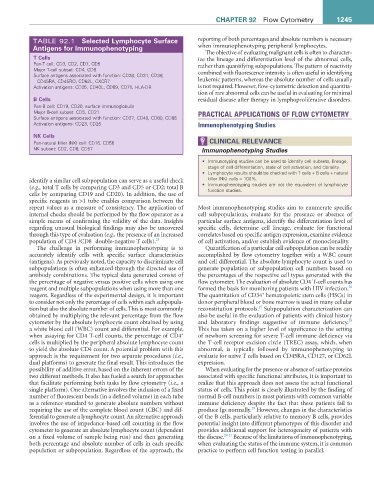
            TABLE 92.1  Selected lymphocyte Surface               reporting of both percentages and absolute numbers is necessary
            antigens for Immunophenotyping                        when immunophenotyping peripheral lymphocytes.
                                                                    The objective of evaluating malignant cells is often to character-
            t Cells                                               ize the lineage and differentiation level of the abnormal cells,
            Pan-T cell: CD3, CD2, CD7, CD5                        rather than quantifying subpopulations. The pattern of reactivity
            Major T-cell subset: CD4, CD8                         combined with fluorescence intensity is often useful in identifying
            Surface antigens associated with function: CD28, CD31, CD38,
             CD45RA, CD45RO, CD62L, CXCR7                         leukemic patterns, whereas the absolute number of cells usually
            Activation antigens: CD25, CD40L, CD69, CD71, HLA-DR  is not required. However, flow-cytometric detection and quantita-
                                                                  tion of rare abnormal cells can be useful in evaluating for minimal
            B Cells                                               residual disease after therapy in lymphoproliferative disorders.
            Pan-B cell: CD19, CD20, surface immunoglobulin
            Major B-cell subset: CD5, CD21                        PRACTICAL APPLICATIONS OF FLOW CYTOMETRY
            Surface antigens associated with function: CD27, CD40, CD80, CD86
            Activation antigens: CD23, CD25                       Immunophenotyping Studies
            nK Cells
            Pan-natural killer (NK) cell: CD16, CD56                  ClInICal rElEvanCE
            NK subset: CD2, CD8, CD57                              Immunophenotyping Studies
                                                                   •  Immunotyping studies can be used to identify cell subsets, lineage,
                                                                     stage of cell differentiation, state of cell activation, and clonality.
                                                                   •  Lymphocyte results should be checked with T cells + B cells + natural
           identify a similar cell subpopulation can serve as a useful check   killer (NK) cells = 100%.
           (e.g., total T cells by comparing CD3 and CD5 or CD2; total B   •  Immunophenotyping studies are not the equivalent of lymphocyte
                                                                     function studies.
           cells by comparing CD19 and CD20). In addition, the use of
           specific  reagents  in  >1  tube enables comparison between the
           repeat values as a measure of consistency. The application of   Most immunophenotyping studies aim to enumerate specific
           internal checks should be performed by the flow operator as a   cell subpopulations, evaluate for the presence or absence of
           simple means of confirming the validity of the data. Insights   particular surface antigens, identify the differentiation level of
           regarding unusual biological findings may also be uncovered   specific cells, determine cell lineage, evaluate for functional
           through this type of evaluation (e.g., the presence of an increased   correlates based on specific antigen expression, examine evidence
                               −
                          −
           population of CD4 /CD8  double-negative T cells). 25   of cell activation, and/or establish evidence of monoclonality.
             The challenge in performing immunophenotyping is to    Quantification of a particular cell subpopulation can be readily
           accurately identify cells with specific surface characteristics   accomplished by flow cytometry together with a WBC count
           (antigens). As previously noted, the capacity to discriminate cell   and cell differential. The absolute lymphocyte count is used to
           subpopulations is often enhanced through the directed use of   generate population or subpopulation cell numbers based on
           antibody combinations. The typical data generated consist of   the percentages of the respective cell types generated with the
           the percentage of negative versus positive cells when using one   flow cytometer. The evaluation of absolute CD4 T-cell counts has
                                                                                                                   26
           reagent and multiple subpopulations when using more than one   formed the basis for monitoring patients with HIV infection.
                                                                                       +
           reagent. Regardless of the experimental design, it is important   The quantitation of CD34  hematopoietic stem cells (HSCs) in
           to consider not only the percentage of cells within each subpopula-  donor peripheral blood or bone marrow is used in many cellular
                                                                                      27
           tion but also the absolute number of cells. This is most commonly   reconstitution protocols.  Subpopulation characterization can
           obtained by multiplying the relevant percentage from the flow   also be useful in the evaluation of patients with clinical history
                                                                                                                   28
           cytometer by the absolute lymphocyte count obtained by using   and laboratory findings suggestive of immune deficiency.
           a white blood cell (WBC) count and differential. For example,   This has taken on a higher level of significance in the setting
                                                            +
           when assaying for CD4 T-cell counts, the percentage of CD4    of newborn screening for severe T-cell immune deficiency via
           cells is multiplied by the peripheral absolute lymphocyte count   the T-cell receptor excision circle (TREC) assay, which, when
           to yield the absolute CD4 count. A potential problem with this   abnormal, is typically followed by immunophenotyping to
           approach is the requirement for two separate procedures (i.e.,   evaluate for naïve T cells based on CD45RA, CD127, or CD62L
           dual platforms) to generate the final result. This introduces the   expression.
           possibility of additive error, based on the inherent errors of the   When evaluating for the presence or absence of surface proteins
           two different methods. It also has fueled a search for approaches   associated with specific functional attributes, it is important to
           that facilitate performing both tasks by flow cytometry (i.e., a   realize that this approach does not assess the actual functional
           single platform). One alternative involves the inclusion of a fixed   status of cells. This point is clearly illustrated by the finding of
           number of fluorescent beads (in a defined volume) in each tube   normal B-cell numbers in most patients with common variable
           as a reference standard to generate absolute numbers without   immune deficiency despite the fact that these patients fail to
                                                                                   29
           requiring the use of the complete blood count (CBC) and dif-  produce Igs normally.  However, changes in the characteristics
           ferential to generate a lymphocyte count. An alternative approach   of the B cells, particularly relative to memory B cells, provides
           involves the use of impedance-based cell counting in the flow   potential insight into different phenotypes of this disorder and
           cytometer to generate an absolute lymphocyte count (dependent   provides additional support for heterogeneity of patients with
           on a fixed volume of sample being run) and then generating   the disease. 29-31  Because of the limitations of immunophenotyping,
           both percentage and absolute number of cells in each specific   when evaluating the status of the immune system, it is common
           population or subpopulation. Regardless of the approach, the   practice to perform cell function testing in parallel.

