


Page 1280 - Clinical Immunology_ Principles and Practice ( PDFDrive )
P. 1280
1242         Part ElEvEn  Diagnostic Immunology


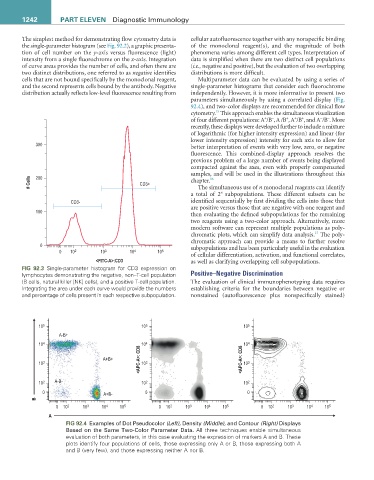
        The simplest method for demonstrating flow cytometry data is   cellular autofluorescence together with any nonspecific binding
        the single-parameter histogram (see Fig. 92.2), a graphic presenta-  of the monoclonal reagent(s), and the magnitude of both
        tion of cell number on the  y-axis versus fluorescence (light)   phenomena varies among different cell types. Interpretation of
        intensity from a single fluorochrome on the x-axis. Integration   data is simplified when there are two distinct cell populations
        of curve areas provides the number of cells, and often there are   (i.e., negative and positive), but the evaluation of two overlapping
        two distinct distributions, one referred to as negative identifies   distributions is more difficult.
        cells that are not bound specifically by the monoclonal reagent,   Multiparameter data can be evaluated by using a series of
        and the second represents cells bound by the antibody. Negative   single-parameter histograms that consider each fluorochrome
        distribution actually reflects low-level fluorescence resulting from   independently. However, it is more informative to present two
                                                               parameters simultaneously by using a correlated display (Fig.
                                                               92.4), and two-color displays are recommended for clinical flow
                                                                        15
                                                               cytometry.  This approach enables the simultaneous visualization
                                                                                        +
                                                                                          −
                                                                                                    +
                                                                                                          −
                                                                                                            −
                                                                                               +
                                                                                                 +
                                                                                            -
                                                               of four different populations: A /B , A /B , A /B , and A /B . More
                                                               recently, these displays were developed further to include a mixture
                                                               of logarithmic (for higher intensity expression) and linear (for
                                                               lower intensity expression) intensity for each axis to allow for
             300                                               better interpretation of events with very low, zero, or negative
                                                               fluorescence. This combined-display approach resolves the
                                                               previous problem of a large number of events being displayed
                                                               compacted against the axes, even with properly compensated
                                                               samples, and will be used in the illustrations throughout this
           # Cells  200                        CD3+            chapter. 16
                                                                  The simultaneous use of n monoclonal reagents can identify
                                                                         n
                                                               a total of 2  subpopulations. These different subsets can be
                        CD3-                                   identified sequentially by first dividing the cells into those that
                                                               are positive versus those that are negative with one reagent and
             100
                                                               then evaluating the defined subpopulations for the remaining
                                                               two reagents using a two-color approach. Alternatively, more
                                                               modern software can represent multiple populations as poly-
                                                                                                        17
                                                               chromatic plots, which can simplify data analysis.  The poly-
                                                               chromatic approach can provide a means to further resolve
              0                                                subpopulations and has been particularly useful in the evaluation
                    0   10 2      10 3     10 4      10 5
                                                               of cellular differentiation, activation, and functional correlates,
                                <FITC-A>:CD3                   as well as clarifying overlapping cell subpopulations.
        FIG 92.3  Single-parameter histogram for CD3 expression on
        lymphocytes demonstrating the negative, non–T-cell population   Positive–Negative Discrimination
        (B cells, natural killer [NK] cells), and a positive T-cell population.   The evaluation of clinical immunophenotyping data requires
        Integrating the area under each curve would provide the numbers   establishing criteria for the boundaries between negative or
        and percentage of cells present in each respective subpopulation.   nonstained (autofluorescence plus nonspecifically stained)


              10 5                             10 5                              10 5
                    A-B+
              10 4                               4                                4
                                               <APC-A>: CD8 10                  <APC-A>: CD8 10
                                   A+B+
              10 3                             10 3                              10 3


              10 2  A-B-                       10 2                              10 2
               0                   A+B-          0                                0
             B
                   0  10 2  10 3  10 4  10 5         0  10 2  10 3  10 4  10 5        0  10 2  10 3  10 4  10 5
                 A
                       FIG 92.4  Examples of Dot Pseudocolor (Left), Density (Middle), and Contour (Right) Displays
                       Based on the Same Two-Color Parameter Data. All three techniques enable simultaneous
                       evaluation of both parameters, in this case evaluating the expression of markers A and B. These
                       plots identify four populations of cells, those expressing only A or B, those expressing both A
                       and B (very few), and those expressing neither A nor B.

