


Page 148 - Clinical Immunology_ Principles and Practice ( PDFDrive )
P. 148
130          ParT ONE  Principles of Immune Response


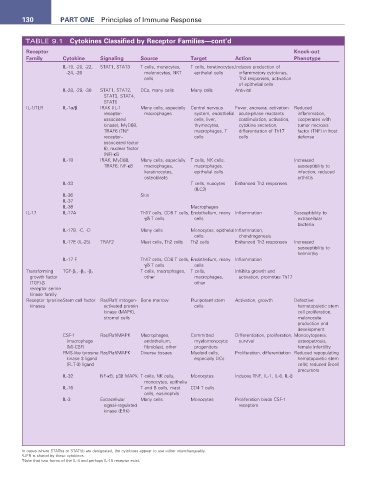
         TABLE 9.1  Cytokines Classified by receptor Families—cont’d
          receptor                                                                               Knock-out
          Family      Cytokine    Signaling    Source          Target         action             Phenotype
                      IL-19, -20, -22,   STAT1, STAT3  T cells, monocytes,   T cells, keratinocytes, Induces production of
                       -24, -26                 melanocytes, NKT   epithelial cells  inflammatory cytokines,
                                                cells                          Th2 responses, activation
                                                                               of epithelial cells
                      IL-28, -29, -30  STAT1, STAT2,   DCs, many cells  Many cells  Antiviral
                                   STAT3, STAT4,
                                   STAT5
          IL-1/TLR    IL-1α/β     IRAK (IL-1   Many cells, especially  Central nervous   Fever, anorexia, activation  Reduced
                                   receptor-    macrophages      system, endothelial  acute-phase reactants   inflammation,
                                   associated                    cells, liver,   costimulation, activation,   cooperates with
                                   kinase), MyD88,               thymocytes,   cytokine secretion,   tumor necrosis
                                   TRAF6 (TNF                    macrophages, T   differentiation of Th17   factor (TNF) in host
                                   receptor–                     cells         cells              defense
                                   associated factor
                                   6), nuclear factor
                                   (NF)-κB
                      IL-18       IRAK, MyD88,   Many cells, especially  T cells, NK cells,      Increased
                                   TRAF6, NF-κB  macrophages,    macrophages,                     susceptibility to
                                                keratinocytes,   epithelial cells                 infection, reduced
                                                osteoblasts                                       arthritis
                      IL-33                                    T cells, nuocytes   Enhanced Th2 responses
                                                                 (ILC2)
                      IL-36                    Skin
                      IL-37
                      IL-38                                    Macrophages
          IL-17       IL-17A                   Th17 cells, CD8 T cells, Endothelium, many  Inflammation  Susceptibility to
                                                γ/δ T cells      cells                            extracellular
                                                                                                  bacteria
                      IL-17B, -C, -D           Many cells      Monocytes, epithelial Inflammation,
                                                                 cells         chondrogenesis
                      IL-17E (IL-25)  TRAF2    Mast cells, Th2 cells  Th2 cells  Enhanced Th2 responses  Increased
                                                                                                  susceptibility to
                                                                                                  helminths
                      IL-17 F                  Th17 cells, CD8 T cells, Endothelium, many  Inflammation
                                                γ/δ T cells      cells
          Transforming   TGF-β 1 , -β 2 , -β 3  T cells, macrophages,  T cells,   Inhibits growth and
           growth factor                        other            macrophages,   activation, promotes Th17
           (TGF)-β                                               other
           receptor serine
           kinase family
          Receptor tyrosine Stem cell factor  Ras/Raf/ mitogen- Bone marrow  Pluripotent stem   Activation, growth  Defective
           kinases                 activated protein             cells                            hematopoietic stem
                                   kinase (MAPK),                                                 cell proliferation,
                                   stromal cells                                                  melanocyte
                                                                                                  production and
                                                                                                  development
                      CSF-1       Ras/Raf/MAPK  Macrophages,   Committed      Differentiation, proliferation, Monocytopenia,
                       (macrophage              endothelium,     myelomonocytic   survival        osteopetrosis,
                       (M)-CSF)                 fibroblast, other  progenitors                    female infertility
                      FMS-like tyrosine Ras/Raf/MAPK  Diverse tissues  Myeloid cells,   Proliferation, differentiation Reduced repopulating
                       kinase 3 ligand                           especially DCs                   hematopoietic stem
                       (FLT-3) ligand                                                             cells; reduced B-cell
                                                                                                  precursors
                      IL-32       NF-κB, p38 MAPK T cells, NK cells,   Monocytes  Induces TNF, IL-1, IL-6, IL-8
                                                monocytes, epithelia
                      IL-16                    T and B cells, mast   CD4 T cells
                                                cells, eosinophils
                      IL-3        Extracellular   Many cells   Monocytes      Proliferation binds CSF-1
                                   signal–regulated                            receptors
                                   kinase (ERK)


        In cases where STAT5a or STAT5b are designated, the cytokines appear to use either interchangeably.
        a LIFR is shared by these cytokines.
        b Note that two forms of the IL-4 and perhaps IL-15 receptor exist.

