


Page 144 - Clinical Immunology_ Principles and Practice ( PDFDrive )
P. 144
CHaPTEr 8  T-Cell Development           125.e1


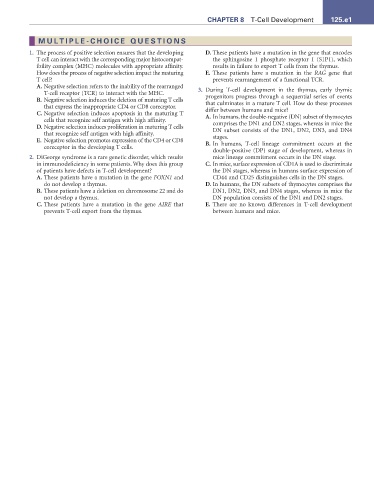
              MULTIPLE-CHOICE QUESTIONS

           1.  The process of positive selection ensures that the developing    D. These patients have a mutation in the gene that encodes
             T cell can interact with the corresponding major histocompat-  the sphingosine 1 phosphate receptor  1 (S1P1), which
             ibility complex (MHC) molecules with appropriate affinity.   results in failure to export T cells from the thymus.
             How does the process of negative selection impact the maturing    E.  These patients have a mutation in the  RAG gene that
             T cell?                                                   prevents rearrangement of a functional TCR.
              A. Negative selection refers to the inability of the rearranged   3.  During T-cell development in the thymus, early thymic
               T-cell receptor (TCR) to interact with the MHC.      progenitors progress through a sequential series of events
              B. Negative selection induces the deletion of maturing T cells   that culminates in a mature T cell. How do these processes
               that express the inappropriate CD4 or CD8 coreceptor.  differ between humans and mice?
              C. Negative selection induces apoptosis in the maturing T    A. In humans, the double-negative (DN) subset of thymocytes
               cells that recognize self antigen with high affinity.   comprises the DN1 and DN2 stages, whereas in mice the
              D. Negative selection induces proliferation in maturing T cells   DN subset consists of the DN1, DN2, DN3, and DN4
               that recognize self antigen with high affinity.         stages.
              E.  Negative selection promotes expression of the CD4 or CD8    B. In  humans,  T-cell  lineage  commitment  occurs  at  the
               coreceptor in the developing T cells.
                                                                       double-positive (DP) stage of development, whereas in
           2.  DiGeorge syndrome is a rare genetic disorder, which results   mice lineage commitment occurs in the DN stage.
             in immunodeficiency in some patients. Why does this group    C. In mice, surface expression of CD1A is used to discriminate
             of patients have defects in T-cell development?           the DN stages, whereas in humans surface expression of
              A. These patients have a mutation in the gene FOXN1 and   CD44 and CD25 distinguishes cells in the DN stages.
               do not develop a thymus.                              D. In humans, the DN subsets of thymocytes comprises the
              B. These patients have a deletion on chromosome 22 and do   DN1, DN2, DN3, and DN4 stages, whereas in mice the
               not develop a thymus.                                   DN population consists of the DN1 and DN2 stages.
              C. These patients have a mutation in the gene  AIRE that    E.  There are no known differences in T-cell development
               prevents T-cell export from the thymus.                 between humans and mice.

