


Page 185 - Clinical Immunology_ Principles and Practice ( PDFDrive )
P. 185
CHaPTEr 10  Chemokines and Chemokine Receptors                   167


                                                                  lesions and reduced accumulation of macrophages in the vessel
           Malaria                                                wall. Adoptive transfer studies with bone marrow from Cxcr2
                                                                                                                   −/−
           Plasmodium vivax also uses a chemokine receptor for target cell   mice have also revealed a role for CXCR2 in promoting athero-
               31
           entry.  The parasite ligand, named the Plasmodium vivax Duffy   sclerosis in mouse models, apparently by promoting monocyte
           Binding Protein (PvDBP), is expressed in micronemes of mero-  adhesion to early atherosclerotic endothelium through interaction
           zoites and binds to the N-terminal domain of ACKR1 (originally   with its mouse ligand KC and activation of the VLA-4/VCAM-1
           known as Duffy and later as DARC [Duffy Antigen Receptor for   adhesion system.
           Chemokines]) on erythrocytes via a cysteine-rich domain. This   The CX3CR1 genetic variant CX3CR1-M280, which lacks
           interaction is required for junction formation during invasion,   normal CX3CL1-dependent adhesive function under conditions
           but not for initial binding or parasite orientation. P. vivax-malaria   of physiological flow, has been associated with reduced risk of
           is rare in sub-Saharan Africa because of genetic deficiency in   atherosclerotic vascular disease in humans. Mechanistic studies
           ACKR1/Duffy caused by a single nucleotide substitution in the   suggest that CX3CL1 on coronary artery smooth muscle cells
           gene promoter (–46 C) affecting an erythroid-specific GATA-1   anchors macrophages via CX3CR1.
           site. Fixation of the mutation in Africa presumably occurred
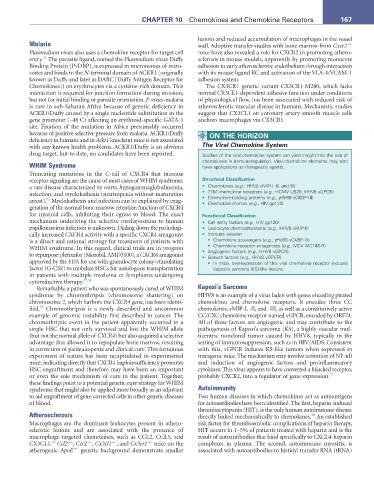
           because of positive selective pressure from malaria. ACKR1/Duffy    ON THE HOrIZON
           deficiency in humans and in Ackr1 knockout mice is not associated
           with any known health problems. ACKR1/Duffy is an obvious   The Viral Chemokine System
           drug target, but to date, no candidates have been reported.  Studies of the viral chemokine system can yield insight into the role of
                                                                   chemokines in immunoregulation. Viral chemokine elements may also
           WHIM Syndrome                                           have applications as therapeutic agents.
           Truncating mutations in the  C-tail of CXCR4 that increase
           receptor signaling are the cause of most cases of WHIM syndrome,   Structural Classification
           a rare disease characterized by warts, hypogammaglobulinemia,   •  Chemokines (e.g., HHV8 vMIP-I, II, and III)
           infection, and myelokathexis (neutropenia without maturation   •  7TM chemokine receptors (e.g., HCMV US28, HHV8 vGPCR)
                32
           arrest).  Myelokathexis and infection can be explained by exag-  •  Chemokine-binding proteins (e.g., γHV68 vCKBP-III)
                                                                   •  Chemokine mimics (e.g., HIV gp120)
           geration of the normal bone marrow retention function of CXCR4
           for myeloid cells, inhibiting their egress to blood. The exact   Functional Classification
           mechanism underlying the selective predisposition to human   •  Cell entry factors (e.g., HIV gp120)
           papillomavirus infection is unknown. Dialing down the pathologi-  •  Leukocyte chemoattractants (e.g., HHV8 vMIP-II)
           cally increased CXCR4 activity with a specific CXCR4 antagonist   •  Immune evasion
           is a direct and rational strategy for treatment of patients with   •  Chemokine scavengers (e.g., γHV68 vCKBP-III)
           WHIM syndrome. In this regard, clinical trials are in progress   •  Chemokine receptor antagonists (e.g., MCV MC148-R)
           to repurpose plerixafor (Mozobil, AMD3100), a CXCR4 antagonist   •  Angiogenic factors (e.g., HHV8 vGPCR)
                                                                   •  Growth factors (e.g., HHV8 vGPCR)
           approved by the FDA for use with granulocyte colony-stimulating   •  In mice, overexpression of this viral chemokine receptor induces
           factor (G-CSF) to mobilize HSCs for autologous transplantation   Kaposi’s sarcoma (KS)-like lesions.
           in patients with multiple myeloma or lymphoma undergoing
           cytoreductive therapy. 33,34
             Remarkably, a patient who was spontaneously cured of WHIM   Kaposi’s Sarcoma
           syndrome by chromothripsis (chromosome shattering) on   HHV8 is an example of a virus laden with genes encoding pirated
           chromosome 2, which harbors the CXCR4 gene, has been identi-  chemokines and chemokine receptors. It encodes three CC
              35
           fied.  Chromothripsis is a newly described and uncommon   chemokines, vMIP-I, -II, and -III, as well as a constitutively active
           example of genomic instability first described in cancer. The   CC/CXC chemokine receptor named vGPCR, encoded by ORF74.
           chromothriptic event in the patient apparently occurred in a   All of these factors are angiogenic and may contribute to the
           single HSC that not only survived and lost the WHIM allele   pathogenesis of Kaposi’s sarcoma (KS), a highly vascular mul-
           (but not the normal allele of CXCR4) but also acquired a selective   ticentric nonclonal tumor caused by HHV8, typically in the
           advantage that allowed it to repopulate bone marrow, resulting   setting of immunosuppression, such as in HIV/AIDS. Consistent
           in correction of panleukopenia and clinical cure. This fortuitous   with this, vGPCR induces KS-like tumors when expressed in
           experiment of nature has been recapitulated in experimental   transgenic mice. The mechanism may involve activation of NF-κB
           mice, indicating directly that CXCR4 haploinsufficiency promotes   and induction of angiogenic factors and proinflammatory
           HSC engraftment and therefore may have been an important   cytokines. This virus appears to have converted a hijacked receptor,
           or even the sole mechanism of cure in the patient. Together,   probably CXCR2, into a regulator of gene expression. 37
           these findings point to a potential genetic cure strategy for WHIM
           syndrome that might also be applied more broadly as an adjuvant   Autoimmunity
           to aid engraftment of gene-corrected cells in other genetic diseases   Two human diseases in which chemokines act as autoantigens
           of blood.                                              for autoantibodies have been identified. The first, heparin-induced
                                                                  thrombocytopenia (HIT), is the only human autoimmune disease
           Atherosclerosis                                        directly linked mechanistically to chemokines.  An established
                                                                                                       38
           Macrophages are the dominant leukocytes present in athero-  risk factor for thromboembolic complications of heparin therapy,
           sclerotic lesions and are associated with the presence of   HIT occurs in 1–5% of patients treated with heparin and is the
           macrophage-targeted chemokines, such as CCL2, CCL5, and   result of autoantibodies that bind specifically to CXCL4-heparin
                                                 −/−
                       −/−
                             −/−
                                     −/−
                  36
           CX3CL1.  Ccl2 , Ccr2 , Cx3cl1 , and Cx3cr1  mice on the   complexes in plasma. The second, autoimmune myositis, is
                         −/−
           atherogenic  ApoE  genetic background demonstrate smaller   associated with autoantibodies to histidyl transfer RNA (tRNA)

