


Page 180 - Clinical Immunology_ Principles and Practice ( PDFDrive )
P. 180
162          ParT ONE  Principles of Immune Response


                                                         Endothelial cell
                                                 G
                                                 A
                                                 G
                                                 CK               γ     GTP
                                                               α i      α 1
                                                            GDP  β
                                      Leukocyte
                                                                    RGS
                                                 GRK     P13 Kγ  γ     PLC β2/β3
                                              Arrestin
                                                                 β

                                                                PIP2         PKC
                                                                                      IP3 R
                                                         PIP3          DAG       Ca 2+
                                                                                       Ca 2+
                                                RhoGEF  RacGEF  cdc42GEF     IP3          Ca 2+
                                            Rho          Rac         cdc42

                                        PKCζ   ROCK      Pak         Arp2/3

                                                   myosin            F-actin

                                       Adhesion   Contraction   F-Actin polymerization
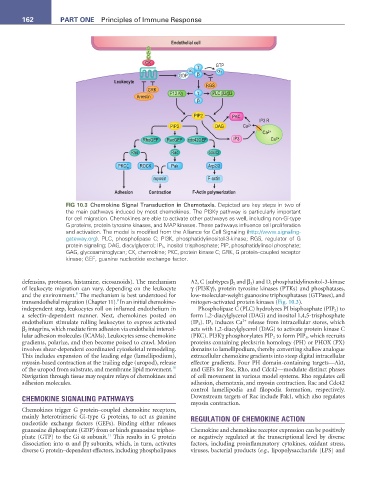
                       FIG 10.3  Chemokine Signal Transduction in Chemotaxis. Depicted are key steps in two of
                       the main pathways induced by most chemokines. The PI3Kγ pathway is particularly important
                       for cell migration. Chemokines are able to activate other pathways as well, including non-Gi-type
                       G proteins, protein tyrosine kinases, and MAP kinases. These pathways influence cell proliferation
                       and activation. The model is modified from the Alliance for Cell Signaling (http://www.signaling-
                       gateway.org). PLC, phospholipase C; PI3K, phosphatidylinositol-3-kinase; RGS, regulator of G
                       protein signaling; DAG, diacylglycerol; IP 3 , inositol trisphosphate; PIP, phosphatidylinsol phosphate;
                       GAG, glycosaminoglycan; CK, chemokine; PKC, protein kinase C; GRK, G protein–coupled receptor
                       kinase; GEF, guanine nucleotide exchange factor.


        defensins, proteases, histamine, eicosanoids). The mechanism   A2, C (subtypes β 2  and β 3 ) and D, phosphatidylinositol-3-kinase
        of leukocyte migration can vary, depending on the leukocyte   γ (PI3Kγ), protein tyrosine kinases (PTKs) and phosphatases,
                          8
        and the environment.  The mechanism is best understood for   low-molecular-weight guanosine triphosphatases (GTPases), and
                                       9
        transendothelial migration (Chapter 11).  In an initial chemokine-  mitogen-activated protein kinases (Fig. 10.3).
        independent step, leukocytes roll on inflamed endothelium in   Phospholipase C (PLC) hydrolyzes PI bisphosphate (PIP 2 ) to
        a  selectin-dependent  manner. Next, chemokines  posted  on   form 1,2-diacylglycerol (DAG) and inositol 1,4,5-trisphosphate
                                                                                2+
        endothelium stimulate rolling leukocytes to express activated   (IP 3). IP 3  induces Ca  release from intracellular stores, which
        β 2  integrins, which mediate firm adhesion via endothelial intercel-  acts with 1,2-diacylglycerol (DAG) to activate protein kinase C
        lular adhesion molecules (ICAMs). Leukocytes sense chemokine   (PKC). PI3Kγ phosphorylates PIP 2  to form PIP 3 , which recruits
        gradients, polarize, and then become poised to crawl. Motion   proteins containing pleckstrin homology (PH) or PHOX (PX)
        involves shear-dependent coordinated cytoskeletal remodeling.   domains to lamellipodium, thereby converting shallow analogue
        This includes expansion of the leading edge (lamellipodium),   extracellular chemokine gradients into steep digital intracellular
        myosin-based contraction at the trailing edge (uropod), release   effector gradients. Four PH domain-containing targets—Akt,
                                                         10
        of the uropod from substrate, and membrane lipid movement.    and GEFs for Rac, Rho, and Cdc42—modulate distinct phases
        Navigation through tissue may require relays of chemokines and   of cell movement in various model systems. Rho regulates cell
        adhesion molecules.                                    adhesion, chemotaxis, and myosin contraction. Rac and Cdc42
                                                               control  lamellipodia  and  filopodia  formation,  respectively.
        CHEMOKINE SIGNALING PATHWAYS                           Downstream targets of Rac include Pak1, which also regulates
                                                               myosin contraction.
        Chemokines trigger G protein–coupled chemokine receptors,
        mainly heterotrimeric Gi-type G proteins, to act as guanine   REGULATION OF CHEMOKINE ACTION
        nucleotide exchange factors (GEFs). Binding either releases
        guanosine diphosphate (GDP) from or binds guanosine triphos-  Chemokine and chemokine receptor expression can be positively
                                    11
        phate (GTP) to the Gi α subunit.  This results in G protein   or negatively regulated at the transcriptional level by diverse
        dissociation into α and βγ subunits, which, in turn, activates   factors, including proinflammatory cytokines, oxidant stress,
        diverse G protein–dependent effectors, including phospholipases   viruses, bacterial products (e.g., lipopolysaccharide [LPS] and

