


Page 182 - Clinical Immunology_ Principles and Practice ( PDFDrive )
P. 182
164          ParT ONE  Principles of Immune Response


                                                                                           Tissues   Environment
                                        CXCR4
                                     N
                                        CXCR2
                         Bone Marrow  HSC CXCR4
                                     B CXCR7                        T em CCR7
                                                                                          Skin
                                   B
                                  N          HSC CXCR4
                                 Eo           N  CXCR4
                                 Mo           B CXCR4                                     CCR2
                 Thymus           NK                     B CXCR4    Lymph Node             MΦ
                            T n CCR7  Tp                T cm CCR7       CCR7               TLR
                                                        T h1 CXCR3  GC  DC  T             CCR7
            T dp  CCR9 T sp  CCR4        Blood          Th CCR4        T   zone            DC          PAMPs
                      CCR7
                                                          2
                                                        T c1 CXCR3      fh CXCR5           iDC
                             T p
                               ?                      B   T       T m                   CCR6 TLR
                                                              T cm
                                CXCR5  B        T   CXCR5  n  CCR7  CCR5       T m        Gut
                                                                  CD8
                                                 em
                                CCR2 Mo        CCR1      CCR7                  CCR4          Eo  CCR3
                                               CCR3                           CCR10        T m CCR9
                                               CCR5  T h1
                                        B          CXCR3 T                                PC CCR9
                                                        h2
                                  T           B CXCR7  CCR4  T h17  N  Eo  Mo  Mo  NK
                                           MZ
                                                                              CCR2
                                   Spleen                 CXCR3 CXCR2  CCR3  CX3CR1 CX3CR1 CX3CR1
                                                                                   CCR5
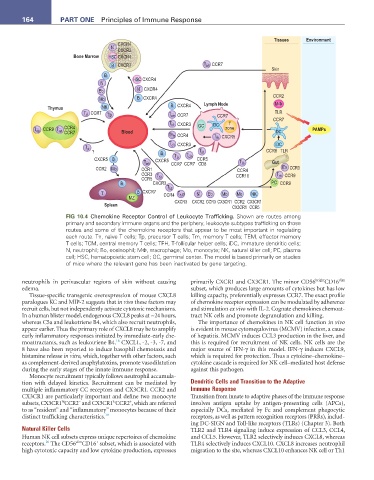
                       FIG 10.4  Chemokine Receptor Control of Leukocyte Trafficking. Shown are routes among
                       primary and secondary immune organs and the periphery, leukocyte subtypes trafficking on those
                       routes and some of the chemokine receptors that appear to be most important in regulating
                       each route. Tn, naïve T cells; Tp, precursor T cells; Tm, memory T cells; TEM, effector memory
                       T cells; TCM, central memory T cells; TFH, T-follicular helper cells; iDC, immature dendritic cells;
                       N, neutrophil; Eo, eosinophil; MΦ, macrophage; Mo, monocyte; NK, natural killer cell; PC, plasma
                       cell; HSC, hematopoietic stem cell; GC, germinal center. The model is based primarily on studies
                       of mice where the relevant gene has been inactivated by gene targeting.


                                                                                                                dim
        neutrophils in perivascular regions of skin without causing   primarily CXCR1 and CX3CR1. The minor CD56 bright CD16
        edema.                                                 subset, which produces large amounts of cytokines but has low
           Tissue-specific transgenic overexpression of mouse CXCL8   killing capacity, preferentially expresses CCR7. The exact profile
        paralogues KC and MIP-2 suggests that in vivo these factors may   of chemokine receptor expression can be modulated by adherence
        recruit cells, but not independently activate cytotoxic mechanisms.   and stimulation ex vivo with IL-2. Cognate chemokines chemoat-
        In a human blister model, endogenous CXCL8 peaks at ~24 hours,   tract NK cells and promote degranulation and killing.
        whereas C5a and leukotriene B4, which also recruit neutrophils,   The importance of chemokines in NK cell function in vivo
        appear earlier. Thus the primary role of CXCL8 may be to amplify   is evident in mouse cytomegalovirus (MCMV) infection, a cause
        early inflammatory responses initiated by immediate-early che-  of hepatitis. MCMV induces CCL3 production in the liver, and
                                       18
        moattractants, such as leukotriene B4.  CXCL1, -2, -3, -7, and   this is required for recruitment of NK cells. NK cells are the
        8 have also been reported to induce basophil chemotaxis and   major source of IFN-γ in this model. IFN-γ induces CXCL9,
        histamine release in vitro, which, together with other factors, such   which is required for protection. Thus a cytokine–chemokine–
        as complement-derived anaphylatoxins, promote vasodilatation   cytokine cascade is required for NK cell–mediated host defense
        during the early stages of the innate immune response.  against this pathogen.
           Monocyte recruitment typically follows neutrophil accumula-
        tion with delayed kinetics. Recruitment can be mediated by   Dendritic Cells and Transition to the Adaptive
        multiple inflammatory CC receptors and CX3CR1. CCR2 and   Immune Response
        CX3CR1 are particularly important and define two monocyte   Transition from innate to adaptive phases of the immune response
                           −
                                           +
                     hi
                                      lo
        subsets, CX3CR1 CCR2  and CX3CR1 CCR2 , which are referred   involves antigen uptake by antigen-presenting cells (APCs),
        to as “resident” and “inflammatory” monocytes because of their   especially  DCs, mediated by Fc and complement phagocytic
        distinct trafficking characteristics. 19               receptors, as well as pattern recognition receptors (PRRs), includ-
                                                               ing DC-SIGN and Toll-like receptors (TLRs) (Chapter 3). Both
        Natural Killer Cells                                   TLR2 and TLR4 signaling induce expression of CCL3, CCL4,
        Human NK cell subsets express unique repertoires of chemokine   and CCL5. However, TLR2 selectively induces CXCL8, whereas
                                 +
                          dim
                20
        receptors.  The CD56 CD16  subset, which is associated with   TLR4 selectively induces CXCL10. CXCL8 increases neutrophil
        high cytotoxic capacity and low cytokine production, expresses   migration to the site, whereas CXCL10 enhances NK cell or Th1

