


Page 311 - Clinical Immunology_ Principles and Practice ( PDFDrive )
P. 311
292          ParT TwO  Host Defense Mechanisms and Inflammation


                                                                           Control of infection  Associated pathologies
                      DC   MΦ   NK   ILC1
                                                       CCR5              • By intracellular pathogens  • Inflammation
                                                                           (bacteria, viruses)
                                             IL-12   Th1       IFN-γ     • PMN activation
                                             IFN-γ   (Tbet)    TNF-α     • MΦ activation
                                                                         • B-cell Ig class switching
                                                                           IgG2a (mouse system)
                                                       CxCR3               IgG1 (human system)

                          MC   MΦ  NK1.1  ILC2          CCR4             • By intracellular pathogens  • Allergy
                                                                           (parasites)         • Asthma
                                                     Th2       IL-4      • B-cell Ig class switching
                                             IL-4   (GATA3)    IL-5
                                                               IL-13       IgG1 (mouse system)
                                                                           IgG4 (human system)
                  CCR7                                  CCR8             • IgE antibodies

               Th0
                            MΦ  EC  ILC3               CCR6
                CxCR4                                                    • By intracellular pathogens  • Inflammation
                                             TGF-β   Th17      IL-17A
                                             IL-6   (RORγ)     IL-17F      (bacteria, fungi)   • Autoimmunity
                                             IL-23             IL-22     • Response to commensal
                                                                           bacteria


                             MΦ    DC                  CxCR5
                                                                         • All pathogens       • Autoimmunity?
                                                     Tfh
                                             IL-6    (Bcl6)    IL-21     • Germinal center
                                                                           formation
                                                                         • High affinity antibodies
                                                       CCR3
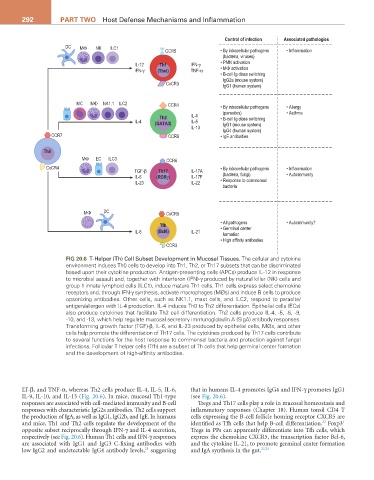
                       FIG 20.6  T-Helper (Th) Cell Subset Development in Mucosal Tissues. The cellular and cytokine
                       environment induces Th0 cells to develop into Th1, Th2, or Th17 subsets that can be discriminated
                       based upon their cytokine production. Antigen-presenting cells (APCs) produce IL-12 in response
                       to microbial assault and, together with interferon (IFN)-γ produced by natural killer (NK) cells and
                       group 1 innate lymphoid cells (ILC1), induce mature Th1 cells. Th1 cells express select chemokine
                       receptors and, through IFN-γ synthesis, activate macrophages (MØs) and induce B cells to produce
                       opsonizing antibodies. Other cells, such as NK1.1, mast cells, and ILC2, respond to parasite/
                       antigen/allergen with IL-4 production. IL-4 induces Th0 to Th2 differentiation. Epithelial cells (ECs)
                       also produce cytokines that facilitate Th2 cell differentiation. Th2 cells produce IL-4, -5, -6, -9,
                       -10, and -13, which help regulate mucosal secretory immunoglobulin A (SIgA) antibody responses.
                       Transforming growth factor (TGF)-β, IL-6, and IL-23 produced by epithelial cells, MØs, and other
                       cells help promote the differentiation of Th17 cells. The cytokines produced by Th17 cells contribute
                       to several functions for the host response to commensal bacteria and protection against fungal
                       infections. Follicular T helper cells (Tfh) are a subset of Th cells that help germinal center formation
                       and the development of high-affinity antibodies.


        LT-β, and TNF-α, whereas Th2 cells produce IL-4, IL-5, IL-6,   that in humans IL-4 promotes IgG4 and IFN-γ promotes IgG1
        IL-9, IL-10, and IL-13 (Fig. 20.6). In mice, mucosal Th1-type   (see Fig. 20.6).
        responses are associated with cell-mediated immunity and B-cell   Tregs and Th17 cells play a role in mucosal homeostasis and
        responses with characteristic IgG2a antibodies. Th2 cells support   inflammatory responses (Chapter 18). Human tonsil CD4 T
        the production of IgA, as well as IgG1, IgG2b, and IgE. In humans   cells expressing the B-cell follicle homing receptor CXCR5 are
                                                                                                                 +
                                                                                                          22
        and mice, Th1 and Th2 cells regulate the development of the   identified as Tfh cells that help B-cell differentiation.  Foxp3
        opposite subset reciprocally through IFN-γ and IL-4 secretion,   Tregs in PPs can apparently differentiate into Tfh cells, which
        respectively (see Fig. 20.6). Human Th1 cells and IFN-γ responses   express the chemokine CXCR5, the transcription factor Bcl-6,
        are associated with IgG1 and IgG3 C-fixing antibodies with   and the cytokine IL-21, to promote germinal center formation
                                                21
        low IgG2 and undetectable IgG4 antibody levels,  suggesting   and IgA synthesis in the gut. 23,24

