


Page 312 - Clinical Immunology_ Principles and Practice ( PDFDrive )
P. 312
CHaPTEr 20  Host Defenses at Mucosal Surfaces               293


           B-Cell Isotype Switching and IgA Plasma                 Nasal mucosa    CpG ODN
           Cell Differentiation                                                                 pFL
           Isotype switching is preceded by transcriptional activation of   Antigens
           the isotype in question (Chapter 4). IL-4 and TGF-β induce
                                 +
           surface IgM-positive (sIgM ) B cells to switch to IgE and IgA.
                              +
                                     +
           TGF-β 1  can induce sIgM  to sIgA  B-cell switches, and addition
           of TGF-β 1  to LPS-triggered mouse B-cell cultures increased IgA        B
           synthesis. In humans, anti-CD40 stimulation of tonsillar B cells,      B B B
           together with TGF-β 1  in the presence of IL-10, stimulates IgA        T T                   Ag-specific sIgA Ab
                  1
           synthesis.  Cα 1  transcripts can also be induced by B-cell mitogen      T
           plus TGF-β, and Cα 2  transcripts can be induced by TGF-β together       T
           with IL-10.                                                                                  FL
                                     +
             DCs can also induce surface IgA  B cells via direct stimulation of
           B cells with B-cell activation factor of the TNF family (BAFF) and
                                         25
           a proliferation-inducing ligand (APRIL).  APRIL–transmembrane
           activator and CAML interactor (TACI) signaling plays a key role
                                                  25
           in CD40-independent IgA class switching in mice.  In humans,
           functional mutations in TACI can result in IgA deficiency (IgAD;   FIG 20.7  Dendritic Cell (DC) Targeting With a Nasal Adjuvant.
                                       +
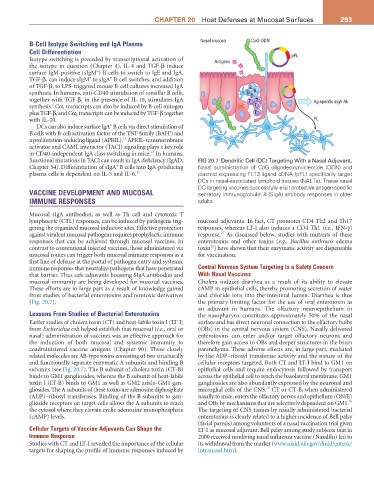
           Chapter 34). Differentiation of sIgA  B cells into IgA-producing   Nasal  administration  of  CpG  oligodeoxynucleotide  (ODN)  and
           plasma cells is dependent on IL-5 and IL-6. 26         plasmid expressing FLT3 ligand cDNA (pFL) specifically target
                                                                  DCs in nasal-associated lymphoid tissues (NALTs). These nasal
                                                                  DC-targeting vaccines successfully elicit protective antigen-specific
           VACCINE DEVELOPMENT AND MUCOSAL                        secretory immunoglobulin A (SIgA) antibody responses in older
           IMMUNE RESPONSES                                       adults.
           Mucosal sIgA antibodies, as well as Th cell and cytotoxic T
           lymphocyte (CTL) responses, can be induced by pathogens trig-  mucosal adjuvants. In fact, CT promotes CD4 Th2 and Th17
           gering the organized mucosal inductive sites. Effective protection   responses, whereas LT-I also induces a CD4 Th1 (i.e., IFN-γ)
                                                                         27
           against virulent mucosal pathogens requires prophylactic immune   response.  As discussed below, studies with mutants of these
           responses that can be achieved through mucosal vaccines. In   enterotoxins and other toxins (e.g., Bacillus anthracis edema
                                                                      28
           contrast to conventional injected vaccines, those administered via   toxin ) have shown that their enzymatic activity are dispensable
           mucosal routes can trigger both mucosal immune responses as a   for vaccination.
           first line of defense at the portal of pathogen entry and systemic
           immune responses that neutralize pathogens that have penetrated   Central Nervous System Targeting Is a Safety Concern
           that barrier. Thus safe adjuvants boosting SIgA antibodies and   With Nasal Vaccines
           mucosal immunity are being developed for mucosal vaccines.   Cholera induces diarrhea as a result of its ability to elevate
           These efforts are in large part as a result of knowledge gained   cAMP in epithelial cells, thereby promoting secretion of water
           from studies of bacterial enterotoxins and nontoxic derivatives   and chloride ions into the intestinal lumen. Diarrhea is thus
           (Fig. 20.7).                                           the primary limiting factor for the use of oral enterotoxin as
                                                                  an adjuvant in humans. The olfactory neuroepithelium in
           Lessons From Studies of Bacterial Enterotoxins         the nasopharynx constitutes approximately 50% of the nasal
           Earlier studies of cholera toxin (CT) and heat-labile toxin I (LT-I)   surface and has direct neuronal connection to the olfactory bulbs
           from Escherichia coli helped establish that mucosal (i.e., oral or   (OBs) in the central nervous system (CNS). Nasally delivered
           nasal) administration of vaccines was an effective approach for   enterotoxins can enter and/or target olfactory neurons  and
           the induction of both mucosal and systemic immunity to   therefore gain access to OBs and deeper structures in the brain
           coadministered vaccine antigens (Chapter 90). These closely   parenchyma. These adverse effects are, in large part, mediated
           related molecules are AB-type toxins consisting of two structurally   by the ADP–ribosyl transferase activity and the nature of the
           and functionally separate enzymatic A subunits and binding B   cellular receptors targeted. Both CT and LT-I bind to GM1 on
           subunits (see Fig. 20.7). The B subunit of cholera toxin (CT-B)   epithelial cells and require endocytosis followed by transport
           binds to GM1 gangliosides, whereas the B subunit of heat-labile   across the epithelial cell to reach the basolateral membrane. GM1
           toxin I (LT-B) binds to GM1 as well as GM2 asialo-GM1 gan-  gangliosides are also abundantly expressed by the neuronal and
                                                                                        29
           gliosides. The A subunits of these toxins are adenosine diphosphate   microglial cells of the CNS.  CT or CT-B, when administered
           (ADP)–ribosyl transferases. Binding of the B subunits to gan-  nasally to mice, enters the olfactory nerves and epithelium (ON/E)
                                                                                                                   30
           glioside receptors on target cells allows the A subunits to reach   and OBs by mechanisms that are selectively dependent on GM1.
           the cytosol where they elevate cyclic adenosine monophosphate   The targeting of CNS tissues by nasally administered bacterial
           (cAMP) levels.                                         enterotoxins is clearly related to a higher incidence of Bell palsy
                                                                  (facial paresis) among volunteers of a nasal vaccination trial given
           Cellular Targets of Vaccine Adjuvants Can Shape the    LT-I as mucosal adjuvant. Bell palsy among study subjects that in
           Immune Response                                        2000 received nonliving nasal influenza vaccine (Nasalflu) led to
           Studies with CT and LT-I revealed the importance of the cellular   its withdrawal from the market (www.niaid.nih.gov/dmid/enteric/
           targets for shaping the profile of immune responses induced by   intranasal.htm).

